Rising to the challenges of assisting client Rand Water to urgently boost its capacity, contractor Liviero has fast tracked the first delivery target in its R231 million contract at the Panfontein water treatment residue disposal site near Vereeniging.
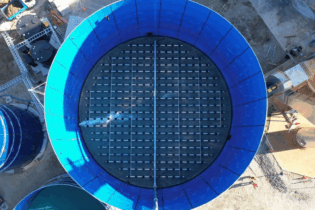
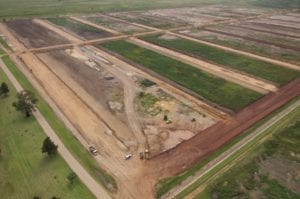
CEO Neil Cloete explains that Liviero commenced its contract for the expansion of the sludge disposal site at Panfontein – along with modifications to the supernatant pipeline – in August last year. “Our client is in desperate need of additional capacity due to the fact that all the existing drying ponds are filled to maximum capacity. It is for this reason that Liviero has committed to handing over 10 ponds in September this year – to assist Rand Water with the required additional capacity for its residue.” Between 500 and 1 300 t of dry sludge is produced each day during Rand Water’s purification process. This is removed from the sedimentation tanks at Zuikerbosch and Vereeniging in thin slurry containing 3% mass by volume of dry sludge. This sludge is pumped to Rand Water’s sludge disposal site at Panfontein. Here it is dosed with an organic flocculent in gravity thickening plants to aid the separation of the solids from the liquid. The thickened sludge is pumped onto drying beds where it is dried by evaporation and the clear supernatant fluid is drawn off and returned to the purification system. Liviero’s project at Panfontein entails removing existing sludge and drainage pipes and installing new sludge pipes and water guns, as well as a new drainage system, including concrete channels and sand flumes, Cloete states. Associated steel sludge delivery pipelines, sub-surface drains and fittings will also be installed. In addition, the contractor will raise the pond walls by 4 m in a total of 20 drying ponds. The ponds will be lined with 1.5 mm HDPE lining. The sub-surface drains will drain into a trapezoidal concrete channel, which is 1 km long.
Liviero’s contract at Panfontein has been, quite literally, slippery work, Cloete reports. “This is because work is taking place in the old sludge ponds, which get easily saturated during even light rainfall, resulting in slippery surfaces.” Liviero mitigated this by creating access roads with imported G7fill, and creating sufficient drainage to prevent water from pooling.
“We also installed 90% of the sub-surface drains early in the project to drain the saturated existing ponds,” Cloete adds, noting that the constant supply of a large quantity of G7 fill to site on a daily basis presented Liviero with a challenge. This contract is on schedule for completion in August 2014. A total of 1 000 000 m3of commercial G7 fill was imported for the wall construction. Liviero will install 825 000 m2 of HDPE lining and geotextile during the course of the project, along with 19 km of steel sludge pipes and 68 km of subsoil drainage.