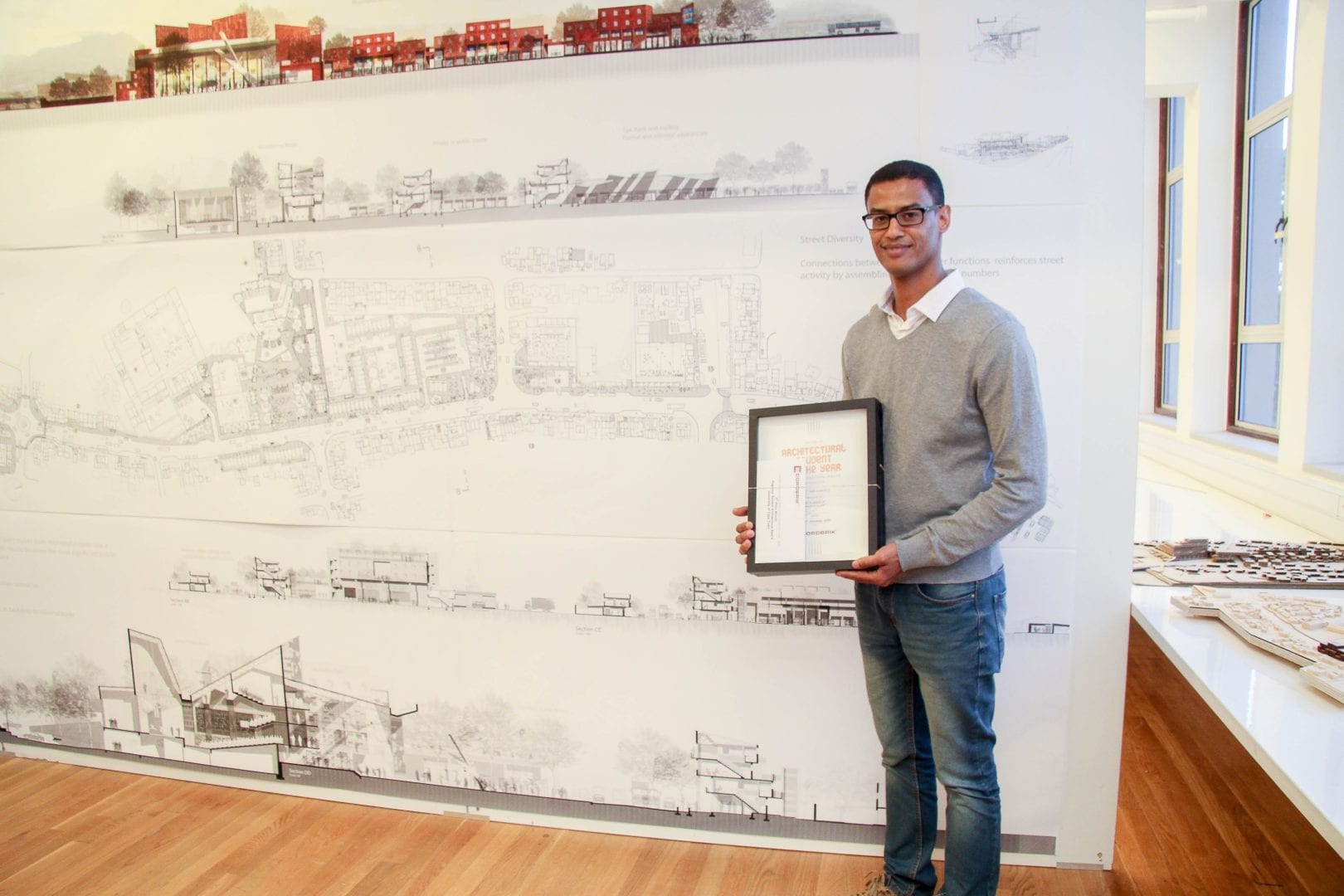
Clint Abrahams of the University of Cape Town (UCT) won third prize in his region in this year’s Corobrik Architectural Student of the Year Awards for his thesis entitled ‘High Streets: Constructing the public realm in low income areas’.
Clint Abrahams of the University of Cape Town (UCT) won third prize in his region in this year’s Corobrik Architectural Student of the Year Awards for his thesis entitled ‘High Streets: Constructing the public realm in low income areas’. He also won an award for the best use of clay brick in his thesis.
His thesis proposes, through the design of a Further Education and Training (FET) college in the low income area of Delft, to construct an institutional building that aids a positive public realm and reinforces the town’s emerging high street by facilitating diversity.
High streets, high energy
Abraham’s interest in high streets came from growing up in Macassar, an apartheid-planned township which had no high street.
Having lived in Observatory for the past seven years, he became intrigued by the different energies of the adjacent high streets there. This prompted him to try and understand what constituted a functioning high street and how architects and urban designers could retrofit this idea to lower income areas.
He decided to site his thesis in Delft, a low income area 25km from Cape Town’s CBD, because its unique street energy was reminiscent of areas like Observatory.
“In Delft, the high street is an emerging one that has both informal and institutional use. However, here the energies are brought about by the informal activities and not the institutional use. My design explores how institutional buildings can also aid positive street-making conditions in the same way the informal use does.”
He believes that his design of an FET college, an institutional building, would facilitate diversity in Delft’s high street.
“The components of street diversity are explored by developing three building types that make various street conditions, namely a building onto a town square, a building as a thoroughfare and a building as an edge,” Abrahams said.
The use of clay brick
Abrahams specifies clay brick for the construction of his Delft design and, as a result, was also named UCT’s winner of the Award for Best Use of Clay Brick.
“By using clay brick construction to construct the public realm, an enduring new civic image is created that speaks of robustness and low maintenance,” he said. ‘The construction methods are appropriated to available skills and thus create job opportunities.”
Abraham went on to say that, by using clay brick in a creative manner, it challenges the mundane use of clay brick for traditional institutional buildings in these areas.
“In my Delft design, brick is used as enclosure, screening and ground cover as well as craft and pays homage to the informal way it is used in the area.”