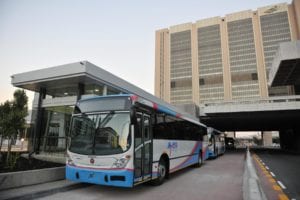
Transforming the City of Cape Town’s current road-based public transport system, and providing reliable, efficient mass transport services to the people, is the aim of Cape Town’s Integrated Rapid Transit project, commonly referred to as MyCiTi. IMIESA provides insight into this development.
The City of Cape Town’s west coast is not only renowned for its white sandy beaches, ideal kite surfing weather and picturesque views of Table Mountain, but is also fast becoming an increasingly popular residential site, mainly due to its leafy suburbs and vast array of amenities. It does, however, have a disadvantage: the commute into the city centre, which is plagued by heavy traffic during peak hours. Enter MyCiTi – the City of Cape Town’s latest public transport system, which is proving to be such a hit on the west coast that more and more stations are popping up throughout other parts of the city. With buses available every 10 minutes during peak time (06:00 to 09:00 and 17:00 to 19:00) and every 20 minutes during off-peak time,and not forgetting the convenient airport route, MyCiTi prides itself on being Cape Town’s reliable, scheduled bus service. When developing this bus service, safety, hygiene and passenger comfort were important factors that wereconsidered – as important as reliability and solid infrastructure. No food and drink are allowed on the buses, no is any behaviour that may be disruptive to fellow commuters such as loud music, vendors or obscene language. The stations are also constantly monitored by official MyCiTi personnel and CCTV equipment. With automated station and bus doors, tap card technology, computerised voice prompts between stations and dedicated road lanes, MyCiTi is equivalent to Johannesburg’s Gautrain. A bird’s eye view The City’s Business Development work stream is primarily responsible for planning the process of operating MyCiTI, including the preparation of major tenders, contracting of service providers and the design and procurement of technology systems. These systems include:- MyCiTi buses and related technology
- control centre equipment such as tracking systems, ICT and associated intelligent transport systems
- automated fare collection systems.

Reviving old roads
The Potsdam Road Project also forms part of the MyCiTi infrastructure. Construction started in March 2012 and it was completed toward the end of 2013. At a cost of R112 million, the project included the construction of a new bus lane from Blaauwberg Road to Usasaza Road, which is the access road to a MyCiTi bus depot. The project involved the upgrade of Potsdam Road between Blaauwberg and Usasaza roads; construction of a new carriageway and bus lane; construction of four new IRT stations at Blaauwberg Road, Killarney Road, Sati Road and Usasaza Road; upgrade of the Killarney Racetrack entrance; installation of traffic lights at the intersections to facilitate the buses; and the upgrade of the footway network along this road and in Killarney Gardens. As with any major project, challenges are expected. In the case of the Potsdam Road Project, several challenges were encountered, but these were overcome. The major of these issues included community participation, relocation of informal houses, traffic accommodation and road closures, and protection and relocation of major Chevron Refinery services. Meet the team Over the past five years, Martin & East has been instrumental in the MyCiTi development, having been awarded a substantial chunk of the trunk route contract from the CBD to Atlantis. The company opted for innovative drilling trenchless technology for construction of the bus lanes, as this approach preserves the existing road surface, reduces installation time and eliminates traffic congestion and safety risks associated with open trench excavation. Red, ultra-thin friction course was developed on the CBD bus lanes by another subsidiary of the company, Zebra Surfacing, which was also responsible for the asphalt surfacing on this project. Martin & East was also involved in the construction of two adjacent sections of bus lanes in PaardenEiland and Milnerton. HHO Africa and GIBB have also played a big role in this project, with the balance of the Atlantis Corridor contracts having been awarded to HHO. The company was also involved in construction at Blaauwberg Road, Dunoon Century City, Potsdam Road, and the Table View and Melkbos feeders, to name a few. Some of the aspects of work were: conceptual design of busways, stations, depots and feeder infrastructure, EIA processes, detailed design of 40 km of bus lanes, detailed design of 16 trunk stations, design of feeder stops along service routes and detailed design of two BRT depots. GIBB was instrumental in the construction at Thibault Square, Adderley Street, the V&A Waterfront, inner city feeders, the Inner City Depot and Gardens Centre, to name a few. Civils 2000 handled the construction of bus stop infrastructure in Table View and Milnerton, and IRT Omuramba, Montagu Drive and Century City, while Group 5 was the contractor on the IRT Major Station Superstructures contract and the IRT Open Feeder Bus Stops contract. Busmark 2000 recently won the tender to supply the City of Cape Townwith 190 brand new feeder buses. The new fleet is Optare Solo – a low-floor, low entry midibus that is 9 m in length and 2.5 m wide. Each vehicle has 25 seats, with four flip-down seats and one wheelchair bay, able to cater for 50 passengers per trip as well as provision for some standing passengers. “The buses will be supplied in kit form and assembled locally, using local labour, parts and materials where possible,” explains Councillor Brett Herron, the City of Cape Town’sMayoral Committee Member for Transport, Roads and Stormwater. “This translates into much-needed investment for the city and valuable job opportunities for the locals.” More than 285 000 hours of work will be created thanks to the local assembly of these buses and more than 110 staff will be employed in the Busmark facility in Elsies River, Cape Town. The name Solo is a play on the low-floor status of the bus – the entrance is ‘so low’ from the floor, namely 200 mm. The buses also feature a kneeling suspension, which means it can lower itself even further to allow the bottom of the doors to line up with the height of a pavement. Boarding bridges that extend from beneath the bus doors will provide level boarding, not just at stations, but also at kerbside feeder bus stops. “Feeder buses are used to alleviate congestion on existing feeder routes and for service on new feeder routes,” says Herron. The new feeder bus fleet is also Euro5 rated – a step up from the Euro 4 of the current MyCiTi buses. The vehicles required for Phase 1B were procured as part of the same tender for Phase 1A. So far, no risk is foreseen in the delivery of these vehicles for the launch later this year (2014). In a country in which the middle class has traditionally relied on private transport, decent, regulated and reliable public transport is still a new concept for many citizens and MyCiTi was initially greeted with uncertainty.The figures have indicated that it is catching on quickly, with more than 6 million people having hopped on a MyCiTi bus to date. This is also proof that not all people are reluctant to give up their private vehicles in South Africa – if there is an efficient, reliable, safe public transport system available, it will be used. And it’s also proof that MyCiTi is worth every cent of the multimillion rands already spent.