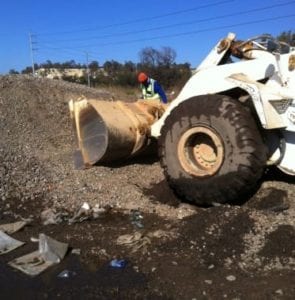
Road crews and construction companies may not excavate natural sands, aggregates and minerals from borrow pits without all the necessary permissions from local, regional and national government authorities.
Despite initial cries that project prices would escalate, there has been little if any evidence of rocketing project prices. Furthermore, the regulation of borrow pits brings stability to legally operated quarries that operate within the confines of mining, environmental, and health and safety legislation. In the past, it was deemed acceptable for construction companies and even municipalities to excavate sand and aggregates from informal borrow pits for the duration of specific projects. This was done to speed up operations and reduce the need to transport materials over long distances. The consequences of unregulated excavations, however, had disastrous effects on the environment and surrounding communities, as well as negatively impacting legally operated quarries nearby. Mining is mining According to Nico Pienaar, director of the Aggregate and Sand Producers Association of Southern Africa (ASPASA), people mistakenly think they can remove ground wherever they want to, but this is not the case. “The Mineral and Petroleum Resources Development Act is clear that once this material is taken away from its natural state and put in another form, it is being mined. “Users need to go through the same process as legal mining operations to get the necessary permissions to mine the material required. This includes rezoning the land at local government level, undertaking the necessary environmental studies required on a regional and national basis, water use licences, as well as obtaining a mining licence from the Department of Mineral Resources (DMR).
“Borrow pits can be an essential part of the construction industry’s efforts, but it must be done legally and in a manner that does not harm the environment, nor negatively affect surrounding communities and detract from future land use possibilities. Equally important is that workers are subject to the same safety and health requirements as legally operated quarries,” he says.
Report illegal borrow pits Pienaar adds that in some instances, illegally operated borrow pits are being started mere kilometres away from legitimate suppliers of sand and aggregate, most likely to make use of a “free” resource. Such operators usually pay scant regard to sustainable practices and make use of cheap, unqualified labour. Once projects are completed they simply move on, leaving the workers jobless and the surrounds scarred forever. “We are working closely with all relevant authorities to close down such operations and we strongly advise our ASPASA members to report suspected illegal operations to us. We have the full backing of the DMR and will act upon every case that we receive,” he concludes.