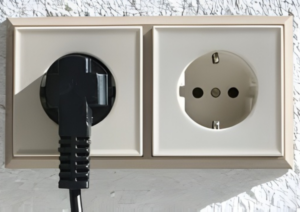
Ongoing confusion within South Africa’s electrical sector has led to claims that all Schuko sockets are banned. The reality is far more nuanced, and the misunderstanding is affecting product sales, Certificate of Compliance (COC) approvals, and appliance imports.
“There’s a fundamental misreading of the specifications,” explains Dr Andrew Dickson, Engineering Executive at
CBi-electric: low voltage. “Many people assume all Schuko-style plugs and sockets are illegal. That’s incorrect and is causing unnecessary disruption across the supply chain.”
What’s Actually Banned
Traditional earthed Schuko plugs and sockets, with exposed earth contacts on the sides, are prohibited in South Africa. The side-contact earth design, standard in Europe, has the risk of becoming live due to adverse conditions that are more common in South Africa than in other geographical areas, thus placing consumers at risk of shock.
“South African standards use a dedicated earth pin, while Schuko plugs rely on side-contact clips,” Dr Dickson explains. “If the earth fails, live parts can be exposed, posing a genuine risk to life.”
What Remains Legal
Contrary to popular belief, unearthed two-pin Schuko-style sockets for Class II (double-insulated) appliances remain legal:
- SANS 164-6 permits 16A two-pin plugs and sockets for equipment such as hairdryers, drills, blenders, and chargers
- SANS 164-2, the newer hexagonal socket standard, is designed to accept these plugs safely with recessed, shuttered contacts that prevent accidental contact with live pins.
“Many imported appliances come with plugs that resemble Schuko but have no earth connection,” notes Dr Dickson. “These are fully legal and safe for double-insulated equipment.”
The Warranty Trap
Replacing a moulded plug with a standard three-pin plug often voids the manufacturer’s warranty. Dr Dickson warns: “Consumers shouldn’t tamper with factory-fitted plugs. Using compliant two-pin socket outlets is the proper solution.
Installation Standards Matter
While earth leakage devices help minimise risk, they only function correctly if installations comply with SANS 10142-1. “Not all installations meet these standards,” says Dr Dickson. “That’s why using the correct socket specifications is critical for safety.”
The Path Forward
“The standards exist to protect South African consumers in our specific infrastructure environment,” concludes Dr Dickson. “By specifying compliant sockets and not earthed Schuko configurations, we can safely accommodate international appliances while maintaining rigorous safety standards. Clear guidance in the market ensures the right products are used correctly.”
About CBi-electric: low voltage
Established in 1949, CBi-electric: low voltage is a manufacturer and supplier of quality low voltage electrical distribution, protection, and control equipment. Previously known as Circuit Breaker Industries or CBI, the company specialises in the design, development, and manufacturing of circuit breakers, residential current devices, surge protection, wiring accessories, and metering products.
Headquartered in Johannesburg, South Africa, the company is a subsidiary of the renowned JSE listed industrial group Reunert, established in 1888, with international operations across Africa, Asia, Australia, Europe, and USA.
CBi-electric: low voltage can be found in almost every home and has firmly become a market leader over the last 75 years while supplying products to authorities, utilities, manufacturers, commercial property developers, industrial, mining, telecommunications, and general power distribution applications.
In 2021, the brand launched its smart IoT (internet-of-things) home automation range, called the Astute Range.