The 10 Mℓ expansion at the Percy Stewart Wastewater Treatment Works will not only increase the Mogale City Local Municipality’s raw sewage processing capabilities to meet the current demand – for the first time there will be PLCs and a SCADA system installed on-site, Royal HaskoningDHV’s Michelle Vogts, project manager: civils; and Kegean Reddy, project manager: C&I, tell Chantelle Mattheus.
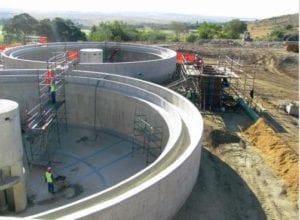
After complaints by the Department of Water Affairs about the Percy Stewart Wastewater Treatment Works (WWTW) effluent not meeting the legal requirements, Mogale City Local Municipality (MCLM) appointed Royal HaskoningDHV (then SSI) in February 2008 to investigate and report on the shortcomings of the plant. According to Vogts, a scientific study concluded that the plant required urgent maintenance and also recommended that the WWTW’s capacity be increased with a 10 Mℓ/d extension to handle the current and future flows. “The plant was refurbished in May 2008 and the design of the extensions for the additional 10 Mℓ/dstarted in 2009.” Setting the scene Percy Stewart WWTW is on the edge of expansive urban areas, overlooking valleys of natural terrain and farmland. The WWTW is also located on a steep hill, with a 46-m height difference from the inlet works to the last manhole, before the final effluent is piped to the river. “The old works consisted of trickling filters and a 10 Mℓ/d biological nutrient removal (BNR) activated sludge system. The waste sludge is anaerobically digested and used for irrigation on the instant lawn farm next to the works, using centre pivots,” says Vogts, adding that the instant lawn farm also receives a limited annual volume of trickling filter effluent, according to the WWTW’s licence. The maintenance phase included repairing the trickling filters’ rotating arms and pipework. “The old BNR also required maintenance – fixing aerators and replacing rusted penstocks and valves. Motor control centres (MCCs) and certain existing instrumentation were also flagged for upgrade/refurbishment as part of this appointment,” continues Vogts. Currently, the required increase in capacity of the second 10 Mℓ/d BNR is nearing completion, with the civil contractor having handed over newly built structures to the mechanical and electrical contractor for wiring and equipment fitting. Vogts adds that apart from the 10 Mℓ/d BNR reactor with it’s primary settling tank (PST) and two final clarifiers (secondary settling tanks [SSTs]), the extension involved building a fat trap for the Gelita effluent, a new larger inlet works, balancing tank, and a new larger chlorine contact tank (CCT), as well as associated pump stations and electrical substations, with backup generators in the event of a power failure.“The main power supply to the plant was also augmented. The new inlet works, balancing tank and PST were placed near the existing inlet works and the PST of the existing BNR. These three primary treatment components, next to the existing 10 Mℓ/d BNR’s PST, were founded on rock.” Electrical additions Royal HaskoningDHV was also appointed as electrical and C&I consultant for the design, installation, commissioning and performance testing of electrical and instrumentation equipment, for the upgraded plant, explains Reddy.
The existing site had no SCADA (supervisory control and data acquisition) or PLCs (programmable logic controllers) installed. Royal HaskoningDHV’s approach in this respect was to gather information for the design from planned site visits, client interaction and design meetings held by its engineers, who then subsequently produced a composite preliminary design, which was completed and put out to tender by the firm.
“Various control system architectures were evaluated during the master planning phase, and these included plant wide telemetry communication, individual PLCs and remote input/output(I/O) systems for each plant area,” says Reddy. Automation solution The final configuration includes two Schneider Modicon M340 PLCs and an Adroit SCADA. There is a PLC for the inlet works (HOW and PSTs) and a PLC for the bioreactor. Each PLC will be fitted in a PLC panel with a Schneider Magalies human machine interface (HMI) on the front of the panel for local control of plant areas. “The SCADA is situated in the control room with view only capabilities – a client request – in the belief that this would encourage the operators to walk through the site should any corrective action need to be taken, instead of just starting a drive from the SCADA, for example,” says Reddy, adding that the possibility of changing this at a later stage still exists through PLC and SCADA software changes. “A fibre optic infrastructure solution was selected, for its robustness, and the footprint of the plant didn’t warrant telemetry,” adds Reddy. Beneficial monitoring Both Reddy and Vogt agree that the expansion at Peter Stewart WWTW will not only increase the client’s raw sewage processing capabilities to meet the current demand, but for the first time there will be PLCs and a SCADA system installed on-site, which would substantially assist in day-to-day operations and maintenance. “The operating and managing staff will have a monitoring system for the plant, which will reduce plant downtime and increase operator visibility into the water treatment process,” explains Reddy. Added benefits of the automated system will be increased plant uptime and reduced fault through enhanced fault finding and troubleshooting capabilities. “The installation of a fibre optic ring network will provide for a more flexible and robust networking solution,” concludes Reddy.