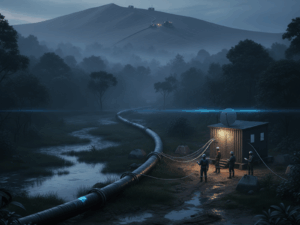
When it comes to digital infrastructure in Africa, few things are more pressing than the need for faster, more resilient, and more direct connectivity between the continent’s east and west coasts. As things stand today, if a submarine cable is cut north of Mombasa, data traffic must travel all the way down to South Africa, across the country, and back up the West Coast to reach Europe or the Americas. That detour not only adds significant cost but also doubles latency – something no cloud-reliant business or internet user wants.
However, what if we flipped the model? We aim to explore an innovative new concept: Utilising submarine cable technology to address the longstanding challenges in Africa’s terrestrial infrastructure.What’s the Big Idea?
SEACOM‘s Head of Transmission Engineering, Nic Breytenbach and Afrim Beka, Director of Submarine Network Solutions at Nokia conceptualised using Subsea technology over land. The key problem is that building a direct fibre route from East to West Africa has never been done. Why? Because it’s complicated, and there are two main reasons for this:- Infrastructure gaps: Long-distance terrestrial fibre routes ideally require repeater sites every 60 to 80 kilometres. These sites need reliable power and physical security, both of which are in short supply in large parts of Central Africa.
- Inaccessible terrain: Central Africa, with its swamplands, rainforests, desert environments and political instability, is hostile to traditional fibre builds, which require trenching, civil works, and constant maintenance access.
- First, you eliminate the need for utility power along the route, since the system is powered from both ends.
- Second, these cables are already engineered to withstand harsh environments, including wetlands, extreme temperatures, and other challenging conditions.
- Lastly, they offer performance benefits.
Connecting the dots – and the people
One of the most exciting aspects of this model is the potential to create “add-drop” points along the route. This means that landlocked countries such as Rwanda, Uganda, Zambia, and Malawi, among others, could tap into the cable, providing them with access to submarine systems on either coast. Of course, these drop points would still need localised infrastructure and utility power. However, even a few strategic access nodes could significantly enhance digital inclusion for millions of Africans.
As with any ambitious infrastructure project, there are challenges to overcome. The first is regulatory and political. Laying cable across multiple countries requires securing permits, engaging with governments, and, in some cases, navigating civil unrest or post-conflict instability. It might require high-level engagement from shareholders or even foreign affairs ministries to get buy-in.
Then there’s the issue of vandalism. Submarine systems send electricity through copper tubing inside the cable. Copper, as we know, is a high-value commodity. To deter theft, one approach is to use aluminium instead of copper. It carries current just as well for this purpose, but has little to no resale value. An education drive to inform communities about the nature of the cable – and the fact that it’s not worth stealing – would also be critical. While most of our examples focused on swamplands and rainforests, the same principle applies in desert environments as well. But there, the challenge changes. Deserts like the Sahara are not static. Sand dunes shift constantly. So, how do you track or recover a buried cable? One idea is to install satellite tracking devices at intervals to help locate the cable over time. Another is to anchor the cable to concrete blocks, buried deep enough to stabilise it despite dune movement. Alternatively, you could let it “float” with the sand, though this would require additional testing and monitoring.A bold vision within reach

Nic Breytenbach, Senior Transmission Architect at SEACOM