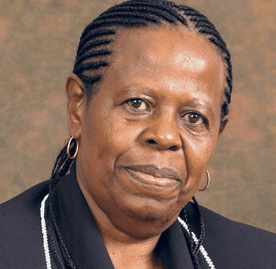
“As leaders in government, you are no strangers to the fact that waste management is at the core of service delivery,” said Deputy Minister of Water and Environmental Affairs, Rejoice Mabudafhasi on Tuesday 06 August 2013, when she led a round table discussion with mayors and municipal managers on waste management and water conservation issues at Emperor’s Palace in Kempton Park.
The mayors’ dialogue, the first of its kind, is a fulfillment of the commitment made by the Deputy Minister during her Budget Vote address at the National Council of Provinces earlier this year to meet with local government to discuss water and waste management issues. During the roundtable, a pledge was signed by the Deputy Minister and mayors in attendance, declaring their commitment to waste management, as well as water conservation and demand management (WCWDM). In recognition of Women’s Month, the pledge also included a commitment to working towards women and youth participation in water and environmental programmes. “It is important that the state improves its capacity to deliver waste services. This is not only to meet service delivery needs, but also to provide dignity and quality of life to our people. South Africa’s democratic government inherited an unequal and inhumane waste management sector, in which services such as town-planning and improvements were prioritised for the minority. Building much needed capacity in our townships, peri-urban areas and rural areas in the waste sector will go a long way towards beginning to address these historical imbalances,” said Mabudafhasi. The dialogue, which included focused group discussions, provided overviews of waste and water conservation in South Africa; local government’s strategy with regards to waste and water; as well as perspectives on water conservation and waste management in the country. “The Department of Environmental Affairs has conducted numerous studies that have clearly illustrated the capacity constraints that are experienced by you in the Municipalities, in delivering waste services,” said Mabudafhasi, highlighting major challenges faced with regards to capacity including, but not limited to, landfill operations, waste collection planning and administration, separation at source and refuse collection.
According to Mabudafhasi, the waste sector has been identified as one of the critical sectors with the potential to contribute substantially to the generation of jobs within the green economy. It is in this light that the Department of Environmental Affairs is increasingly expanding its programmes in job creation and enterprise development programmes within the waste sector.
The capacity gaps in municipalities, however, also present an opening for the creation of job opportunities, on-the-job training, continuous up-skilling, as well as enterprise development for the youth. This has begun to be addressed through initiatives such as the Youth Jobs in Waste programme.Through Youth Jobs in Waste, an estimated 3 577 jobs will be created by placing young people in municipalities, who will be serving as landfill site assistants, waste collection administrators, and environmental awareness educators. The Deputy Minister urged the mayors to support the youth in their municipalities, saying “We urge all of you who will be hosting these young people in your municipalities, to welcome them and provide them with the required support, exposure and mentorship they will need.”