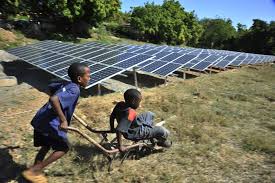
Creating favourable conditions for modern solar lighting markets can provide a low-cost solution to reducing carbon emissions while bringing electricity to an estimated 600 million people in Africa, says a new report by United Nations Environment Programme (UNEP).
The report, entitled Developing Effective Off-Grid Lighting Policy – Guidance Note for Governments in Africa, recommends best practices and smart policies enabling the market uptake of off-grid lighting solutions. The publication was jointly launched by UNEP, the Global Off-Grid Lighting Association (GOGLA), and the Economic Community of West African States’ (ECOWAS) Centre for Renewable Energy and Energy Efficiency (ECREEE). “On average, 76 per cent of the population in West Africa lacks access to electricity and spends up to 20 per cent of the household budget on kerosene, which is potentially damaging to their health and detrimental to the planet’s climate,” says Achim Steiner, United Nations Under-Secretary-General and UNEP Executive Director. “Adopting modern, solar powered solutions could provide these households with less expensive, more-efficient and healthier source of electricity, while boosting productivity and job creation.”
“However, the uptake of off-grid instruments in Africa is being stifled by inadequate and often outdated regulations and subsidy schemes,” he adds.
Steiner says by incorporating the measures recommended in this report in their energy policies, countries can achieve the 2030 goal of universal sustainable energy access. “Introducing fiscal mechanisms, such as VAT and tariff exemptions, as well as promoting minimum quality standards and the sustainable management of spent products can create an enabling environment for the healthier and cheaper off grid technologies to thrive,” he concludes.