South Africa is in a water crisis and wastewater reuse, desalination and potable water quality are top of the agenda. Where will our future water be sourced?
The most common solutions to South Africa’s water challenges usually entail a massive infrastructure capital spend and long-term implementation. The belief that scale always brings down the unit costs leads to focus on centralised water catchment and treatment – the bigger, the better, the cheapest and the easiest to operate. In looking towards megaprojects to solve the entire South African water crisis, we tend to forget about the smaller, easier projects that can assist with water supply. With failing infrastructure, which includes the pipelines transporting water for hundreds of kilometres across the country, decentralised water treatment starts making sense for smaller, remote communities or industry. Advanced technologies provide a smaller footprint, less operator involvement and less dependency on chemicals for water treatment. QFS has brought globally leading technologies to South Africa and localised them to be more affordable for South African applications.Wastewater reuse
There are a number of small wastewater facilities of between 1 MLD and 5 MLD scattered throughout South Africa. Most of the water at these facilities is not seen as a source but as an environmental contamination risk. Rural wastewater facilities compete with many other services for the budgets of local authorities and are often neglected, suffering from insufficient maintenance and incorrect operation. The wastewater facilities are also under pressure to produce water good enough to release into a natural source. However, this ‘liability’ can be turned into an income stream, using the correct technology to produce safe irrigation or industrial water. For the reuse process to be successful, there has to be infrastructure in place to biologically treat the raw sewage. The biological process must be able to produce water of acceptable quality for the reuse process to accept this for further treatment.The process
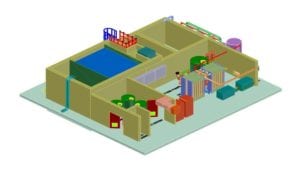
QFS offers modular, pre-designed systems that can be installed with minimal site work. The following core technologies for water treatment are available:- Flocculation/clarifier
- Drum screen @ 20 micron
- Ultrafiltration (UF)
- Advanced oxidation
- Granular activated carbon
1 Flocculation/clarifier
A clarifier allows for flocculation to be included in the pre-treatment process. Chemical dosages will be confirmed during the final design phase, but typically three dosing stations are included for the addition of chlorine, pH correction and flocculants. The clarifier combats high solid carry-over from the treatment works and adds the ability for organic flocculation. Carry-over solids enter the clarifier and settle out with the assistance of installed tubular settlers, which utilise individual, isolated tubular channels. The modules are engineered with the individual tubes rising in the same direction to eliminate mixing currents and unstable flow patterns. Structural ribs provide considerable vertical loading structural strength. The unique design insures a solid interface during installation. Grating panels are installed on top of the tube settler packs to provide UV protection against extended exposure to sunlight. The grid also replaces a possible mobile walkway, as well as providing a protective layer from foot traffic and the repeated hydraulic impact of routine wash-downs.