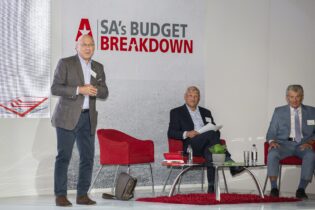
National Treasury has been allocated R91.835 billion over the medium-term, with the South African Revenue Service (SARS) receiving the largest component of the transfers.
Tabling National Treasury’s Budget Vote in Parliament, Finance Minister Enoch Godongwana said the department’s budget (excluding direct charges) over the medium-term is R91.835 billion, which is an average growth rate of 6.2% from 2024/25 – 2027/28.“The largest component is for transfers to SARS, which is allocated R45.760 billion (or 49.8%) of the department’s budget for operations and capital projects over the medium-term.“This is an increase of R8 billion of the SARS baseline compared to the 2024 Estimate of Expenditure. Part of this increase is to improve effectiveness in revenue collection by enhancing their ability to collect debt through better systems, increasing staff capacity and modernising their processes to establish e-invoicing for VAT, instant payment systems and upgrades of customs infrastructure,” Godongwana said on Tuesday. Last week, National Treasury published monthly debt collection data from SARS for the first time to monitor progress and improve transparency. The budget allocation per economic classification over the medium-term is as follows:
- R3.422 billion on compensation of employees;
- R6.983 billion on goods and services;
- R78.554 billion on transfers and subsidies;
- R89 million on payment of capital assets, and
- and R2.786 billion on payment for financial assets.
Sustainable public finances
National Treasury’s Annual Performance Plan 2025/26 sets out clear and ambitious programmes to realise its goals of job creation, lowering poverty and greater inclusion.“In terms of restoring sustainability and the impact of our public finances, a review of how the government spends money has been central to our policy efforts. To achieve all of our national priorities we need to realise much greater efficiencies on the spending side,” the Minister said.As such there are new reviews that government plans to conduct, namely: An audit of ghost workers in the public service using a data-driven approach that links administrative and financial databases to identify bogus and non-existent employees and immediately remove them from the system. An infrastructure conditional grant review. This will assess why provinces and municipalities underspend, why projects are not delivered on time and within budget, and where relevant, why the quality of the deliverables is poor; and A review of the remuneration of executives and board members of public entities. The aim is to develop a standardised framework for all schedule three public entities, based on their mandates, areas of influence, and the complexity of a given organisation.

Financial Action Task Force grey list
With South Africa completing all 22 recommended action items outlined by the Financial Action Task Force (FATF), the Minister stressed that the country must continue to strengthen the laws to fight illicit and corrupt financing.“Lastly, I am happy to say that our endeavors, not just the National Treasury’s but the government’s as a whole, to remove South Africa from the Financial Action Task Force grey list, are succeeding,” he said.South Africa was placed on the FATF grey list due to deficiencies in its anti-money laundering and counter-terrorism financing (AML/CFT) regime. The FATF recently confirmed that South Africa has substantially completed its action plan and warrants an on-site assessment. The on-site assessment will be to verify that the implementation of AML/CFT reforms has begun and is being sustained, and that the necessary political commitment remains in place to sustain implementation in the future. The on-site visit will take place before the next FATF Plenary, and, if the outcome of the visit is positive, the FATF will delist South Africa from the greylist at its next Plenary in October 2025. Preparations for the on-site visit have commenced. “A General Laws Anti-Money Laundering and Combating Terrorism Financing Bill, to further improve our ability to combat money laundering, terrorism financing and proliferation financing, is being finalised for another round of public comment, and tabling in Parliament in the third quarter of 2025. “Similarly, the National Treasury has made substantial progress implementing the State Capture Commission recommendations through multiple concrete actions. SARS investigations have recovered R4.8 billion in unpaid taxes, while professional bodies like the South African Institute of Chartered Accountants (SAICA) have imposed consequence management including disbarment,” the Minister said. The Financial Intelligence Centre launched the ‘Enablers Project’ with law enforcement to trace state capture fund flows, and a 10-year ban was imposed on Bain & Co (currently under litigation). “Critically, a central register now tracks dismissed officials and those who have resigned during their disciplinary processes across all government spheres,” Godongwana said. Originally posted on SAnews.gov.za