Regulation 3630 mandates all process controllers to register by June 2025. Is your facility compliant?
In June 2023, the Department of Water and Sanitation (DWS) introduced Regulation 3630, requiring all Class V and VI process controllers – senior-level professionals – to be formally registered as professional process controllers (Pr.PC.Water).
The deadline for full compliance is June 30, 2025. Crucially, every treatment works must now have at least one supervisor qualified at a minimum of Class V, meaning that no facility can operate without employing or contracting a registered professional process controller. In addition, all process controllers – regardless of level – must be registered with the DWS.Not only for the public sector
According to the latest Blue Drop Reports and Green Drops, taking into account the amount of registered water treatment and wastewater treatment plants, there needs to be:- 1904 registered process controllers for water treatment plants
- 1394 registered process controllers for wastewater treatment plants.

Anet Muir, chief director: Water Use Compliance Monitoring and Enforcement, DWS.
Safeguarding the profession of process controllers

Dr. Lester Goldman, CEO, WISA

Dewald van Staden, lead: Process Controller Division, WISA

Teslim Mohammed Yusuf Executive – Planning, Monitoring and Evaluation, EWSETA
The purpose of the regulation
At its core, Regulation 3630 aims to:- Elevate professional standards by requiring formal registration and qualifications for process controllers.
- Enhance accountability in water and wastewater treatment operations.
- Improve compliance with national and international best practices.
- Strengthen workforce development, ensuring continuous learning and skill enhancement. Skills will remain relevant as technology is updated.
Classifying plants and process controllers
Process controllers are classified according to their training and experience, ranging from Class I (with basic training and limited experience) to Class VI (with extensive training and experience). Class I process controllers have limited responsibilities while Class V and Class VI process controllers hold a supervisor or management position and are in charge of quality control. All treatment works are classified into five categories (A, B, C, D and E). This classification determines the level of expertise required from a process controller. “If we were to liken a process controller to a driver, the classification of plants determine if a ‘Lewis Hamilton’ or person with code 10 licence is needed. A process controller working on an E Class works (a plant with very basic operating processes, a small design capacity that needs very little maintenance) could be a lower level. However, process controllers working on A Class works (a plant with large design capacity, using technology that serves a large population) would need Class V and Class VI process controllers,” explains van Staden. He adds that, for example, a borehole in a rural area where the water has to be further disinfected and then distributed to a community will be classified as a treatment works.“Everybody, no matter where they are, deserves to receive SANS 241 compliant water.”The classification of a plant is aligned to its water use license. “Any water works that requires abstraction and/or discharge, requires authorisation under the National Water Act. Our Integrated Regulatory Information System (IRIS) handles processes for application for the works as well as registration,” states Muir. Classification is based on a range of parameters:
- Technology
- design capacity
- complexity of the treatment process (such as reverse osmosis; absorption; ion exchange, Nereda
- operating procedures (such as coagulation, flocculation, sedimentation, chlorination, reactor tanks, activated sludge processes)
- control processes (level, laboratory, pumps)
- if wastewater is treated for reuse and reclamation processes
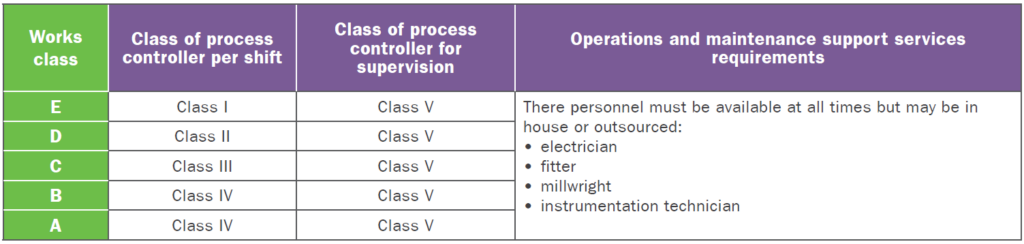 A Class I process controller will typically coordinate, control and monitor the activities and operations of an E Works. They will collect wastewater samples as per sampling techniques and monitoring programmes.
In comparison, Class V process controllers manage plant personnel and shifts, finances and assets. They play a key role in process optimisation and water quality management.
A Class I process controller will typically coordinate, control and monitor the activities and operations of an E Works. They will collect wastewater samples as per sampling techniques and monitoring programmes.
In comparison, Class V process controllers manage plant personnel and shifts, finances and assets. They play a key role in process optimisation and water quality management.
“Through completing 30 points a year (and remaining compliant with Regulation 3630), a Class 0, I or II, process controller can complete an occupation certificate over six years, and be eventually elevated to a higher class,” states van Staden.Regulation 3630 has mapped out requirements that must be met by process controllers to improve their class gradings.
How to comply
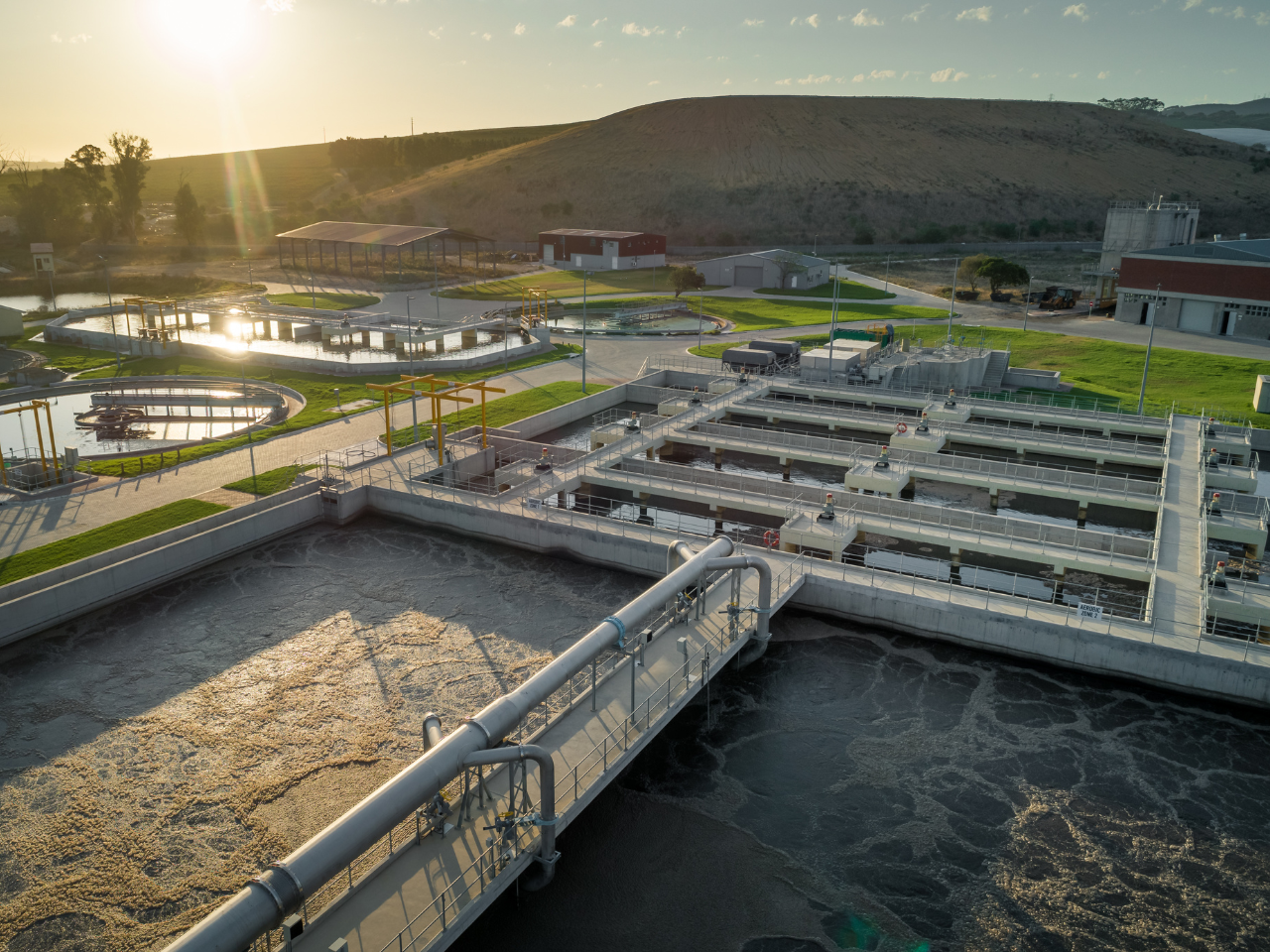 Owners of these works need to ensure their infrastructure is classified and the process controllers registered per works on the DWS’ Integrated Regulatory Information System.
For assistance please contact:
Owners of these works need to ensure their infrastructure is classified and the process controllers registered per works on the DWS’ Integrated Regulatory Information System.
For assistance please contact:
- Blue Drop Help Desk: Maryna Niemand, 012 336 6794, bluedrop@dws.gov.za
- Green Drop Help Desk: Ikageng Mashigo, 012 336 7371, mashigoI@dws.gov.za
Pathways to certification
The National Qualifications Framework, professional credits and ‘grandparent process controllers’ are recognised. “Grandparent process controllers are people who are employed at a water services institution or by a water services work owner as a process controller without formal qualifications between 27 December 1985 and 27 December 2005. They are registered with DWS as a class 0 and were subjected to a competency assessment. The grandparent class is site specific and non-transferrable to any other plant. Anyone appointed after 2005 does not qualify for the grandparent class,” adds Muir. WISA and the Energy and Water Sector Education Training Authority (EWSETA) will work together with experts to help process controllers receive the required training to gain and maintain professional status. “EWSETA’s programmes are demand-led. According to the recent Blue Drop Report, we have a shortfall of 1704 qualified process controllers for water treatment plants. We have therefore developed various upskilling programmes with WISA for process controllers that provide a pathway to give them their certifications,” explains Yusuf.
These include:
“EWSETA’s programmes are demand-led. According to the recent Blue Drop Report, we have a shortfall of 1704 qualified process controllers for water treatment plants. We have therefore developed various upskilling programmes with WISA for process controllers that provide a pathway to give them their certifications,” explains Yusuf.
These include:
- Recognition of prior learning (RPL) interventions: Many process controllers have ample experience but lack the certifications. There is a recognition of prior learning intervention, ensuring seasoned operators can achieve professional registration without starting from scratch.
- Occupational qualification development: There are also longer courses for a candidacy programme for process controllers looking to upgrade to Class V and Class VI. EWSETA has facilitated the creation and registration of the Water Works Management (NQF Level 6) qualification to equip supervisors and managers with the skills needed to oversee treatment plants. We are also developing an NQF Level 8 Water Resource Management programme, aimed at training senior professionals in advanced water management techniques.
- Water reticulation manager course
- Water works management practitioner
- National certificate: water and wastewater process controller
- National certificate: water and wastewater treatment process operations
- National certificate: landscape irrigation
- Occupational trade in plumbing
Continuous professional development
 Given the rapid technological advancements in the water sector, process controllers must continuously upgrade their skills and cannot afford to remain stagnant. Therefore, once registered, process controllers (much like engineers and doctors) will be required to maintain their competence through achieving 30 continuous professional development (CPD) points over a three year cycle.
CPD activities must be accredited with WISA and include, but are not limited to:
Given the rapid technological advancements in the water sector, process controllers must continuously upgrade their skills and cannot afford to remain stagnant. Therefore, once registered, process controllers (much like engineers and doctors) will be required to maintain their competence through achieving 30 continuous professional development (CPD) points over a three year cycle.
CPD activities must be accredited with WISA and include, but are not limited to:
- Conferences
- Workshops
- Lectures
- Seminars
- Courses
- Colloquiums
- Online learning.
What if you do not comply?
“The Water Services Amendment Bill stipulates that failure to comply with the standards and regulations outlined in the Act constitutes an offence, punishable by fines ranging from R1 million to R10 million and five to ten years of imprisonment,” states Muir. Furthermore, there is a water service provider licensing mechanism that is introduced in Amendment Bill, and the WSA applying for that license will be penalised and may not qualify to be licensed should they fail to register their process controllers, they will not receive a license.“If municipalities want to stay in business as water service providers, they will have to comply with this Regulation,” adds Teslim Yusuf, executive: Planning, Monitoring and Evaluation, Energy and Water Sector Education Training Authority (EWSETA).In conclusion Yusuf sums up Regulation 3630 aptly with a quote from the author Brian Herbert – ‘the capacity to learn is a gift, the ability to learn is a skill and the willingness to learn is a choice’.
EWSETA Water Occupational Qualifications
 Registered with Quality Council For Trades and Occupations:
- Occupational Certificate: Industrial Water Plant Operator NQF 5
- Occupational Certificate: Industrial Water Process Controller NQF 6
- Occupational Certificate: Water Regulation Practitioner NQF 8
- Occupational Certificate: Water Works Management Practitioner NQF 6
- Occupational Certificate: Borehole Pump Operator NQF 7
- Occupational certificate: Water and Wastewater Process Control NQF 3
- Occupational Certificate: Water Resource Management Practitioner NQF 8
- Skills Programme: Water Conservation Practitioner NQF 4
- Water Data Collector NQF 3
- Water Use Specialist NQF 7
- Water Control Officer NQF 6
- Higher Occupational Certificate: Sanitation Worker NQF 5