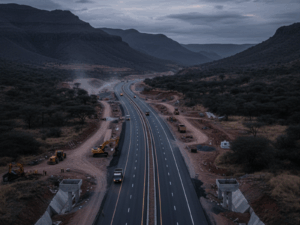
With a road infrastructure network stretching 27 478 kilometres, South Africa’s national roads are an important lifeline of the economy.
A safe, efficient and reliable road network is vital to the health of the nation’s economy, much like the arteries in the human body, that keep the body moving. The failure of these arteries, have serious and far-reaching consequences. “In this country, over 70% of the freight that moves on the surface, moves on the national road network, not on rail. The road network is a very critical component of our economic life.“We have cargo coming in and leaving the country through our ports. For those goods to reach their destination, you need a reliable road network,” South African National Roads Agency SOC Ltd (SANRAL) General Manager for Marketing and Communications, Vusi Mona, said in an interview with SAnews.An entity of the Department of Transport, SANRAL is strengthening South Africa’s economic backbone while laying the groundwork for inclusive growth by building and maintaining better roads. Beyond facilitating trade and commerce, this extensive network connects people, communities and opportunities. Through continuous maintenance, upgrades and improved safety measures, SANRAL ensures that South Africa’s national roads remain a driver of development and prosperity. As a member of the Southern African Development Community (SADC), the country’s extensive road network also plays a vital role in facilitating cross-border trade. “The road network must contribute not only to South Africa’s development, but to the region’s development. The road network we build and maintain connects us to neighbouring countries so that we can facilitate the movement of people, facilitate the movement of trade and the movement of goods,” Mona said as the country commemorates Transport Month. Commemorated annually in October, Transport Month aims to raise awareness of the important role of transport in the economy and investments in the transport sector aimed at stimulating development and creating jobs. With projects to build and upgrade the road network amounting to R18.526 billion in the 2024/25 financial year and the appointment of 2 012 Small, Medium, and Micro Enterprises (SMMEs) for the provision of services, the roads agency continues to demonstrate its commitment to supporting the growth of the economy. The work that is being undertaken by the roads agency aligns with the objectives of the Group of Twenty (G20) nations. These are countries with the largest economies in the world, who come together to tackle global economic challenges. The G20 is the premier forum for international economic cooperation, and it plays an important role in shaping and strengthening global architecture and governance on all major international economic issues. The member states meet annually to discuss economic, political and social initiatives. As President of the G20 in 2025, South Africa has the privilege of hosting the Leaders’ Summit in Gauteng next month. The G20 also emphasises the importance of infrastructure through the Infrastructure Working Group (IWG) which is one of the seven technical groups in the in the G20 Finance Track. The IWG discusses various aspects of infrastructure financing such as identifying and suggesting innovative instruments for securing financial investment resources. While all roads will lead to the Sandton Convention Centre for the two day-day summit that will conclude on 23 November 2025, the country has been planning and thinking of the future of its roads.
Charting the way forward
The roads agency plans to construct a new toll route on the portion of the N1 at the Beit Bridge International Border Post in Limpopo. Approximately 1.1km of the road has been declared to be on the South African side.
“In the past, all tolls collected at Beit Bridge went to Zimbabwe. Going forward, we will collect tolls from inward-bound traffic so that the revenue can be used to improve and maintain our infrastructure. We are hoping to build a second border post through the collection of these tolls,” Mona said.Beitbridge is the busiest border post in Southern Africa, connecting South Africa to Zimbabwe, Botswana, the Democratic Republic of the Congo, Malawi, Mozambique, Zambia and other SADC member states. Moreover, the rehabilitation of the N4, between Pretoria and Maputo, is underway to ensure that it remains safe, efficient, and well-maintained. The work includes routine pavement rehabilitation and strengthening, as well as major upgrades such as road widening, interchange construction, and new bridges. “We are involved through one of our concessionaires, Trans African Concessions (TRAC), which manages the N4 from just outside Pretoria to the Lebombo Border Post. “Beyond the border, we have assisted Mozambique in managing their national road network from Lebombo right through to the harbour. This ensures that trade and freight moving through the harbour can flow smoothly,” the road agency’s Mona, said.With a price tag of R28 billion, SANRAL has undertaken one of South Africa’s most ambitious road infrastructure development – the N2 Wild Coast project. The N2 connects four provinces namely the Western Cape, Eastern Cape, KwaZulu-Natal and Mpumalanga. The route also traverses the cities and towns of Cape Town, George, Knysna, Gqeberha (Port Elizabeth), East London, Mthatha, Durban and Ermelo. It further connects Mpumalanga to Mozambique. The project includes two mega-bridges: the Msikaba Bridge, which spans the Msikaba Gorge near Lusikisiki, and the Mtentu Bridge near Lundini. At a budget of R11.5 billion, the state entity is also upgrading the R573 Moloto Road, which traverses Gauteng, Mpumalanga, and Limpopo. “We would like to highlight the infamous Moloto Road. It used to be known as the road of death. It is now going to be famously known as just Moloto Road. We’ve taken over that piece of road. It used to belong to three provinces, Limpopo, Mpumalanga and Gauteng,” he said.
Job creation
During its upgrade, nearly 400 local labourers received temporary jobs on the portion of the project.“We are very big on job creation as we invest billions of rands to enhance the national network. It would be a travesty if the taxpayers were giving us this money and not seeing any value in terms of job creation,” he said.Through these and many other projects, SANRAL continues to connect South Africa with world-class road infrastructure that supports inclusive economic growth. SANRAL’s efforts will help the country pave the way to a better future, one less pothole at a time. Afterall, Rome was not built in a day. Originally posted on SAnews.gov.za