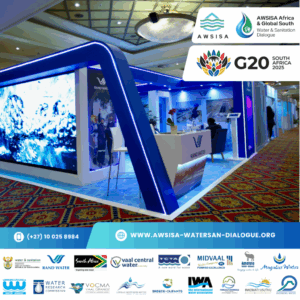
The Youth Stream of the AWSISA Africa and Global South Water and Sanitation Dialogue served as a powerful platform for young professionals, researchers, and practitioners to share their perspectives, innovations, and frustrations around the current state of youth participation in the water and sanitation sector.
The session was opened by Mrs. Mbali Sibiya the Youth Stream Lead and facilitator, where she set the context for the youth stream, highlighting the importance of youth inclusion in ensuring a sustainable future. Mrs. Sibiya introduced the Deputy Minister of Water and Sanitation, Hon. Sello Seithlolo to deliver the opening remarks and set the scene for the youth stream discussions. In his remarks, DM Seithlolo called for deeper community engagement and ownership in water-related decision-making.“The thinking needs to move from a linear economy to a circular economy,” he emphasised. A trigger question framed the session’s tone: ‘Does government hinder the adoption of innovative technologies that could address the challenges faced in the water sector?’
Presentations: Innovation Meets Implementation Gaps
Six youth-led presentations explored solutions ranging from macadamia orchard development and spring recharge to AI-based systems for accountability and community engagement as well as skills advancement for people with disabilities in the water sector. Yet, a recurring theme emerged: community exclusion from design and implementation. Several projects showed technical merit but lacked clarity on stakeholder roles and ownership. A participant from Vaalkop, where water quality issues persist, reflected that local government failures – not youth innovation – are the main barriers to change.Themes and Reflections
The discussions revealed four major contradictions:- Inclusion vs. Implementation: Communities are still treated as beneficiaries rather than partners.
- Innovation vs. Bureaucracy: Youth feel that policy and institutional red tape delay the adoption of new technologies.
- Diversity vs. Discrimination: Participants questioned the notion that “disability inclusion is expensive,” asserting instead that “disability is not inability.”
- Visibility vs. Voice: While youth are often seen in programs, they remain sidelined from decision-making spaces.
Workshops: Skills, Communication, and Courage
The ‘Communicating with Impact’ panel, featuring professionals from Infrastructure News, Umgeni-UThukela Water, WRC, SALGA, and Rand Water, emphasised courage and storytelling as vital tools for youth leadership.A group exercise on “30-second impact pitches” energised the participants, culminating in Deputy Minister Seithlolo’s charge to youth:“Do not be afraid to step up. The decisions made today will affect your future – fight for opportunities within the sector.”An interactive training session focusing on Water quality and technology followed in partnership with Universal Water Solutions. An interactive ‘Battle of pH’ activity showcasing Chem-key testing technology was one of the highlights as some lucky delegates won prizes while learning about water quality management . The closing plenary session was a Youth-led Innovation and WASH Impact session, a keynote address was delivered by the Deputy Chairperson of UMngeni-UThukela Water Ms. Mkhize stressed that “laws alone will not work – we need to review policies and include youth where it matters.” She emphasised on moving away from tokenism and towards transformation for an inclusive and sustainable water future.
Emerging Consensus
Youth must own their work, document and communicate it with impact; communities must co-design solutions; government and private sector must open pathways for youth-led innovation; and soft skills must accompany technical expertise.Youth Declaration from the AWSISA Africa and Global South Dialogue
We, the youth of Africa and the Global South, gathered at the AWSISA Water and Sanitation Dialogue, reaffirm our commitment to shaping a sustainable, inclusive, and innovative water-secure future. Recognising the intersecting challenges of inequality, climate change, and governance, we declare our intent to be active agents of transformation—not passive observers.Our Commitments:
- Community Co-Ownership: We commit to strengthening the relationship between science, technology, and communities through participatory approaches promoting ownership and accountability.
- Innovation for Impact: We will scale AI-driven and circular economy solutions to address water and sanitation challenges.
- Equity and Inclusion: We will champion gender equality, youth empowerment, and disability inclusion. “Disability is not inability.”
- Collaboration and Policy Engagement: We call for open spaces for youth in policy dialogue, budgeting, and project implementation.
- Courage and Accountability: We pledge to publish our work, bridge technical excellence with social relevance, and tell our stories authentically.
Our Call to Action:
To the Government:- Reform bureaucratic barriers and invest in youth-led water innovations.
- To the Private Sector: Create funding models that de-risk youth participation.
- To Communities: Partner with us in co-owning solutions.
- To Youth: Step up, speak up, and stand together – our time is now.
“We are not the future – we are the present architects of water security in Africa and the Global South.”