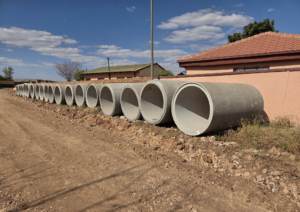
Lebowakgomo, a residential area and part of the Sekhukhune District Municipality in Limpopo Province, recently had four kilometres of gravel road upgraded to a tar surface, which included the laying of new stormwater pipes supplied by Rocla.
The project, which forms part of important infrastructure upgrades in the area, is an ongoing project that will offer the local community safer and more reliable roads and walkways and services. Karel Komape, project manager on the Lebowakgomo project for Ditlou Suppliers and Services, says “Infrastructure maintenance plays a crucial role in the upliftment of communities who in the past have had to utilise deteriorating roads and walkways and drainage systems. We believe, as contractors to the project, that infrastructural components must meet the standards required by our programme, and Rocla’s Interlocking Joint stormwater pipes did just that.” Rocla supplied 1,037 x 100D standard 2.44 m long Interlocking Joint (IJ) stormwater pipes ranging from 450 mm up to 1200 mm in diameter.
“We at Rocla view all projects, large or small, with the same focus towards delivering a solution that meets customer requirements,” says Matthews Ntjie, sales consultant for Rocla, Polokwane. “Initially, we were not aware of the volume of pre-existing stormwater piping needing to be replaced, but upon discovery, we revised this quantity internally and engaged with our manufacturing plant to formulate a game plan to meet the required deadlines set by the contractor, without negatively impacting other projects/customers, which we managed to achieve successfully,” says Ntjie.
“Our interlocking joint pipe is manufactured specifically for use in stormwater applications, as opposed to sewer applications. The male/female type joint is formed inside the wall of the pipe, which prevents any widening of the pipe, ensuring the outside dimensions of the pipe remain constant. The joint itself is used for centring the pipe during laying operations. The joint is sealed with a sealant and/or a membrane with a bitumen sealant or similar. A rubber collar, placed around the outside of the pipe diameter, can be supplied to prevent any soil particle movement into the pipe and enhance the watertightness of the joint. Therefore, the rubber collar should be specified where groundwater ingress must be avoided, and a more expensive rubber ring joint pipe is not necessary,” explains Ntjie. Komape commented that the product supplied by Rocla was a locally manufactured and high-quality stormwater pipe that met their requirements for the project.“The interlocking joint stormwater pipes were delivered on time, which enabled us to keep the project on schedule. We would work with Rocla again on future projects,” says Komape.