


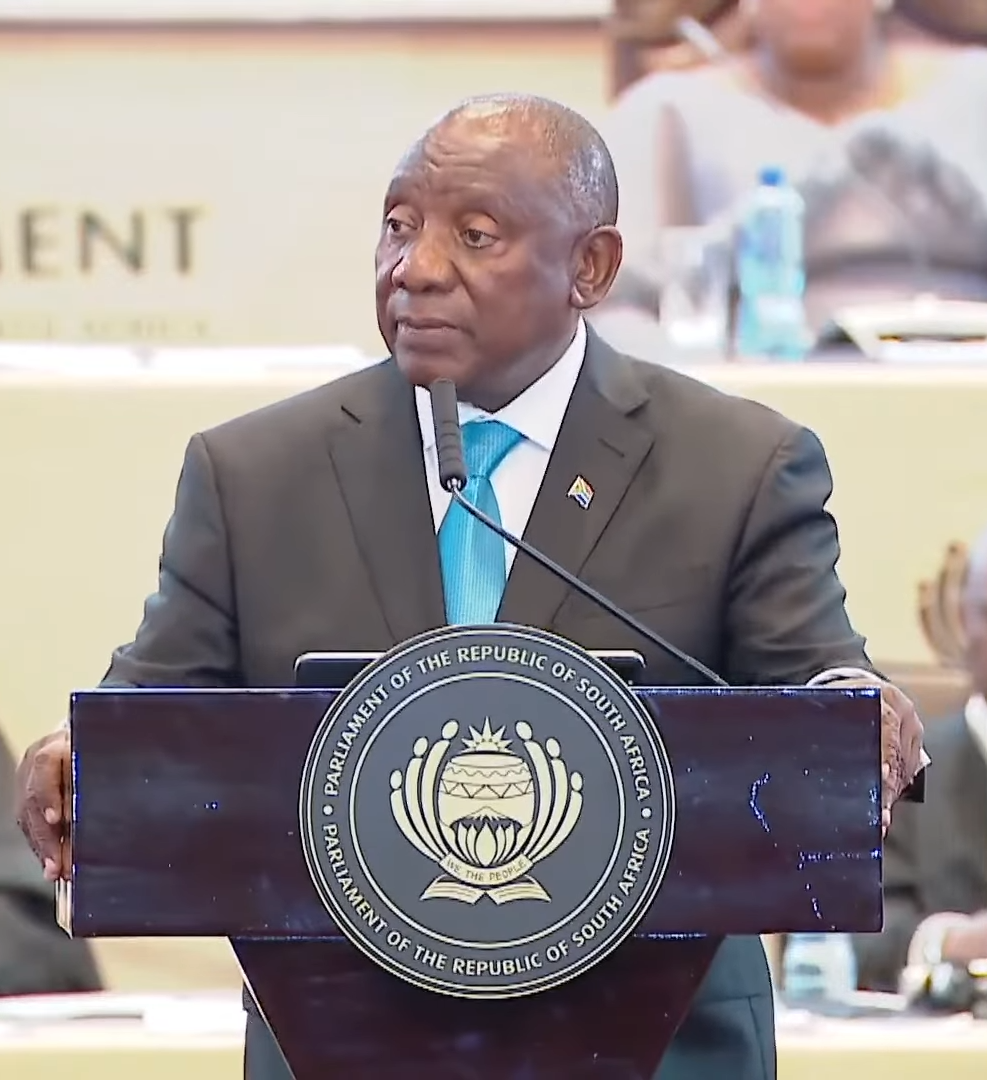
President of South Africa Cyril Ramaphosa delivering the State of the Nation Address (SONA) 2026 which positions infrastructure as a key economic driver.
Infrastructure: The key to economic growth
Ramaphosa characterises South Africa as a country with low growth and high unemployment. Linking these challenges to the broader infrastructure agenda, the Cabinet has approved a comprehensive implementation plan under the Medium Term Development Plan aimed at accelerating growth and advancing inclusion. He says, “Through this plan, we are working to revive growth by creating the conditions for firms to invest by maintaining a clear and stable macroeconomic framework, investing in infrastructure that works, creating a conducive regulatory framework that supports growth and enables competition, and a focused and forward-looking industrial policy. The foundation of this plan is investment, particularly in public infrastructure, as well as labour-intensive growth sectors that are capable of future growth.” There will be heightened focus on green and digital economies, as this is where South Africa identifies space for addressing youth unemployment. The president adds, “Infrastructure is much more than an investment in brick, mortar, concrete and steel. It is an investment in jobs, productivity and growth. For many years, fixed investment has been declining. We are now changing that.” The change will come in the form of R1 trillion investment over the next three years. He explains, “This is the largest allocation of its kind in our country’s history.” The trillion rand is not enough on its own; it has to be unlocked and accounted for, which will be enabled by new regulations for public-private partnerships, something that South Africa has long been working towards. This also exists alongside relooking at funding models, reducing risk, and attracting investors to fast-track projects in energy, water, transport and digital infrastructure. An example of this funding model is the launch of the first-ever infrastructure bond, which has been twice oversubscribed. This bond is a clear move towards market-driven solutions, an ideological shift away from direct state intervention, in the hopes of attracting investment, so far it has raised R11 billion, signalling interest in infrastructure development. Another model that is being looked into is the tender process, which Ramaphosa says, “Causes delays.” To address this, he says, “To prevent undue delays in critical projects, we will establish specialised courts for commercial matters with dedicated judges and dedicated court rolls to ensure faster outcomes in matters that have a bearing on the economy and development.” State infrastructure is still a top priority. Ramaphosa explains, “This year, we will begin the work to establish a professional State Property Company to transform the 88,000 buildings and 5 million hectares of land owned by the state into professionally managed engines of growth and development.” The president explains that “Through Operation Vulindlela, we are working to transform the structure of our economy, to fix our infrastructure and make our electricity, water and logistics sectors more competitive and efficient.”Water infrastructure
Water is a sore subject; the ongoing Johannesburg Water crisis, coupled with country-wide problems, delayed projects, and increasing demand, has brought water to the forefront of the conversation in South Africa. Ramaphosa acknowledges the frustration, going so far as to direct the Minister of the Department of Water and Sanitation, Pemmy Majodina, away from SONA to engage directly with the Johannesburg crisis. Ageing infrastructure, poor planning, inadequate maintenance, and a failing municipal system are all name-checked, with the president adding, “There is no silver bullet to address this challenge, which has its roots in systemic failure and many years of neglect.” To ensure long-term supply, he notes that new dams and upgrades to existing infrastructure will continue, with R156 billion in public funding for water and sanitation over the next three years. He adds, “The construction of the Lesotho Highlands Water Project and other large-scale projects like the Ntabelanga Dam, part of the Mzimvubu Water Project in the Eastern Cape, is advancing.” The promised National Water Resource Infrastructure Agency is still being established, missing the February 2026 mark that was originally laid out, but Ramaphosa assures that it is “In the final stages of establishing” the agency, which will fast-track and monitor key water infrastructure in South Africa. He goes on to acknowledge that the supply is not the issue, but the delivery of water, and the amended Water Services Bill will allow the national government to directly hold water service providers accountable for their performance, and crucially, “withdraw their license if they fail to deliver.” The national government has already laid criminal charges against 56 municipalities that failed to meet their water obligations, and is moving to lay charges against municipal managers in their personal capacity for violating the National Water Act. President Ramaphosa also addresses the issue of water revenue being funnelled into other purposes, a direct contributing factor to the Johannesburg water crisis, by allocating R54 billion in incentives for metros to reform their water, sanitation and electricity services. The hope is to ringfence water revenue and allow for water revenue to be reinvested into infrastructure. Comparing water to energy, the president explains how the National Energy Crisis Committee enabled the end of load shedding, and a new National Water Crisis Committee is being formed to enable water service delivery in South Africa. This structure brings existing efforts under a single coordinated body to address the water challenges in South Africa.Electricity and energy infrastructure
The Just Energy Transition and the calculated move away from overreliance on coal are another key infrastructure growth point. The president says, “Having put load shedding behind us, we must now transform our energy system to ensure long-term energy security.” 2026 sees the fruition of regulatory changes that aim to enable massive investment into renewable energy. The president says, “By 2030, more than 40% of our energy supply will come from cheap, clean, renewable energy sources.” An ambitious claim, given that coal still accounts for 83% of the country’s energy production. International pledges to the Just Energy Transition Investment Plan now stand at approximately R250 billion. This is financing large-scale investment in manufacturing, infrastructure and skills. The hope is that establishing a level playing field for competition will drive a competitive market and reduce the risks of relying on only one energy source.
While the private sector is entering the market, Eskom still plays a vital role in energy. The entity is being restructured into a fully-independant state owned transmission entity. This entity will have ownership and control of transmission assets and be responsible for operating the electricity market.
Ramaphosa adds, “Given the importance of this restructuring for the broader reform of the electricity sector, I have established a dedicated task team under the National Energy Crisis Committee to address various issues relating to the restructuring process, including clear timeframes for its phased implementation. It will report to me within three months.” In addition to this, this year commences the first round of independent transmission projects to enable private investment in expanding our national grid. While enabling the sector is crucial, there are historic problems to be addressed, and the president says, “We will work in each province to address transformer overloading, illegal connections and equipment failure to eradicate load reduction by next year. We are committed to the path that we have embarked on to modernise our energy system.”

