Fire is not an insurance boogeyman; it is a real risk to business, life, and infrastructure. Compliance with South Africa’s fire protection regulations is more than a regulatory exercise; it is a necessary part of ensuring security and safety for any building.
South Africa has SANS 10400-T, part of the National Building Regulations that deal specifically with fire protection. While it prescribes a minimum and stipulates access to municipal water, in practice, going beyond these requirements is essential to achieve meaningful fire resilience. Paul Warrener of Rainbow Reservoirs says, “These regulations are put in place for protection, but more importantly, they’re minimums. They don’t account for what happens when municipal supply fails in a real emergency.”SANS 10400-T and the limits of municipal supply
Under SANS 10400-T, municipalities are legally required to supply water for fire protection. However, the regulation does not address operational realities such as pressure fluctuations, burst pipes, maintenance shutdowns or unplanned outages. According to Warrener, this gap has become increasingly apparent over the past 18 months.“We’ve seen a noticeable increase in site visits related specifically to fire and emergency water storage,” he says. “Fire engineers and insurance companies are far more aware of the risks created by unreliable municipal supply.”As a result, insurers are often applying stricter requirements than those set out in the regulations, particularly for high-value or high-occupancy buildings.
Emergency water storage as a first line of defence
Warrener emphasises that emergency water storage systems are designed to operate independently of external supply. “Emergency water storage provides an immediate, reliable and independent water source for fire suppression,” Warrener explains. “It’s there to respond instantly, with the correct pressure and flow rate, when the fire starts.” These systems are designed to support sprinkler systems, hydrants and hose reels during the critical early stages of a fire. “The first few minutes are decisive,” Warrener says. “The goal is to suppress and contain the fire until the fire department arrives. Without guaranteed water, that simply doesn’t happen.” The minimum water supplied is calculated by area and time. The water tanker must run for a given time over the specified area for it to be effective. Hoses must have a flow rate of 0.5 litres per second, while hydrants usually have a stipulated pressure of 100 to 150 kilo newtons per metre squared.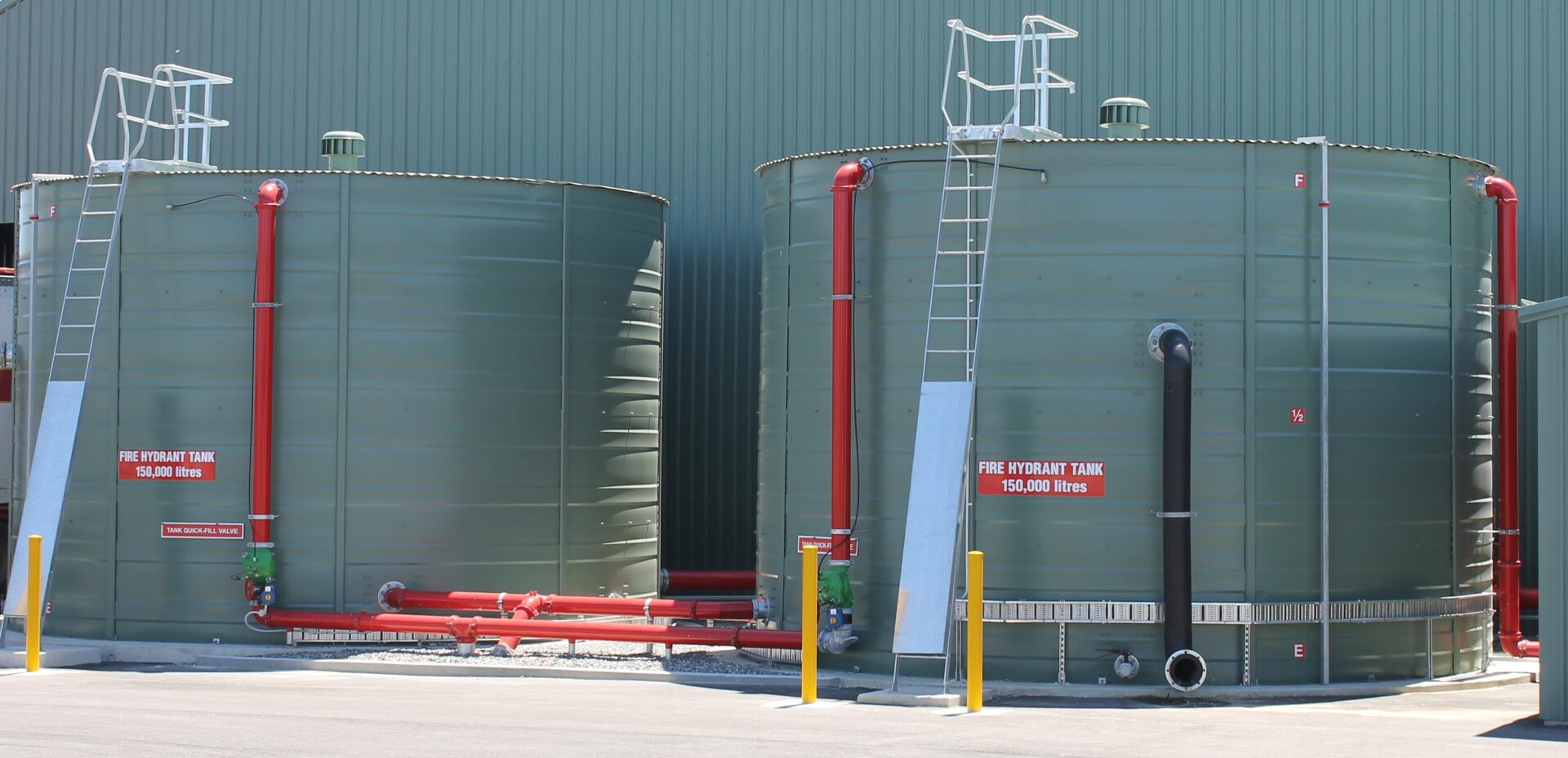
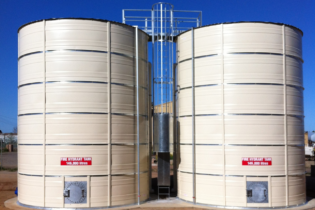
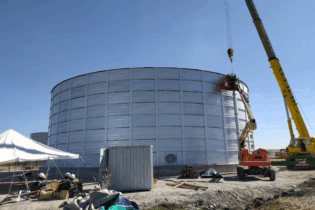
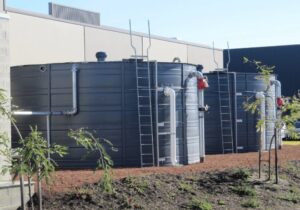
For businesses who are serious about fire protection, high-quality, dependable fire tanks are essential
Insurance exposure and business risk
While municipal supply may satisfy the letter of the law, it does not always satisfy insurers. In practice, insurance assessments focus on risk mitigation rather than minimum compliance. “If a warehouse or shopping centre burns down and there is no backup water storage, insurers are going to ask why,” says Warrener. “Relying solely on the municipal line is a risk many businesses can’t afford.” Municipal water infrastructure is subject to maintenance, downtime, and leaks, which can make immediate access to water in an emergency non-viable. There is also the documented decline in water infrastructure in South Africa that makes a permanent tank a much more reliable solution. Warrener adds that losses following uncontrolled fires are often unrecoverable. “In many cases, businesses never reopen,” he says. “The upfront cost of emergency water storage is small compared to the long-term financial and legal consequences.”When dedicated fire-water Storage is required
The requirement for separate emergency water storage is typically determined by a combination of factors, including building size, occupancy levels and usage.“Size matters, but it’s not the only factor,” Warrener notes. “It’s also about how many people are inside the building and what’s being stored or processed there.”Large commercial and public buildings, such as shopping centres, hospitals, factories and apartment complexes, are commonly required to install sprinkler systems supported by dedicated emergency water storage. Smaller buildings may rely on hydrants and hose reels, but still require stored water and pumping systems capable of delivering adequate flow.
Design, placement and performance
Although fire-water tanks are often specified in litres or cubic metres, capacity alone does not guarantee performance.
“A fire engineer doesn’t just say how much water you need,” Warrener explains. “They specify how much water must flow, at what pressure, and for how long before emergency services arrive.”
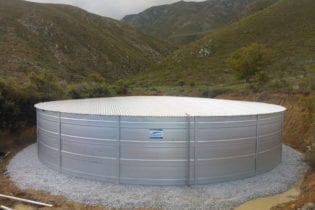
To meet these requirements, systems must be carefully designed. Placement is critical: tanks should be protected from damage but located close enough to reduce pumping losses and delays. Technical features also play a role. Rainbow Reservoirs, for example, incorporates customised vortex inhibitors into its systems. “These prevent air from being drawn into the pump,” Warrener says. “You get a steady, uninterrupted flow of water, which is essential when the system is under pressure.” Modern emergency water storage systems are increasingly customised to suit site-specific constraints.“After the fire engineer has done their work, we assess the site,” Warrener explained. “Space and accessibility don’t always work together.”In large urban developments, tanks have been installed in otherwise unused structural spaces. One notable example is the Mall of Africa, where tanks were installed “That allowed the client to remain compliant without losing parking bays or buying additional land,” Warrener said. In environmentally sensitive settings, aesthetics also play a role. “For game lodges, we use colours that blend into the surroundings,” he added. “You don’t want a bright metal tank disrupting the landscape.”
Dual-use water storage
Customisation also allows for dual-use systems, where stored water can serve operational needs without compromising fire protection. “We can include a mid-level outlet for cleaning or domestic use,” Warrener adds, “while always maintaining the minimum volume required for fire suppression.” This approach is increasingly popular in factories and large commercial facilities, where water security is a growing concern.The role of ASIB certification
Oversight of fire suppression systems in South Africa falls largely to the Automatic Sprinkler Inspection Bureau (ASIB), an independent body responsible for regulating sprinkler and hydrant systems. “ASIB sets very strict standards for design, installation and maintenance, they inspect systems and issue compliance certificates.” The organisation’s track record is widely regarded as exceptional. “Since the 1970s, there has been no recorded loss under normal fire conditions in any structure with a valid ASIB clearance certificate,” he notes. ASIB certification is recognised by insurers and is often a prerequisite for full cover.“It’s proven reliability,” Warrener says. “It protects building owners legally, financially and operationally.”