
Irene von Knoblauch-Dreyer, Managing Director of EWOR
“EWOR is a waste oil collection company,” she says. “Flexilube is a re-refinery and blending plant. For me, it is one business, circular by design, but we keep them as separate entities for identity and regulation.”The focus is on lubricating oils, the industrial fluids that keep engines and machinery running. “We process waste lubricating oil from gearboxes, hydraulics and engines,” says von Knoblauch-Dreyer. “You cannot mix cooking oil with hydraulic oil or antifreeze with engine oil; those are classified separately. That distinction is critical, which is why the EPR legislation was so specific.” Lubricating oil is a scarce fraction of crude. “Only one to two per cent of a barrel of crude oil is lubricating oil,” she explains. “It takes enormous amounts of energy to extract because it is the last fraction to come off. That makes it precious, so to just burn it at the end of life is madness.”
South Africa’s head start
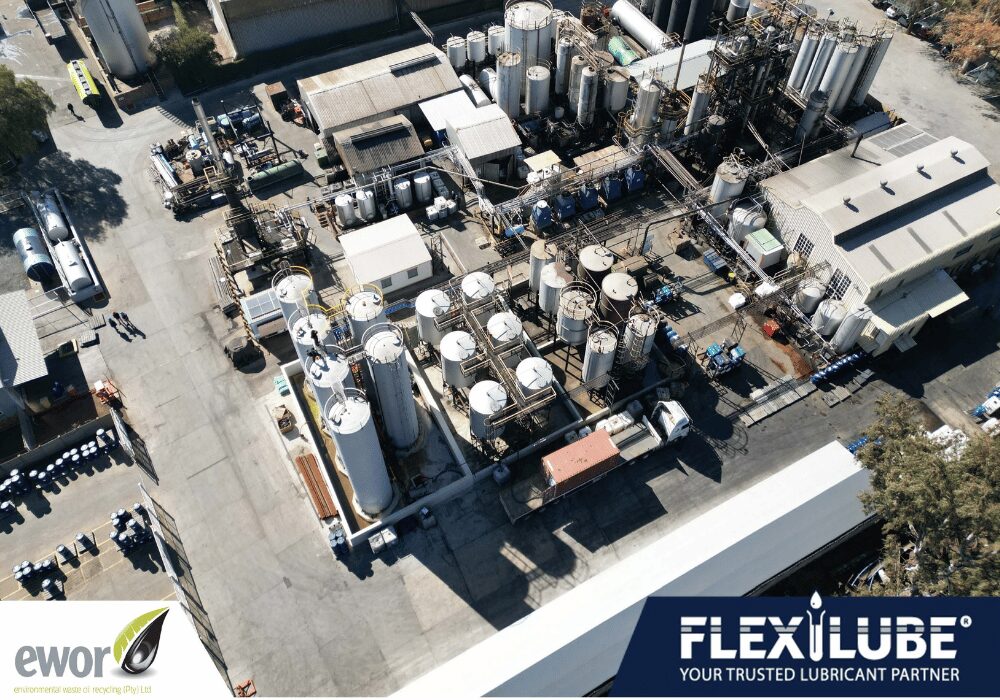
EWOR and Flexilube’s recycling facility
“Used oil has always had an inherent value because it can be burnt as fuel. But that is not recycling, that’s recovery. True recycling means circularity. We can re-refine the same molecule up to seven times. When you burn it, it is gone, and you are releasing dangerous particulates and heavy metals into the atmosphere.”Use of waste oil as burner fuel results in an increase of up to 99% in emissions of criteria pollutants to the atmosphere compared to re-refinement of waste oil, resulting in a negative impact on the environment and human health. EWOR runs its own fleet of trucks and tankers. “We don’t set minimum volumes,” says von Knoblauch-Dreyer. “A small generator today could be a major partner in five years. For us, building partnerships is more important.” Safety is central. “Used oil is classified as hazardous waste, so our drivers receive Hazchem & spill response training. We carry specialised environmental insurance. If a truck accident spills oil, you need expert companies to remediate the soil, test it, and monitor it for months. It is not something you take lightly.”
How re-refining works
- Collection: Used lubricating oil is gathered from workshops, mines and factories, stored safely in drums or tanks, and transported to the re-refinery.
- Dewatering: Water and light contaminants are removed. Even a small percentage of water makes the process inefficient.
- Thermal & Chemical Cracking: Heat and chemical treatment break down long hydrocarbon chains and separate impurities from the valuable oil molecules.
- Filtration: Using diatomaceous earth, impurities are trapped and removed. This stage is vital to ensure oil purity.
- Distillation: The refined oil is distilled to produce base oil, ready to blend into new lubricants.
- By-products: Wastewater, tar residues and spent filtration material are carefully managed, with ongoing research into turning them into useful products instead of disposal.
Managing waste streams
Re-refining also produces by-products, which require careful handling. “You’ve got wastewater, tar residues, and spent filtration on earth,” she says.“The problem is you do not always know what you are getting in waste oil. Instead of separating at source, people illegally mix antifreeze, glycols, greases, and all sorts of synthetic fluids. That makes the waste stream unpredictable.”Despite the challenges, EWOR pursues alternatives to disposal. “Our R&D team and external partners are constantly looking at ways to reuse these by-products, whether in bitumen, compost, or even packaging. We cannot talk about true recycling unless we also take responsibility for the waste we generate. South Africa’s energy and water crises have forced resilience. “We see it as an opportunity to improve our business,” says von Knoblauch-Dreyer. “We invested in generators years ago, and now we are steadily moving to solar as we expand. On the water side, our aim is to reuse treated effluent in our own processes so that we do not draw from the municipal supply. It is all about becoming more self-sufficient.” Flexilube’s re-refined base oils go into industrial applications, mining, manufacturing, hydraulics, and gears. “For mining companies, reducing carbon footprints is critical. Our products offer up to 90% lower environmental impact compared to virgin crude-based lubricants. That is a huge incentive, especially with carbon taxes coming into play.”
The future of oil recycling

The reliance on oil is immense, but it is a finite resource
She adds: “Not one litre of lubricant is refined from crude in South Africa anymore. We are a net importer of virgin base oil. So, if the country is serious about self-sufficiency and sustainability, re-refined base oils are the way.”

Duncan Nortier