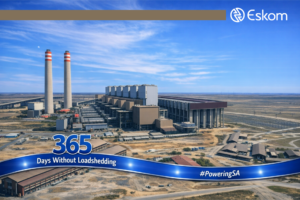
Eskom has officially surpassed 365 days without implementing load shedding.
The power utility last achieved the milestone nearly eight years ago in September 2018. “This moment has been three years in the making since the inception of the generation recovery plan. Eskom’s employees have again delivered using their deep technical and institutional capability built over decades of public investment that remains a critical part of our national capacity, which will now increasingly focus on delivering cleaner sources of energy. “The Eskom board and I are proud of the leadership demonstrated by the Eskom executive team led by Dan Marokane and the perseverance and focus of Eskom employees following the state capture years,” Eskom Board chairperson, Mteto Nyati, said. The electricity supplier’s Group Chief Executive, Dan Marokane, noted that the achievement is a reflection of cooperation from all stakeholders.“The delivery of this milestone again demonstrates that Eskom’s true progress is rooted in the expertise of its 40 000 people, our Original Equipment Manufacturers (OEMs) and other partners.“Government intervention through the Energy Action Plan has also been an important factor towards the progress we have made. Eskom has the scale and human capital experience to partner with investors to help deliver South Africa’s R2.23 trillion Integrated Resource Plan for investment in the energy sector,” Marokane said. Eskom’s Group Executive for Generation, Bheki Nxumalo added that morale at the power utility is “at an all-time high as we reach this milestone” with steadfast determination to “deliver to South Africa what we do best”. “The belief in ourselves and our pride has returned. Today represents the hardest‑won progress in Eskom’s recent history and establishes a stable platform for continued performance improvement, achieved through consistent execution of maintenance and improvement of the reliability of each unit across the system. “We are ready to participate in a competitive power generation marketplace,” Nxumalo said.
Concerted efforts
The power utility’s sustained improvement has seen a rise in the Energy Availability Factor, a drop in breakdowns at power stations, accompanied by less reliance on Open Cycle Gas Turbines, which guzzle diesel. This is a result of the implementation of the government’s Energy Action Plan, coupled with the power utility’s own Generation Recovery Plan.
Since the start of the generation recovery plan in March 2023:
- Energy Availability Factor (EAF) improved from 54.56% to 65.16%, an increase of 10.6%.
- Unplanned outages declined from 32.34% to 22.88%, reflecting a comparable reduction of 9.46%. This signals fewer breakdowns and a more reliable plant.
- Reliance on diesel‑powered emergency generation declined significantly, with expenditure falling from approximately R33.3 billion to R6.4 billion (pending the finalisation of the audit
- process), a reduction of R26.9 billion (around 81%).
“Building on earlier maintenance levels, Eskom intensified planned maintenance to restore long-term fleet reliability, while improving outage planning, reducing unit trips, and strengthening operational discipline across people, plant and processes,” Eskom said.The energy provider vowed to sustain the gains it has made “while supporting the long-term transition of the power system”. “In line with national energy policy, Eskom is applying a rigorous, evidence-based approach to the timing and readiness of new generation capacity. This will inform decisions on the phased shutdown, repowering, and repurposing of older coal-fired stations in a manner that safeguards security of supply while advancing emissions reduction and just transition objectives. “A decision is expected in the second quarter of FY2027. This approach ensures that recent operational gains are preserved and that sufficient baseload capacity is maintained to support economic growth and investment,” the power utility said. Furthermore, Eskom noted that it is using the same “disciplined approach” to deal with affordability and to end load reduction. “[Over] half a million households across the country [are] already benefiting from Eskom’s targeted load reduction programme. “This means that many communities that previously experienced periods of load reduction are now receiving a continuous electricity supply. “Notably, both the Northern Cape and Western Cape have fully eradicated load reduction, demonstrating the real impact of these efforts on people’s daily lives,” Eskom said. Originally posted on SAnews.gov.za