
The Mabunyaneng and Khubelu bridges in Lesotho have reached practical completion, marking a significant milestone for the Concor–Nthane Brothers M&K Joint Venture’s work on Phase II of the Lesotho Highlands Water Project.
Practical completion of the Mabunyaneng and Khubelu bridges on 31 July 2026 marks an important milestone in the development of resilient transport infrastructure in Lesotho’s mountainous Mokhotlong district.
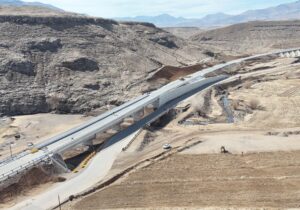
Constructed by the Concor–Nthane Brothers M&K Joint Venture for the Lesotho Highlands Development Authority (LHDA), the bridges provide permanent access along the national A1 highway, replacing the existing low-level river crossings that will be inundated by the future Polihali Dam reservoir. The contract encompasses the construction of the 270-meter long Khubelu Bridge (comprising nine 30-meter spans) and the 120-meter long Mabunyaneng Bridge (four 30-meter spans), alongside approximately two kilometers of A1 Road realignment. Both structures stand more than 2,100 meters above sea level in steep, highly variable mountain terrain.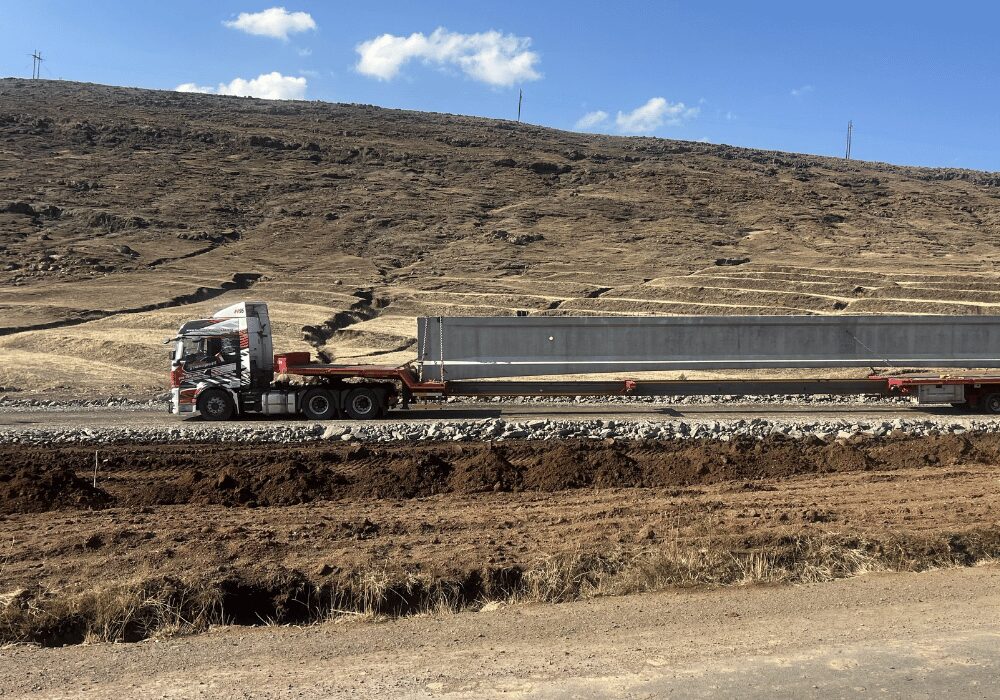
Transportation of precast beam from the Precast Yard to the bridge structure
“Executing major civil works at this altitude demands complete technical flexibility,” says Verreynne. “By adapting our engineering approach and logistics to match site conditions and severe weather, we have maintained continuous progress while keeping safety at the forefront.”
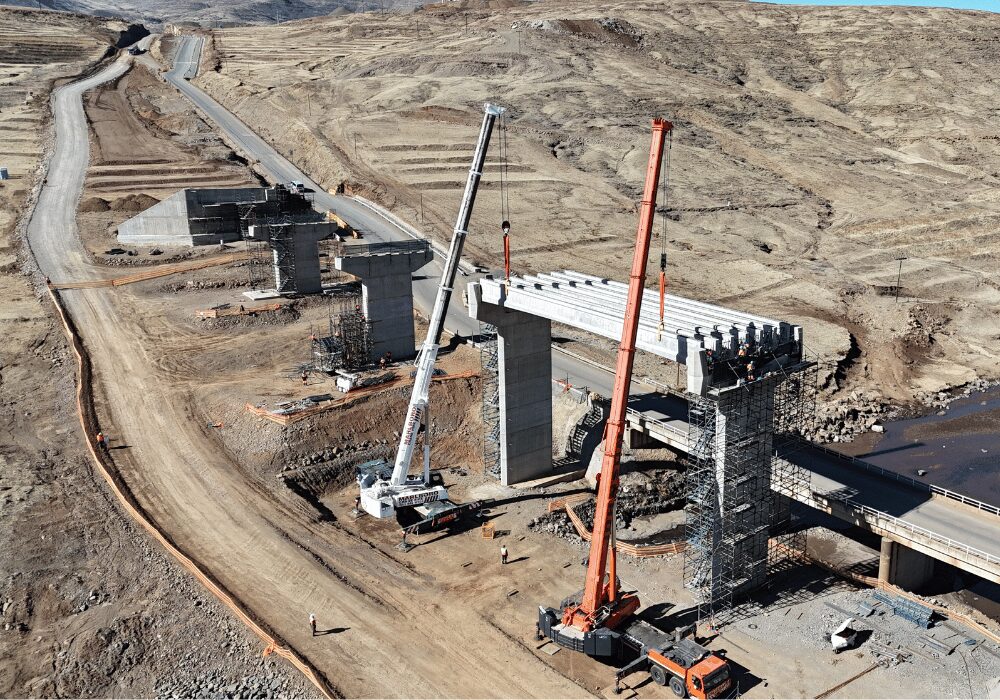
Khubelu Bridge PC Beam Installation – Tandem lifting and placing of the 1st precast beam

“Transporting 51-ton beams along steep, narrow mountain roads required meticulous logistical planning,” says Matlala. “Because single-crane maneuvers were impossible in this terrain, we designed tandem lifting operations using two 275-tonne truck-mounted cranes in partnership with Johnson Cranes and Jacob’s Transport.”
Specialist partner FB Cranes set up and maintained a dedicated gantry crane system at the on-site Precast Yard to handle precast beam fabrication and loading. To maintain concrete curing standards during sub-zero winter temperatures, batching water was pre-heated in storage tanks, and enclosed curing environments with industrial space heaters were established around fresh pours. Further safety innovations included suspending bridge deck formwork directly from the installed precast beams of the bridge structures, drastically reducing high-risk work within active riverbeds. Environmental controls were integrated across all operations. Dedicated on-site wastewater treatment facilities treated construction water for reuse in dust suppression, while natural bioremediation techniques were deployed on site to treat hydrocarbon-impacted soils. To overcome the 200 km supply distance from commercial suppliers, the joint venture partnered with National Asphalt to establish a dedicated asphalt plant directly on site.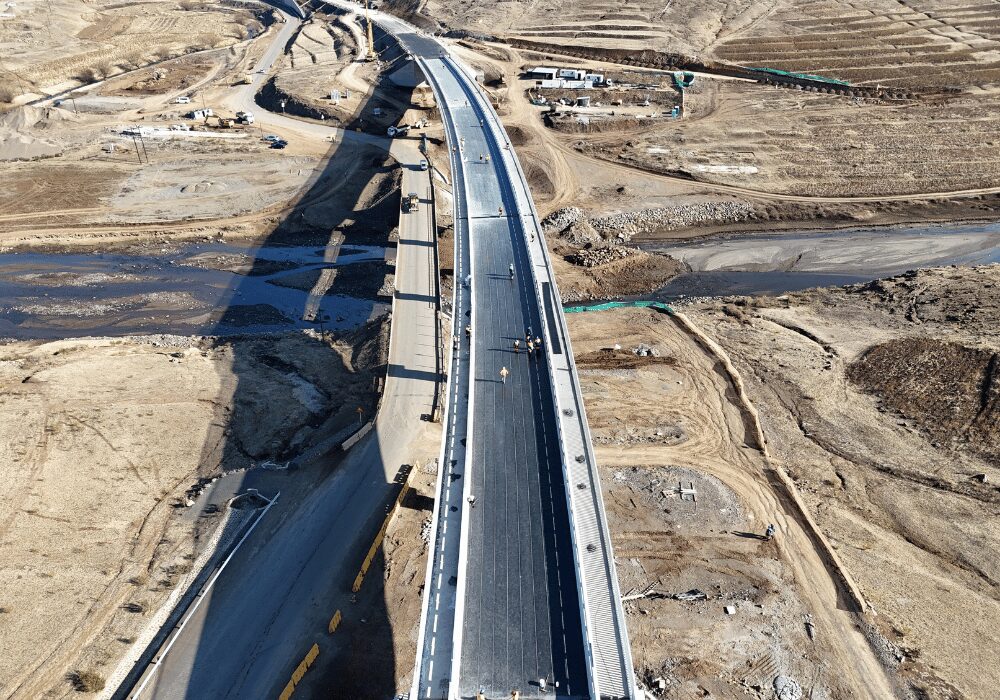
Khubelu Bridge – Bituthene Waterproofing
“Infrastructure projects create opportunities that extend far beyond the physical structures,” concludes Matlala. “Equipping young engineers and local subcontractors with experience on a mega-project of this complexity builds sustainable capability that benefits the industry long after construction ends.”