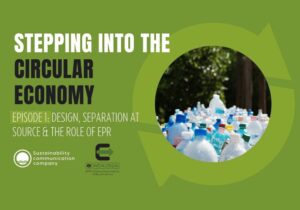
A new six-part documentary, produced by the Sustainability Communication Company (SUSCO) in partnership with the EPR Waste Association of South Africa (eWASA), explores South Africa’s circular economy, following waste materials from design and EPR through to recycling and recovery.
For many people, the ‘circular economy’ only exists as a concept. The term carries different meanings depending on who is using it, and it is rarely seen in practice. Stepping into the Circular Economy is a new six-part documentary series that sets out to change that. Produced by the Sustainability Communication Company (SUSCO) in partnership with the EPR Waste Association of South Africa (eWASA), the series connects high-level industry thought leaders with the practical lessons of the people who recover waste material every day.
“The series follows waste material through the full value chain and aims to show the work of the people who drive each stage of the circular economy,” says Chris Bischoff, Director of SUSCO. Episode one begins by exploring the upstream decisions like design for recyclability, separation at source and the role of extended-producer responsibility (EPR). The episodes that follow will share the stories of waste reclaimers, buy-back centres, small-scale recyclers and entrepreneurs, waste management companies and government departments that hold the system together. “Placing these role players beside one another puts a human face on a waste value chain that is usually described in tonnes and targets,” adds Bischoff. “The circular economy is easy to talk about and sometimes hard to picture,” says Lerato Mphahlele, Circular Economy Specialist at eWASA.“A strong visual story that follows the materials through the value chain will help shift the perspective towards waste – as something that holds value.”Episode one which is now live on SUSCO’s YouTube channel, carries three messages for the sector. Design for recyclability determines whether a product re-enters the system or ends at landfill. Separation at source protects the value of material before contamination strips it away. And extended producer responsibility (EPR) extends the responsibility of producers for the materials that they place into the market, in a way that supports the collection, recycling and enterprise development in the waste value chain.
“Producer responsibility only works when every part of the chain is visible and connected,” says Mphahlele.“This series shows that connection. It follows producer responsibilities through to the recyclers and enterprises that turn recovered material into something with value. If we want to increase our landfill diversion rates and place more material back in the economy, we need to be looking at product design, separation at source infrastructure and accelerated adoption of EPR.”