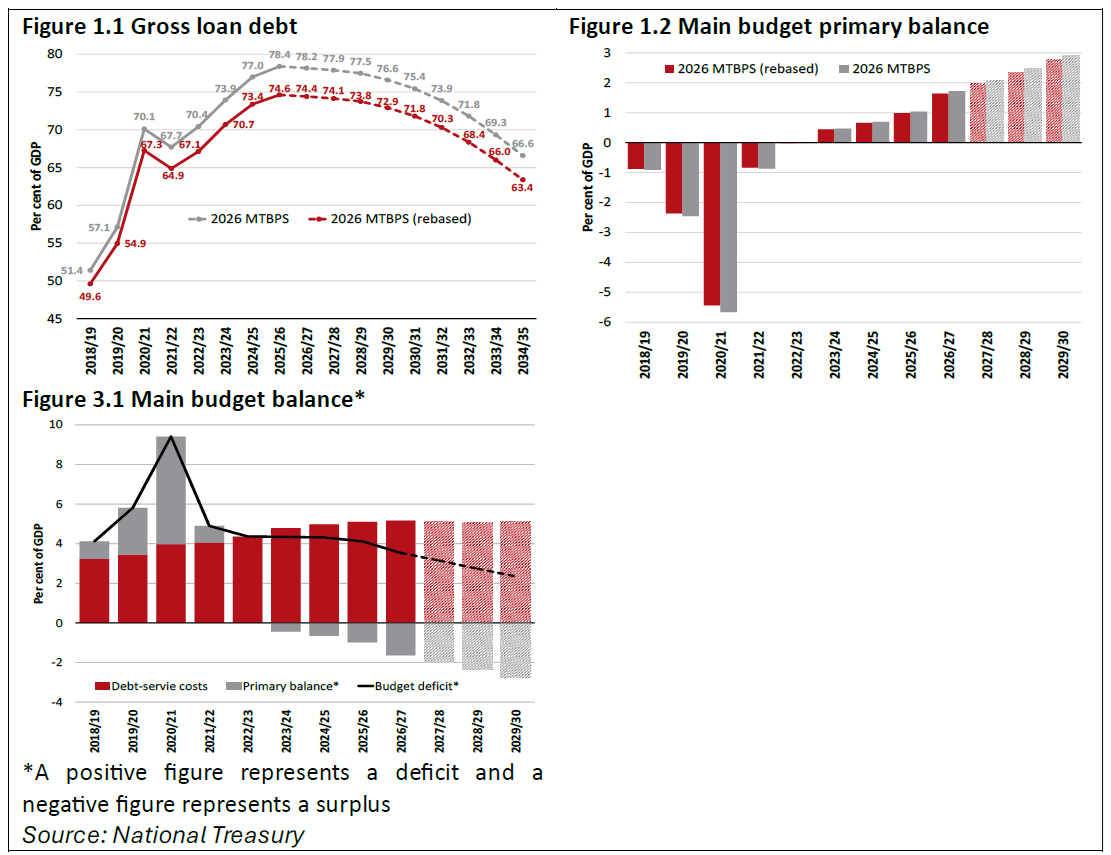

The National Treasury has recalculated key fiscal ratios in light of the 2026 rebasing and benchmarking of official gross domestic product (GDP) data announced by Statistics South Africa (Stats SA) on 29 October 2026. Based on Stats SA’s updated numbers, the debt to GDP ratio peaked at 74.6 per cent in 2025/26, down from the 78.4 per cent estimated in the 2026 Medium Term Budget Policy Statement (MTBPS). The debt to GDP ratio falls below 70 per cent by 2032/33, a year earlier than forecast in the MTBPS.
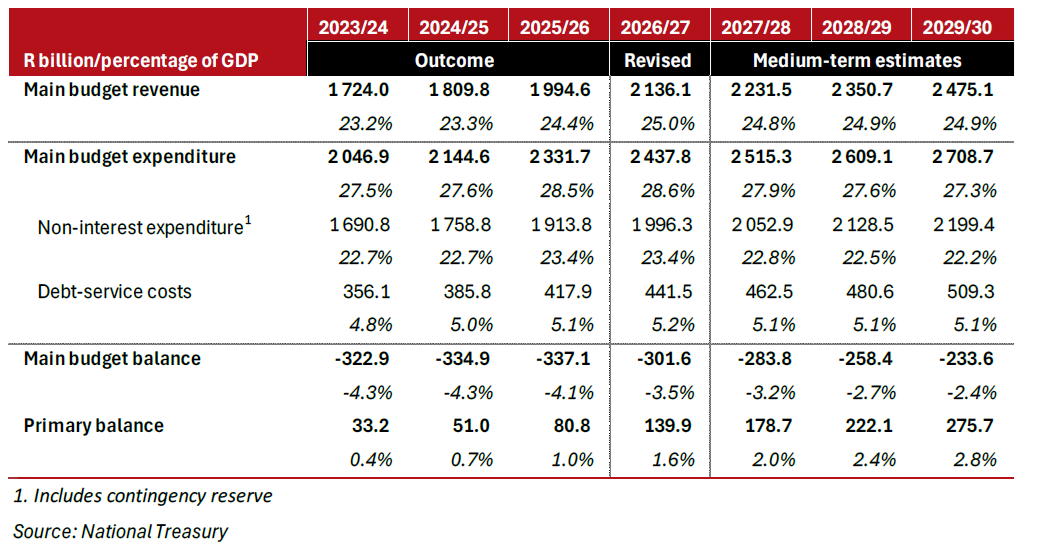
Other key fiscal ratios have likewise shrunk. The primary surplus is 1.6 per cent of GDP in 2026/27 (1.7 per cent in the MTBPS), rising to 2.8 per cent in 2029/30 (2.9 per cent) while the 2026/27 main budget deficit is 3.5 per cent of GDP (3.7 per cent). The updated ratios are simply a mechanical revision based on Stats SA’s new data, all else being equal. The National Treasury has not revised the assumptions it used in its MTBPS estimates, nor changed revenue, spending or debt estimates. The 2027 Budget will provide more detail and update the full macroeconomic forecast and fiscal framework. As Chapter 2 of the MTBPS noted, the denominator used to calculate key fiscal ratios is nominal GDP, which reflects the size of the economy (in money terms) without adjusting for inflation. By contrast, the more familiar real GDP data are inflation-adjusted and expressed in constant currency terms. Rebasing and benchmarking of GDP estimates is implemented by Stats SA every five years, in line with international best practice. Rebasing updates the reference or base year used to calculate GDP in constant currency terms. In the 2026 rebasing, the reference year was changed from 2015 to 2022. The benchmarking exercise uses improved data and methods to ensure that major changes in the economy’s structure are incorporated into GDP calculations, so that these more accurately reflect the size and composition of the economy. Historically, Stats SA’s five yearly benchmarking exercises have often increased the estimated size of the economy – the absolute level of GDP – but have seldom impacted economic growth rates meaningfully. The 2026 benchmarking had the effect of increasing the level of nominal GDP by 5.1 per cent (R393 billion) for 2025/26 and by an annual average of R294 billion for the period 2018/19 to 2025/26.
The effect is to shrink all the fiscal ratios which use nominal GDP as the denominator, as shown in the table and figures below. On average, the consolidated budget deficit improves by 0.2 percentage points of GDP for the current fiscal year and over the medium term. The main budget primary surplus is revised down by an average of 0.1 percentage points over the medium term while debt service costs fall to a medium term average of 5.1 per cent, against 5.4 per cent estimated in the MTBPS. The tax-to-GDP ratio decreases by an average of 1.3 percentage points over the medium term.
The Director General of the National Treasury Duncan Pieterse said: “Our updated calculations confirm that government continues to achieve its fiscal targets, with the fiscal metrics looking even better than we had projected based on Statistics South Africa’s revised GDP data. We are restoring fiscal credibility and South Africa is seeing the benefits in lower borrowing costs and a stronger foundation for investment and growth.” Table 3.5 presents the revised main budget fiscal framework when including the rebased GDP.Table 3.5 Main Budget Framework
 The following tables below have also been revised.