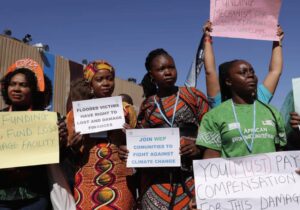

African countries have committed themselves to cutting greenhouse gas emissions and protecting their people from the worsening effects of climate change. These commitments form part of the Paris Agreement, an international climate treaty adopted in 2015 in which countries agreed to take steps to limit global warming.
Doing this requires billions of dollars in climate finance for clean energy and for making agriculture, water systems and infrastructure resilient to climate change. But the finance reaching Africa falls far short. The continent received an average of US$43.7 billion a year in 2021 and 2022 – only about 23% of what is needed. Africa needs roughly four dollars for every dollar it currently receives. The money is also distributed unevenly. The ten African countries most vulnerable to climate change receive only 11% of the continent’s climate finance, while another ten attract 76% of private climate investment. African countries need financing for mitigation (reducing the emissions causing climate change) and adaptation (preparing people, economies and infrastructure for unavoidable droughts, floods and extreme heat). Current finance covers only 18% of planned mitigation projects and 20% of adaptation costs. I’m an economist specialising in climate change and governance, with a long background at the United Nations and the African Union. I argue that Africa may be committed to the Paris Agreement, but the international financial system is pricing much of the continent out of implementing it. Climate finance tends to flow to countries where investors believe their money will be safe and profitable. Countries needing the most help often receive the least because investors see them as less likely to repay loans or produce sufficient returns. The system therefore makes finance more expensive and difficult to obtain for countries whose vulnerability makes their need greatest. Africa must negotiate for affordable funding that builds its industries, energy systems, transport, cities and skills – not simply ask for more money labelled “climate finance”. Climate finance should not be separated from development funding. Investment in electricity, transport, cities, irrigation, technology, manufacturing and education is needed both to grow economies and to protect people from climate change. The transition will be fair only if African countries turn their minerals and renewable energy into local jobs, products and stronger economies, instead of being left to export critical minerals that power the just transition while taking on more expensive debt to adapt to the climate damage caused by developed countries.Money promised is not money delivered
There has been an extraordinary number of climate-finance announcements, initiatives, coalitions, road maps, reform plans and targets. But promising money is not the same as delivering it. In 2009, developed countries committed to providing developing countries with US$100 billion in climate finance every year. The money was supposed to be available annually by 2020. But the Organisation for Economic Co-operation and Development’s calculations showed the only time more than US$100 billion in climate finance reached the developing world was in 2022. This was two years after the deadline. There is an important lesson in this. The world congratulated itself on finally exceeding a target that had been negotiated 13 years before and was supposed to have been reached two years earlier. It is also important to understand that the US$100 billion target was never calculated based on what developing countries actually needed to respond to climate change. It was a number negotiated by governments through a political process. The next major climate-finance promise came at the COP29 climate negotiations in Baku, Azerbaijan. Governments agreed to provide developing countries with at least US$300 billion a year by 2035. They also set a much bigger goal of increasing climate finance from all sources to US$1.3 trillion a year by 2035. But look closely at how this promise has been designed:- the guaranteed target is US$300 billion a year
- the deadline is still ten years away
- the money can come from a “wide variety of sources”
- the much larger US$1.3 trillion goal depends on money from everyone. This includes governments, private investors, international financial institutions and alternative sources.

For example, the 2022 Bridgetown Initiative helped international development banks create about US$400 billion in additional lending capacity over ten years. However this must serve many countries, not just those in Africa. Governments and financial institutions have become adept at designing plans to mobilise trillions. The trillions themselves remain elusive.