EFTEC are suppliers and manufactures of fine bubble aeration systems, diffuser systems, stainless steel air manifolds, air compressors or blowers and complete aeration process control systems.
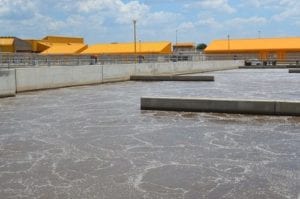
Maryke Foulds met with Hennie Basson MD to discuss the range of products and services on offer with a specific emphasis on its fine bubble aeration system which is gaining in popularity throughout South Africa. It is his view that while this is not a new technology, improved materials have improved its efficiency to such a degree that it is now the preferred aeration system in Europe and North America. “There are a number of benefits to using the system – the biggest of course is an energy saving of up to 50% depending on the size and design of plant. The single largest user of energy in a WWTW is the biological process and this is where the energy saving will occur”, says Basson. This is in part due to the use of improved materials. “Most fine bubble aeration systems are manufactured with polypropylene base material and the membrane of different mix of EPDM. New developments in membrane technology have resulted in EPDM membranes coated in a twin layer of PTFE that improves resistance on diffusor creep (stretch) as well as the resistance for biological growth on the membrane itself. PTFE membrane will also keep its original form four times longer than normal EPDM. The materials are also available for tube diffuse aeration systems.” In the aeration system which includes the air manifolds, particular caution must be taken in the design of the air manifold system – airflow velocities in any section of pipework should not exceed a flow velocity of 40 m/per second in order to limit the friction and heat generation of the air. Other factor to consider is the removal of condensate from the aeration system mounted on the floor. A build-up of condensate can result in tearing of the membrane due to the water being pressed through the membrane. Condensate forms at high humidity together with a high temp generated by compressors. Due to the high pressure increase, moisture will condensate as soon as the air cools off at basin water temperature. Instrumentation Instrumentation is crucial for the control of a WWTW especially when utilising fine bubble aeration. You can only control what you can measure – for each aeration system you would need at least one V-Port knife gate valve with a modulating actuator, a mass flow air meter and an LDO oxygen dissolved oxygen meter. These units work in conjunction to control the biological air demand and will satisfy the demand by supplying sufficient air volume with the correct oxygen mass required. The use of these types of instruments will track the oxygen demand closely over the whole 24 hours per day. At no point will under aeration or over aeration take place, resulting in energy saving.
EFTEC products and services
As exclusive distributors of Stamford Scientific International (SSI) Aeration Systems from the USA, leading diffusor manufacturers in the world, EFTEC also has agreements with Siemens Turbo Equipment from Germany for the municipal market for sub-Saharan Africa. When specifying or purchasing compressors or blowers, specific care must be taken in the terminology used to specify the airflow. The vast specification differences can result in electrical motor size differences of up to two frame sizes. It is misleading and the end user will pay for the loss of efficiency and capacity of the plant. Engineers need to clarify in advance what the actual requirement is and specify a standard that all suppliers can comply with in terms of the performance and output of compressor/blowers. Care must also be taken that compressor/blowers must be witness tested with an actual job motor. In other words, it must be tested with the motor that will be installed onsite. Witness testing must also be in compliance with ISO 5389. The reason for selecting a specific test norm is that all suppliers for a specific project must comply with the norm resulting in the client getting the best value for his money. Equipment The Siemens compressor range includes the small compact units from 37 kW to 400 KW and fully engineered units from 90 kW up to 3.3 megawatts and with capacity up to 123 000 m3 per hour. All Siemens machines has got dual point control – the control of the output pressure independently from the output flow rate by means of either inlet guide veins or frequency inverters for the pressure and outlet diffusor veins for flow control. This is applicable for direct drive units (high-speed machines with air foil or magnetic bearings) or constant speed blowers without variable speed drives. Process control EFTEC utilised the Siemens air bio control system for biological aeration process control. The system is based on the principle of most open valve algorithms. In laymen terms that means: the more open the valve, the lower the friction – the lower pressure the blower puts out, the lower the energy cost without compromising the efficiency of the system. The basic control system requires that the instruments described above, as well as the control system of the blowers combines all of these to control the system 24 hours a day, seven days a week. It also facilitates offsite monitoring. Water treatment companies can now monitor the performance of various plants offsite at the click of a button. It also assists the equipment supplier in monitoring the maintenance requirements and gives preventative maintenance instructions to the end-user.