Extensive work in outlining the worldwide asbestos problem and putting it in its proper perspective has been performed by public health officials, medical researchers and regulatory authorities. Moreover, some of the most comprehensive and unbiased overviews of South African asbestos issues have been compiled by more independent advocates such as Dr Jock McCulloch (RMIT – Australia). Frank Ehrenfeld, laboratory director for International Asbestos Testing Laboratories, sheds some light on the subject.
Asbestiform, asbestos and the ‘regulated six’ Without repeating similar information and assuming an awareness of the global concerns of environmental and worker safety matters – it may be worthy to explore some subtle and growing issues in the United States arena involving the understated mineralogical and laboratory characterisation issues that may prove far reaching in future asbestos issue expansion.| Asbestiform | Specific type of mineral fibrosity in which the fibres and fibrils possess high tensile strength and flexibility |
| Asbestos | Term applied to a group of silicate minerals belonging to the serpentine and amphibole groups which have crystallised in the asbestiform habit, causing them to be easily separated into long, thin, flexible, strong fibres when crushed or processed |
| US Regulated Six | Chrysotile, anthophyllite, actinolite, tremolite, grunerite (Amosite), and riebeckite (crocidolite) |
 Mineral maneuvers
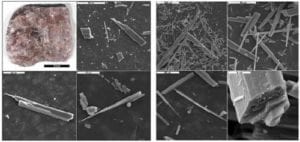
The definition for asbestos listed above simply states: “term applied to a group…” This is from one of the recent ISO methods on asbestos analysis. The original AHERA and other pre-2000 USEPA documents always include the ‘regulated six’ minerals of chrysotile, anthophyllite, amosite (grunerite), crocidolite (riebeckite), tremolite, and actinolite. It is this specific ‘group’ that has been rigidly defined by US regulations and other early foundational documents at the infancy stage of this knowledge base that were mentioned above.
For better or worse, it has also been the foundation of various legal arguments. Stakeholders have invested countless hours and dollars behind these definitions and therefore there is a wealth of legal precedence regarding their ‘acceptance’. However, acceptance does not mean validity, nor does it mean static intransigence. There can be growth and evolution of any recognised definition.
I have witnessed heated dialogue between colleagues debating these definitions. The debate has raged on for well over twenty-five years. As the knowledge base widens, and especially as bio-physiological and epidemiological evidence mounts, the definitions are, by default, evolving. This maturation has been evident in the more open ISO definition above and in other inclusive parameters in associated guidelines (eg. USEPA Vermiculite Attic Insulation Method).
The conversation now involves other asbestiform minerals that exhibit the properties (and possible hazards) of the regulated six. That is, crystal growth habit that is asbestiform with high flexibility, tensile strength, fibrosity, and durability in the environment and, as research is concluding, in biological studies.
Roadmap to EMP
Again, the issue of limitations of the definition of asbestos has been recognised by significant authorities in the US (eg. ASTDR, NIOSH, USGS, OSHA). The best and perhaps most recent example is the Centre for Disease Control’s work with the National Institute of Occupational Safety and Health. Engaged professionals should regard this issue and this topic as a requisite to their vocation and their role in public health. The CDC/NIOSH produced the following document: Current Intelligence Bulletin: Asbestos Fibers and Other Elongated Mineral Particles: State of the Science and Roadmap for Research. This is also available at http://www.cdc.gov/niosh/review/peer/ISI/cibasbestos-pr.html.
The roadmap parallels other historical efforts at clarity. That is to say, the road took some twists and turns and the simple “how do we get from Point A to Point B?” morphed into something that, in an effort to be inclusive of multiple interest group concerns, looked like a map of the Boston Subway. The hope is that other EMPs will be recognised as asbestos, with all of the rights and privileges that entails, and with the bottom line of underscoring public health.
Mineral maneuvers
The definition for asbestos listed above simply states: “term applied to a group…” This is from one of the recent ISO methods on asbestos analysis. The original AHERA and other pre-2000 USEPA documents always include the ‘regulated six’ minerals of chrysotile, anthophyllite, amosite (grunerite), crocidolite (riebeckite), tremolite, and actinolite. It is this specific ‘group’ that has been rigidly defined by US regulations and other early foundational documents at the infancy stage of this knowledge base that were mentioned above.
For better or worse, it has also been the foundation of various legal arguments. Stakeholders have invested countless hours and dollars behind these definitions and therefore there is a wealth of legal precedence regarding their ‘acceptance’. However, acceptance does not mean validity, nor does it mean static intransigence. There can be growth and evolution of any recognised definition.
I have witnessed heated dialogue between colleagues debating these definitions. The debate has raged on for well over twenty-five years. As the knowledge base widens, and especially as bio-physiological and epidemiological evidence mounts, the definitions are, by default, evolving. This maturation has been evident in the more open ISO definition above and in other inclusive parameters in associated guidelines (eg. USEPA Vermiculite Attic Insulation Method).
The conversation now involves other asbestiform minerals that exhibit the properties (and possible hazards) of the regulated six. That is, crystal growth habit that is asbestiform with high flexibility, tensile strength, fibrosity, and durability in the environment and, as research is concluding, in biological studies.
Roadmap to EMP
Again, the issue of limitations of the definition of asbestos has been recognised by significant authorities in the US (eg. ASTDR, NIOSH, USGS, OSHA). The best and perhaps most recent example is the Centre for Disease Control’s work with the National Institute of Occupational Safety and Health. Engaged professionals should regard this issue and this topic as a requisite to their vocation and their role in public health. The CDC/NIOSH produced the following document: Current Intelligence Bulletin: Asbestos Fibers and Other Elongated Mineral Particles: State of the Science and Roadmap for Research. This is also available at http://www.cdc.gov/niosh/review/peer/ISI/cibasbestos-pr.html.
The roadmap parallels other historical efforts at clarity. That is to say, the road took some twists and turns and the simple “how do we get from Point A to Point B?” morphed into something that, in an effort to be inclusive of multiple interest group concerns, looked like a map of the Boston Subway. The hope is that other EMPs will be recognised as asbestos, with all of the rights and privileges that entails, and with the bottom line of underscoring public health.
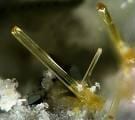 For instance, here’s a brief list of some current mineral fibres of concern:
Vermiculite (winchite/richerite): Much has been made of the disaster at Libby Montana and the amphibole mineral complex associated with vermiculite that originated there. Though the actinolite/tremolite series of amphiboles is commonly the mineral in question, the whole solid solution series of related hornblendes has contributed winchite and richerite to the dialogue.
For instance, here’s a brief list of some current mineral fibres of concern:
Vermiculite (winchite/richerite): Much has been made of the disaster at Libby Montana and the amphibole mineral complex associated with vermiculite that originated there. Though the actinolite/tremolite series of amphiboles is commonly the mineral in question, the whole solid solution series of related hornblendes has contributed winchite and richerite to the dialogue.
Where do these two mineral types stand? Is it from asbestiform growth habit? Fibrosity? Durability? Check, check, check. The biological damage was extensive enough that a new classification of ‘Libby Amphibole (LA)’ has been added to the metrics lexicon to incorporate these end-member minerals. Many laboratory professionals could differentiate these minerals from actinolite and tremolite by conventional means – but, often times an accurate characterisation was outside the grasp of many commercial labs. These are officially not regulated asbestos and there are implications for mischaracterisation.
With the recognition of the LA category, a comfort level was again established that allowed for labs to ‘call it like they see it’ under the guidelines of counting rules and identification parameters. Once again, labs could do their best and let other professionals (risk assessors etc.) deal with the repercussions of their data. Taconite: Headlines in public and academic circles have proclaimed a connection between this iron-rich silicate rock and mesothelioma. Recent research (2007) focusing on at least one large formation of this rock type in the Great Lakes region of the US that has shown iron-rich regulated asbestos minerals in close geologic association with the taconite deposits. These include ferroactinolite, grunerite (amosite), and ferrous rich serpentine mineral. Currently a US$5 million (R42 million) study through the University of Minnesota is being conducted with 2 000 participants to look at the issue. Could taconite be incorporated into a changing and more inclusive definition of asbestos? Or are there mineral and geological issues ancillary to taconite that are the cause for concern? Erionite: Erionite is known to be a human carcinogen and is listed by the International Agency for Research on Cancer as a Group 1 Carcinogen. Erionite has been linked to cases of mesothelioma in Cappadocia, Turkey. Zeolites are microporous aluminosilicates of which there are 176 recognised types. Erionite is a fibrous zeolite, and the Turkish occurrence exhibits extreme fibrosity and can be considered asbestiform. Occupational exposures were prevalent and resulted in many pleural and pericardium diagnosed cases of cancer. Most of the zeolite used in the US is in a very fine, granular, non-fibrous form. It is used extensively as a filtering and catalyst media. Fibrous erionite, a residue from volcanic ash, has also been the cause for health investigations in North Dakota and Arizona. Might this fibrous silicate be added to an expanded definition of asbestos or does the Elongated Mineral Particle definition capture this case? Fluoro-Edenite: The World Asbestos Conference was held in Taormina Sicily in October of 2009. The location was up the coast from Biancavilla, the village where off-the-chart rates of malignant pleural disease have been documented. These cases centered around the absence of industrial exposures to asbestos and the prevalence of volcanic quarry activity where the amphibole mineral was detected. Research continues to demonstrate the health significance of this fibrous mineral especially when compared to asbestos disease cohorts. Like Winchite and Richterite, will this amphibole be considered for any comprehensive list? Breaking ground Are the concerns of these minerals global? Though perhaps not ubiquitous, really anywhere with exposed outcroppings of fibrous silicates, especially volcanic dust may have the potential for health consequences. International health and safety organisations continue to research and discover that the realm of asbestos disease has expanded to include more than the regulated six target minerals! The four examples above cover three continents. Our lab fields calls and emails about these and other exotic fibrous minerals almost daily from around the world. As this is written, a call from Mexico about Erionite was received. IAQ / FAQ / NOA As an interested industrial hygienist or an indoor air quality professional what should you know about these issues? First off, be aware that these elongated mineral particles might be found in many locations – quarries, foundries, road or excavation sites, and in existing building products. There are a number of occupations that might have the potential for exposure – miners, construction workers, demolition contractors, etc. Notice in the examples listed previously that there is a propensity for exterior exposure (mines, quarries, etc.). Natural occurrences of asbestos (NOA) is a term employed by professionals in defining surface occurrences of asbestos. It seems that many asbestos professionals use NOA to mean naturally occurring asbestos. All minerals including asbestos are, of course, originating naturally in geologic formations – thus there is a redundancy with ‘naturally occurring’. Finally, assume nothing. That is, definitions of asbestos may still be in place by regulators, but to provide the highest level of due diligence, a more open-minded approach might be followed when you sample for airborne contaminants, request laboratory analysis, and interpret data for exposure or risk assessments. “The lab data did not detect any asbestos, but there are high concentrations of long thin silicate minerals.” Please consider the consequences of such observations. Final note Perhaps the next step is to be aware (and educated) of the EMP dialogue that is ongoing and become an advocate for expanded definitions of asbestos through local, national and international organisations that promote public health. About the author: Frank Ehrenfeld is the laboratory director for International Asbestos Testing Laboratories. He directs over 40 world-class scientists in environmental and materials investigations from the 12 000 square foot facilities in Mt. Laurel, New Jersey. In his spare time, he participates in his profession as a part of AIHA’s Technical Advisory Panel, Analytical Accreditation Board, and as vice chair of ASTM’s D22.07 Committee on Sampling and Analysis of Asbestos. You can contact Frank at www.iatl.com and at frankehrenfeld@iatl.com.