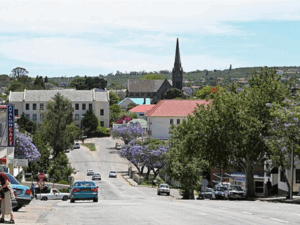
Roads, water supply, electricity supply and finances are in disarray.
It was six days into the 51st annual National Arts Festival (NAF) in July this year, and yet there were no lights to welcome visitors entering the small city of Makhanda (formerly Grahamstown) after sunset.
Only the occasional shop front cast patches of light along High Street between Rhodes University’s Drostdy Arch and the landmark Anglican Cathedral. It was not a temporary power outage, but a situation that would persist for the rest of the 11-day festival. Municipal reports indicate this was mostly due to cable theft. Historically, the main thoroughfares would be filled with buskers, traders, and festival-goers, but the dark streets were now almost deserted. A decade ago the festival attracted 225,000 people to watch more than 600 theatre shows. It’s now a fraction of that. (The municipality’s population is about 100,000.) Usually the Makana Local Municipality makes an effort to temporarily patch up its failures over the festival period. Not this year.Financial mismanagement
The municipality has received disclaimers of opinion from the Auditor General (AG) since the 2018/19 financial year. Prior to that, it had received qualified audits. A disclaimer of opinion is the worst finding the AG makes. It occurs when the municipality’s finances are so mismanaged that the AG cannot provide documents to support its financial statements and therefore the AG cannot form an opinion. After a crumbling reticulation system left residents and festival visitors without water for days on end in 2016, erstwhile festival CEO Tony Lankester publicly stated that the biggest threat to the festival’s continuation was not the paucity of arts funding, but the municipality itself. Under a majority ANC council for at least 25 years, the city has steadily and visibly deteriorated. (This reporter lived there in the 1990s and has visited the city at least once a year for more than 20 years.) Streets across the city are awash with potable water leaks and sewage overflows. Potholes are so prevalent that even some main streets are now little more than corrugated gravel. Water rationing and outages continue. Electricity outages are common. Municipal buildings are derelict from a lack of maintenance. The festival has now shrunk to 242 shows, according to NAF spokesperson Sascha Polkey. Polkey did not supply visitor numbers, but patrons were visibly thin on the ground this year. In 2013, the festival brought R349-million to the province (about R460-million today), including R90-million to the city’s coffers (about R159-million in today’s terms). Last year it brought in R132-million for the province, including R58-million for the city, according to a report by the South African Cultural Observatory.Off grid
 Residents have been experiencing water outages since at least 2012. Yet the municipality is still not able to ensure a continuous water supply to the whole town. This is despite supply dams being full.
The lack of a continuous and reliable water supply has forced large revenue-contributing institutions to seek independent supplies. This in the context of a municipality with a collection rate of less than 60%, according to opposition councillors.
Rhodes University, which has about 9,000 students at its Makhanda campus and is the single largest ratepayer, is moving to make itself independent of the municipality’s erratic water supply.
“A significant challenge facing the university is the unreliable water supply from the Makana municipality,” said deputy vice-chancellor Professor Mabokang Monnapula-Mapesela at an alumni event on 3 July.
“The university is progressing plans to establish its own water treatment facility to process water from its borehole system,” she said, calling on alumni to assist in funding the initiative.
The university communication office said it is also “exploring renewable energy solutions”.
Makhanda is home to three prestigious private schools. All have sought ways to provide a reliable water supply for their learners, staff and grounds.
Managers at the Diocesan School for Girls and Kingswood College said most of the water they now use comes from their own borehole and harvested rainwater. Only St. Andrew’s College still predominantly uses municipal water, relying on its own supplies during water outages.
Residents have been experiencing water outages since at least 2012. Yet the municipality is still not able to ensure a continuous water supply to the whole town. This is despite supply dams being full.
The lack of a continuous and reliable water supply has forced large revenue-contributing institutions to seek independent supplies. This in the context of a municipality with a collection rate of less than 60%, according to opposition councillors.
Rhodes University, which has about 9,000 students at its Makhanda campus and is the single largest ratepayer, is moving to make itself independent of the municipality’s erratic water supply.
“A significant challenge facing the university is the unreliable water supply from the Makana municipality,” said deputy vice-chancellor Professor Mabokang Monnapula-Mapesela at an alumni event on 3 July.
“The university is progressing plans to establish its own water treatment facility to process water from its borehole system,” she said, calling on alumni to assist in funding the initiative.
The university communication office said it is also “exploring renewable energy solutions”.
Makhanda is home to three prestigious private schools. All have sought ways to provide a reliable water supply for their learners, staff and grounds.
Managers at the Diocesan School for Girls and Kingswood College said most of the water they now use comes from their own borehole and harvested rainwater. Only St. Andrew’s College still predominantly uses municipal water, relying on its own supplies during water outages.
Dry taps in the suburb of Tyantji may have contributed to 75-year-old resident Thandisizwe Nondlwana dying when his house burned down last month. Neighbours said they couldn’t douse the flames as their taps were dry. Firefighters arrived too late. A senior firefighter told GroundUp, on condition he was not named, that the roads are so bad that it is difficult to get to an emergency in time.