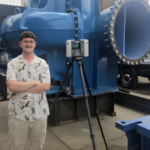
Keagan Morris, technical coordinator, APE Pumps
, one of South Africa’s oldest and most respected pump manufacturers, has quadrupled its turnover and increased its workforce by 56% in five years. This rapid growth is driven by continuous innovation, with 3D scanning being one of the key technologies the company already adopted in 2022.
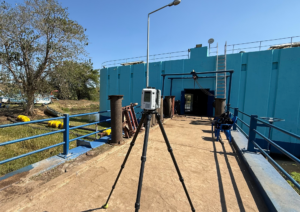
“3D scanning is a non-invasive method of capturing precise spatial data to create accurate digital models of physical environments, enabling detailed analysis, design, and visualisation of complex infrastructure. In the water sector, this is invaluable as an entire pump station or treatment plant can be recreated in vivid, three-dimensional detail – every bolt, flange and pipe is captured down to a 1.9 mm error tolerance over 10 m,” explains Keagan Morris, technical coordinator.
Advanced mobile 3D laser scanner
APE Pumps has invested in one of the most advanced mobile 3D laser scanners available in South Africa. Chosen for its accuracy, in-depth reporting abilities compact design, the 3D laser scanner provides accurate measurements and rapid data capture. Each scan takes roughly two minutes and reaches up to 2 million data and points captured per second.
The scanner’s visual inertial system (VIS) automatically tracks its position as it moves between setups, stitching each scan into a unified 3D environment. This eliminates manual alignment work, speeds up data capture, and ensures a seamless, highly accurate point cloud. A point cloud is a digital collection of millions of individual points in space, each representing an exact location on the surface of a real-world object or environment.
Advantages
Within this virtual space, APE’s engineers can conduct plant walk-throughs, tag equipment name plates, store maintenance records and generate complete as-built drawing packs for clients who no longer have original plans and records. The APE team uses the digital scan to overlay pump models and re-route piping, configure motors, or reposition bases – all virtually – before a single tool is lifted on site. With this information, clients can plan maintenance, replacements and upgrades with confidence.
“3D scanning enables us to work faster and with far greater precision. It speeds up design decisions, eliminates measurement errors, and dramatically improves retrofit planning,” says Morris.
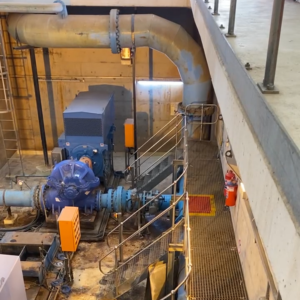
This 3D scanner was chosen for its
accuracy, in-depth reporting abilities
and compact design
He adds that adds that instead of sending a person to site to physically capture measurements – such as flange sizes, bolt patterns, base dimensions and wall clearances – engineers now retrieve that information directly from the scan. “Now, engineers simply open the point cloud and take accurate measurements within minutes. The same applies to projects beyond South Africa’s borders. After scanning multiple pump stations in Malawi, APE Pumps returned with every detail needed Remote work becomes possible because the entire plant exists digitally.”
By understanding access constraints, verifying measurement accuracy and simulating installations, the APE Pumps can prevent costly mistakes and plan refurbishments more effectively.
“CAD modelling and point cloud overlays revealed that a proposed vertical motor installation would collide with overhead structures, avoiding rework. There was also a situation where a scan revealed that site conditions were too muddy for a heavy truck to reach the pump floor, allowing APE Pumps to advise on logistics ahead of time,” states Morris.
As more utilities recognise the value of accurate digital data, scanning is rapidly becoming a standard line item in new contracts. Rand Water, uMngeni-uThukela Water, Eskom and several municipalities have already incorporated it into project specifications. For APE Pumps, the vision is clear: the future will include more scanners, more trained operators and increasingly sophisticated digital models.