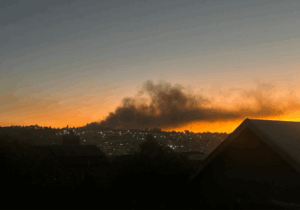
Every evening in Northern Johannesburg, fires can be seen rising from several illegal dumping sites across Kya Sands. By morning, suburbs stretching from Fourways, Broadacres, Bloubosrand, Northriding, Chartwell, and Cosmo City are shrouded in a haze of toxic smoke.
This has been going on for years, and what started as a decommissioning problem has transformed into an organised illegal industry that affects the health and safety of some 150 000 people.
The genesis of this crisis began when the Kya Sands Waste Disposal Site was decommissioned by Pikitup in 2010, having come to the end of its useful life.
According to the Kya Sand Burning Wasteland Community Forum, a residents’ forum that seeks to document and fight this ongoing crisis, the site was never properly closed nor rehabilitated. This lack of oversight set the stage for illegal operators to reopen the landfill; these “waste lords,” as the community has dubbed them, charge clients to dump waste, and they then burn what cannot be recycled or sold. The success of the initial illegal operation created an entire illegal waste ecosystem where operators are illegally using private, provincial, and city property for their commercial gain.
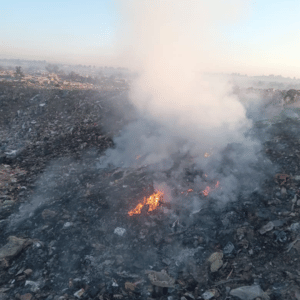
The fires spread underground and burn for days, an operation to stop one fire last two days
and covered 500 square meters
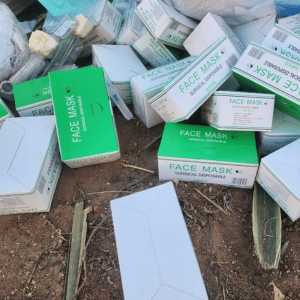
The operation mimics legal waste operations, where clients are charged to dump, but then recyclables and anything of value is separated and sold. The Forum has documented registered waste operators using these illegal facilities, including large tipping trucks and providers of rubble and garden refuse services. Where the illegal waste business differs from legal ones is that there are no waste classifications and properly engineered disposal sites. This means that hazardous waste, as well as organic waste, is being dumped onto unlined ground and set ablaze. These operations charge between R300 and R800 per load, making them attractive to unscrupulous businesses seeking to bypass more expensive legal landfills and save money. The Forum has documented medical waste being dumped; this is especially concerning given the hazardous nature of the waste and illustrates that ‘legitimate businesses’ are making use of the illegal dumps, as medical waste is highly regulated.
The actions of the community have helped; although difficult to track the Forum estimates that the sites are down to five from ten, this still means that a hundred or more trucks may still be dumping each day. The entire criminal enterprise is tightly controlled; the operations include marshals telling people where to dump, but this level of organisation has led residents being threatened at gunpoint for attempting to document the illegal activities. Landowners have also tried, in vain, to have by-laws enforced, but there is no help from the authorities. When one accounts for the leasing of plots in the adjacent informal settlements and illegal electrical connections, combined with illegal dumping and recycling, these schemes generate roughly R11 million a month. This renders opposition to the illegal dumping even more difficult, as the high profit incentivises the criminals to remain in control.
A public health and environmental crisis
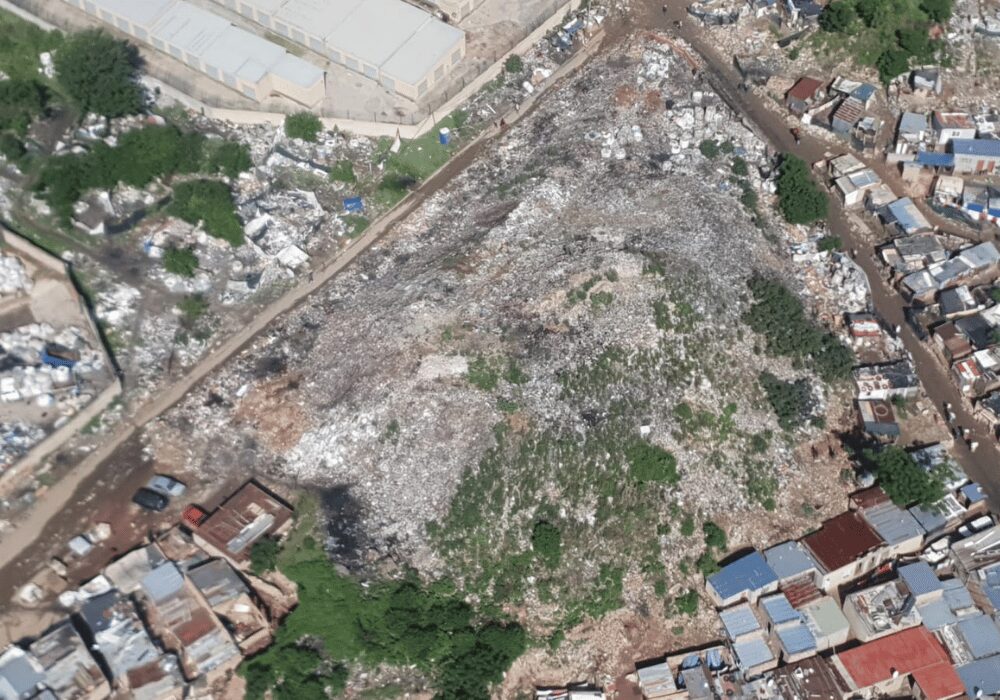
Aerial view of an illegal dumping operation in Kya Sands
The daily burns are more than “just illegal dumping,” and there are profound environmental and health concerns attached to this crisis.
The initial flames and smoke present air quality concerns. Globally, air pollution is linked to approximately 6.5 million deaths annually, and the increased air pollution in northern Johannesburg associated with these daily burns has the community worried. The community commissioned an air quality test in 2024, which confirmed the presence of benzene and other volatile organic compounds which were linked directly to illegal dumping. The community had a legal victory in August 2024 when the High Court ordered the City to conduct air quality testing. Although the April 2025 deadline was missed, these results have now been delivered.
The Kya Sands Community Forum’s legal team are interpreting the results, but they show evidence of potential non-compliance with South African air quality standards. Anecdotally, the community members report increased frequency and severity of conditions such as allergies, hay-fever, headaches, nausea, asthma, and other more severe respiratory illnesses, all coinciding with the uptick in daily burns. While long-term health impacts are difficult to estimate and “impossible to prove,” there is at least one community member with lung cancer. While the Forum indicates that the effects of this smoke do not differentiate between people, heavily polluted air affects the elderly and children at disproportionate rates and will only exacerbate pre-existing conditions.
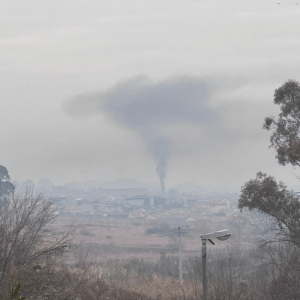
While the initial fires are visually distressing,
the smouldering is when the toxic chemicals are
released
The nature of the burns also means exacerbated health and environmental consequences. Once the initial flames have settled, the dumps smoulder overnight, still producing smoke; it is here that the waste releases its most dangerous toxic compounds, resulting from burning plastics, dry-walling, and tyres and many other materials. These burned materials release dioxins, which are persistent pollutants that the Forum notes “can accumulate in the food chain.” These dioxins are highly toxic and are associated with reproductive, developmental, and immune system damage. They also interfere with hormones and are known to cause cancer.
This health problem exists for residents in both the affluent and poorer areas that are affected by the fires. The Forum says that formal, informal, and commercial properties are all affected, and that stopping this crisis brings health and safety to everyone.
Additionally, there are water and soil health concerns around illegal dump sites. While the initial operation took place on an existing landfill, the illegal operations spread to private and public land not engineered for landfilling. The absence of liners and geosynthetics means that leachate is allowed to seep into the groundwater, and the Forum notes that one of these sites is on a wetland watercourse. The original landfill’s mass is now spilling over the lined space due to increased dumping.
There are also persistent underground fires. As smouldering waste is covered with new waste, the fires continue underneath the freshly dumped waste. This begets a cycle of dumping, burning, dumping, and burning. Effectively stopping these fires requires an earthmoving plant and manually spraying the burning waste with a firehose until the smouldering waste is completely soaked. The Forum explains that one of these exercises took two and a half days, where the fire had spread to 600 square metres.
What does success and failure look like?
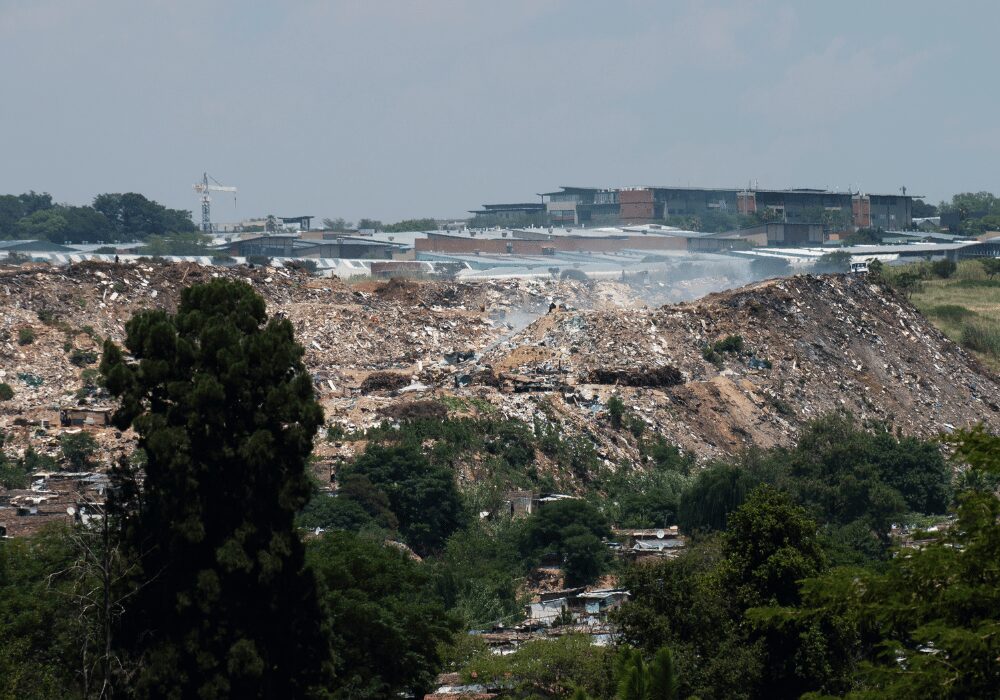
The original landfill site was never closed properly, the City of Johannesburg has awarded a tender for its rehabilitation but the community fears this is not enough
The Forum states that this crisis falls squarely on the government. All three tiers of government, local, provincial, and national, have failed the community, starting with the improper closure of the original landfill site.
The Forum has attempted to engage with government at all three levels, but none has offered strong solutions or outcomes that have changed things for the better.
For a period of eighteen months beginning in 2020, the Forum interacted frequently with Pikitup, the City of Johannesburg, the Gauteng Department of Agriculture and Rural Development, and the Johannesburg Metropolitan Police Department and SAPS. The Forum reports that all these organisations sent junior representatives with little or no authority to conduct site visits.
Their most significant engagement was with Pikitup, where the community forum engaged with them at an executive level, even managing to correspond with the CEO. Fifty emails in, nothing was done.
Finally, the Forum used the Chair of the Risk and Audit Committee of the Board for Pikitup to influence the Pikitup executive to recognise the problem. This led to a site visit in August 2021. Under the protection of JMPD and private security, the Chair of the Pikitup Board, the Chair of the Audit and Risk Committee, one other Non-Executive Director, the CEO, the COO, and several other executives of Pikitup met with the community to conduct a high-level joint site visit. Standing on top of the decommissioned but fully operational landfill, the executives claimed to be astonished by what they saw.
This visit led to a workshop hosted in January 2022, which saw more than forty civil servants representing Pikitup, the city, Green Scorpions, immigration, and the SAPS. After the workshop, a 32-page document titled “Integrated Kya Sands Environmental and Enforcement Strategy” was circulated, but this was as far as it went. No follow-through.
The last development was in 2025, when the City of Johannesburg awarded a tender of R150 million to rehabilitate the old Kya Sands Landfill. The Forum feels that this is a narrow scope that does not stop the continued and expanded illegal operations outside of the old landfill.
On a national level, despite formal correspondence, the community “has received no meaningful or substantive response or intervention from national environmental or health authorities.”
This has left the community to tackle the problem alone, a task that they are not equipped for without the help of government, who should be attending to the matter in the first place. The community is now receiving pro-bono legal services, which has enabled a comprehensive legal challenge, launched in the High Court in late 2025. The community has also started a non-profit, The Kya Sands Burning Wasteland Community Forum NPC, with a volunteer board of directors who hold themselves accountable to stakeholders.
The community also funded private security to establish four checkpoints, which reduced the illegal operations by 80%. This is an expensive endeavour, and the community has since exhausted its funds for the service, which is now suspended.
In the Forum’s words, success in court will be “a coordinated solution which brings national, provincial, and local resources to bear on the problem. We have set timelines for specific actions, but overall, we are demanding that within 120 days, the problem must have been assessed, stakeholders must have been consulted, and an action plan to stop all illegal activities must be devised and implemented. In addition, we are asking that the respondents be compelled to report progress to the Court periodically and that the Court retain supervisory jurisdiction over the matter.”
They also note that, “It also feels very short-sighted to be spending 150m rehabilitating a dump without providing new alternative dump sites. Urban planning and the existing landfills were for a city that no longer exists due to growth, and to make matters worse the City’s other existing dumpsites are about to exceed their capacity as well.”
For more information, please visit Kya Sands home page:
https://www.kya-sand-burning.com/

Duncan Nortier