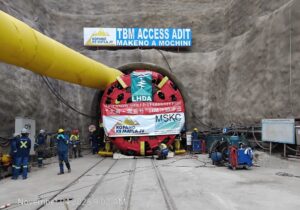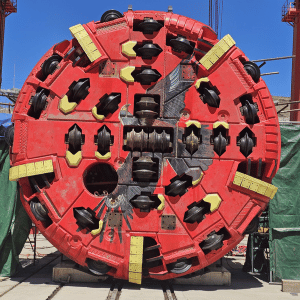
The cutter head of the tunnel boring machines (TBM) spans 5.38 metres
Construction on Phase II of the Lesotho Highlands Water Project (LHWP) marks significant progress on both core water infrastructure and supporting transport networks that will underpin long-term regional water security and economic development.
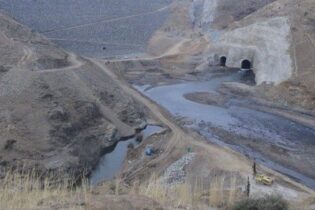
The Lesotho Highlands Development Authority (LHDA) has reached two major milestones on the Polihali Dam and Transfer Tunnel works. Excavation of the 38.5-kilometre Polihali Transfer Tunnel is now underway from both ends, with two massive tunnel boring machines (TBMs) advancing toward each other deep beneath mountainous terrain exceeding 3,000 metres in elevation. By early 2026, the Katse-side TBM had excavated over 600 metres, while the Polihali-side machine had progressed more than 230 metres since commencing operations earlier in the year. Once complete, the tunnel will channel water from the Polihali Reservoir to the Katse Reservoir, forming a critical link in the water transfer system supplying South Africa.
Each TBM is 423 metres long with a cutter head diameter of 5.38 metres. The tunnel will be concrete-lined throughout using precast segments installed as the TBM advances in the main sections, and in-situ concrete for the drill-and-blast sections. This hybrid approach TBM for the 34.5 kilometres of uniform alignment, drill-and-blast for the 8.2 kilometres of complex connection zones optimises both speed and cost-effectiveness.
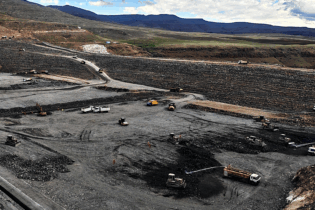
Progress on the Polihali Dam itself is equally notable. Over 7.7 million cubic metres of rockfill, more than half of the total embankment, has already been placed, with construction advancing steadily toward its final height of 165 metres. Once completed, the dam will be the largest concrete-faced rockfill dam in Africa, with a reservoir capacity of 2,325 million cubic metres, more than double that of the Mohale Dam from Phase I. Key structural components, including the intake tower base and spillway excavation, are nearing completion, with the project on track for commissioning in 2029.
Beyond engineering achievements, Phase II is delivering measurable socio-economic benefits. More than 2,600 people have been employed on the dam project alone, with over 90% drawn from local Basotho communities. Procurement has also driven regional economic participation, with over LSL 1.4 billion spent on Lesotho-based enterprises and an additional ZAR 1.38 billion flowing to South African businesses. Skills development remains a priority, with over 1,100 individuals trained across project sites.
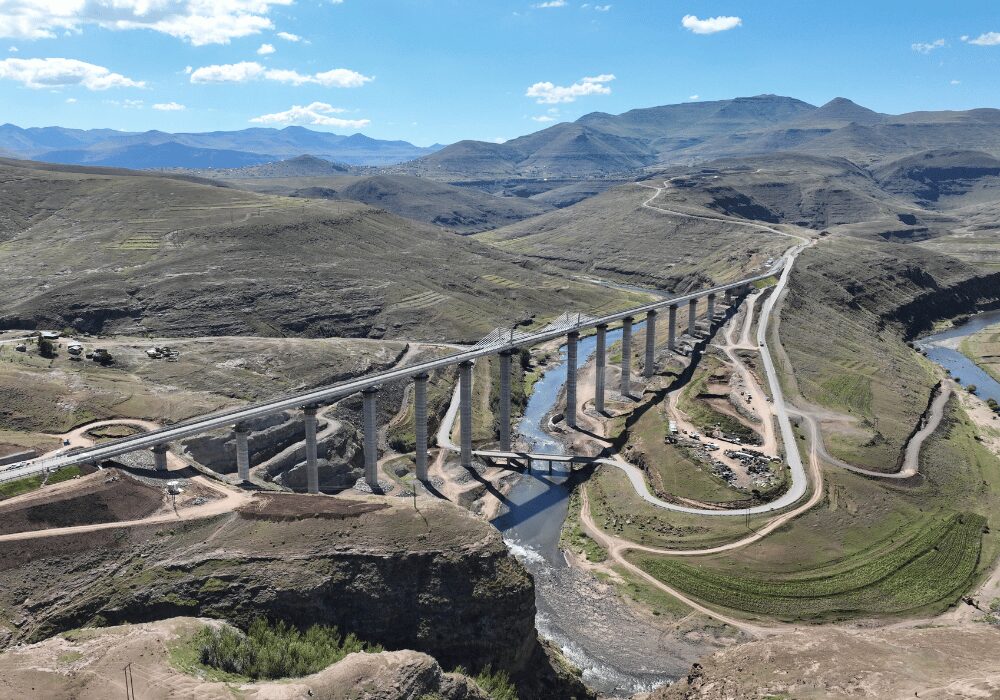
The Senqu bridge was constructed between 2023 and 2026
Complementing the water infrastructure, the newly completed Senqu Bridge represents an achievement in transport engineering and regional connectivity. Officially inaugurated by
Lesotho’s King Letsie III and President of South Africa Cyril Ramaphosa, the 825-metre structure is the longest bridge in Lesotho and the country’s first extradosed bridge, a hybrid design combining elements of box girder and cable-stayed systems. Spanning the Polihali Reservoir, the bridge ensures continued road access for communities in Mokhotlong as water levels rise.
Constructed between 2023 and early 2026, the bridge features 17 piers, many of which will be partially submerged once the reservoir reaches full capacity, and a longest span of 100 metres across the deepest section of the Senqu valley. Built using approximately 10,000 tonnes of steel and 40,000 cubic metres of concrete, the structure also incorporates an advanced monitoring system to track structural performance over its lifespan.
Zutari (formerly Aurecon Lesotho), with White Life Consultants (Lesotho) and Leporogo Specialist Engineers (South Africa), was responsible for the design and construction supervision of the Senqu Bridge. The bridge was constructed by the WRES Senqu Bridge Joint Venture comprising Webuild S.p.A. (Italy), Raubex Construction (South Africa), Enza Construction (South Africa) and Sigma Construction (Lesotho).
The Senqu Bridge project has delivered strong socio-economic outcomes, employing up to 1,200 workers at peak and meeting targets for local participation, including women and youth. The project also supported a broad network of regional contractors and suppliers, reinforcing the LHWP’s role as both an infrastructure and development catalyst.
As a bi-national initiative governed by a treaty between Lesotho and South Africa, the LHWP continues to demonstrate how large-scale infrastructure can deliver both strategic resource security and inclusive economic growth. With major components now taking shape, Phase II is steadily moving from construction toward long-term impact.