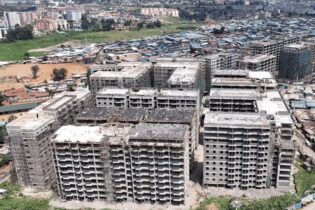
South Africa’s infrastructure cycle is starting to wake up.
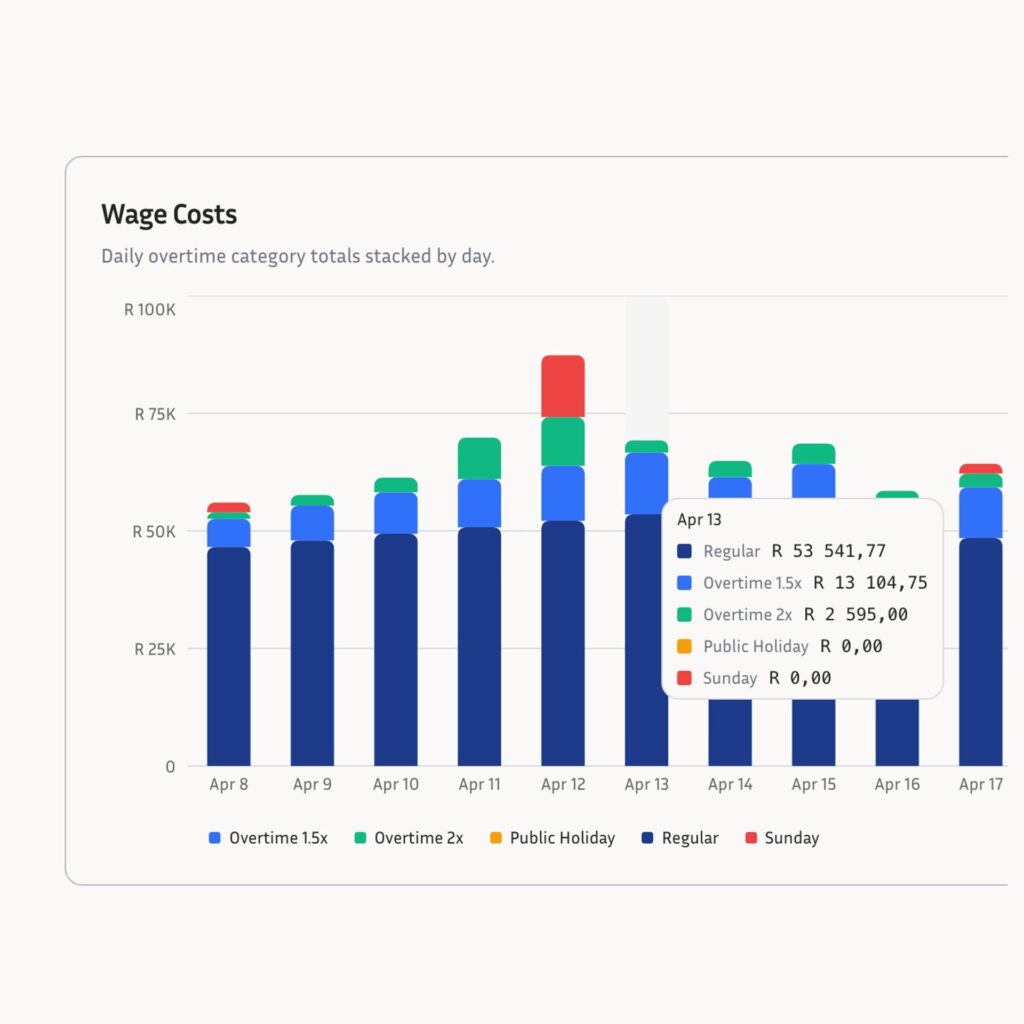
Road upgrades. Water projects. Energy infrastructure. Civil works. Billions of rands are beginning to move into the market after years of delay. For construction companies, the opportunity ahead is enormous. So is the pressure. Most conversations about the workforce crisis focus on skills shortages: Ageing artisans, weak technical training pipelines, and the shortage of experienced foremen. Those problems are real. But there is another issue sitting underneath them that construction companies continue to underestimate: operational visibility. Many contractors still cannot accurately answer three basic questions: Who is on site right now? How many labour hours have been worked today? What is today’s labour cost per project?In an industry where labour can account for up to half of total project cost, that is not a small operational gap. It is a financial risk.
The hidden cost sitting inside admin offices
 Walk into enough construction businesses and you start seeing the same pattern.
Paper registers arrive late on Friday afternoon. Someone in payroll captures hours manually from crumpled timesheets stained with dust, coffee, or rainwater from site. Handwriting is unclear. Overtime gets disputed. Site managers argue over missing entries. By Monday morning, payroll is still reconstructing who worked where three days earlier.
The scary part is how normal this has become.
Paper systems create lag everywhere. Attendance visibility lags. Payroll lags. Site-level labour cost tracking lags.
Then month-end arrives and margins are suddenly tighter than expected.
Most businesses only discover labour problems after the money has already been spent.
A site drifting 10% over labour budget in week three is recoverable. The same issue discovered during month-end reporting usually is not.
Walk into enough construction businesses and you start seeing the same pattern.
Paper registers arrive late on Friday afternoon. Someone in payroll captures hours manually from crumpled timesheets stained with dust, coffee, or rainwater from site. Handwriting is unclear. Overtime gets disputed. Site managers argue over missing entries. By Monday morning, payroll is still reconstructing who worked where three days earlier.
The scary part is how normal this has become.
Paper systems create lag everywhere. Attendance visibility lags. Payroll lags. Site-level labour cost tracking lags.
Then month-end arrives and margins are suddenly tighter than expected.
Most businesses only discover labour problems after the money has already been spent.
A site drifting 10% over labour budget in week three is recoverable. The same issue discovered during month-end reporting usually is not.
Time theft is still hiding in plain sight
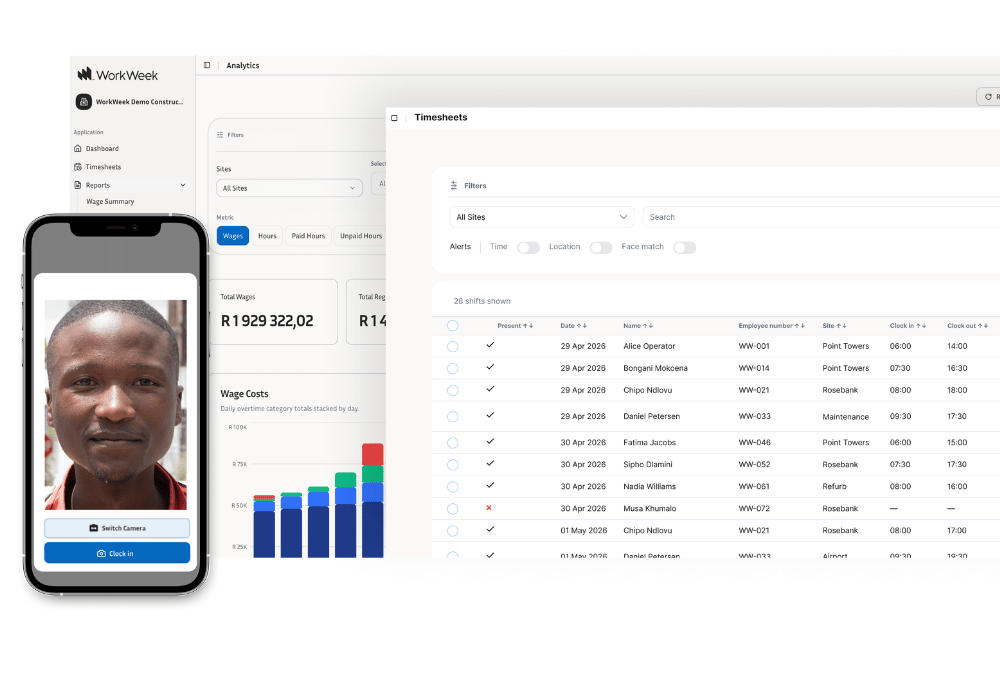
Construction companies also underestimate how much labour leakage weak attendance systems allow. If attendance relies on signatures in a site register, there is no reliable way to prove the person who signed in was actually the person who arrived. One worker signs for another and the cost disappears quietly into project overages where inefficiency usually hides. Over time, the leakage becomes cultural. Businesses stop questioning it because they stop seeing it. The contractors gaining control are operating differently. They are moving toward real-time workforce visibility. When clock-ins are digitally verified through selfies, timestamps, and location records, attendance stops being estimated and starts becoming verifiable. Project managers can see overtime building before it becomes a problem. Business owners can identify sites running above planned labour allocation while the project is still recoverable. A resourcing issue identified at 9am can still be corrected before lunch. The same issue discovered three weeks later becomes a margin problem nobody can reverse.
Compliance becomes dangerous when records are weak
South Africa’s Basic Conditions of Employment Act requires employers to maintain accurate records of hours worked, overtime, and leave. During a CCMA dispute or Department of Labour inspection, the burden of proof sits with the employer. That becomes difficult when the proof lives on paper. Registers disappear. Timesheets get amended after the fact. Hours become disputed months later when nobody remembers what actually happened. Supervisors leave. Employees leave. Suddenly payroll staff are trying to defend historical records built on handwriting and memory. Digital attendance systems strengthen that position immediately because every clock-in becomes timestamped, verified, and permanently stored automatically. No reconstruction. No chasing paperwork. Just a record.Construction sites do not operate in ideal conditions
 Many contractors delayed digitising workforce management because older systems were not designed for how construction actually operates in South Africa.
Connectivity drops. Sites move. Teams work remotely. Workers use different devices. Some employees have smartphones. Others do not.
Any workforce platform that depends on perfect internet connectivity fails quickly on a real construction site.
That is why offline capability matters.
A road project in Limpopo cannot stop tracking attendance because signal disappeared for three hours. A civils team outside Upington cannot rely on stable connectivity to maintain payroll integrity.
The systems gaining traction now are designed around South African operating conditions: offline-first, mobile-based, and capable of syncing attendance data automatically once connectivity returns.
The same applies to mobile data costs. Requiring workers to spend their own money simply to clock in creates friction immediately.
Construction companies need workforce systems that remove operational friction, not add to it.
Many contractors delayed digitising workforce management because older systems were not designed for how construction actually operates in South Africa.
Connectivity drops. Sites move. Teams work remotely. Workers use different devices. Some employees have smartphones. Others do not.
Any workforce platform that depends on perfect internet connectivity fails quickly on a real construction site.
That is why offline capability matters.
A road project in Limpopo cannot stop tracking attendance because signal disappeared for three hours. A civils team outside Upington cannot rely on stable connectivity to maintain payroll integrity.
The systems gaining traction now are designed around South African operating conditions: offline-first, mobile-based, and capable of syncing attendance data automatically once connectivity returns.
The same applies to mobile data costs. Requiring workers to spend their own money simply to clock in creates friction immediately.
Construction companies need workforce systems that remove operational friction, not add to it.
The operational floor has changed
The next decade of South African construction will reward companies that can control labour with precision while projects are running. That is the shift many contractors still have not fully absorbed. The competitive advantage is no longer just machinery, pricing, or headcount. Increasingly, it is operational visibility: knowing what is happening across your workforce while it is happening. Workers notice weak systems quickly. They know when absenteeism goes unchecked and overtime is inconsistently tracked. Over time, that erosion of accountability damages morale and retention alike. Paper timesheets belonged to a slower construction industry. The environment ahead will be less forgiving.
Because when labour is your largest controllable cost, running projects without real-time workforce visibility stops being an inconvenience.
It becomes a financial risk.
Expert insights by Niven Poleman, CEO of WorkWeek
Paper timesheets belonged to a slower construction industry. The environment ahead will be less forgiving.
Because when labour is your largest controllable cost, running projects without real-time workforce visibility stops being an inconvenience.
It becomes a financial risk.
Expert insights by Niven Poleman, CEO of WorkWeek