South Africa has long been home to some of the continent’s most remarkable landscapes – sweeping grasslands that sustain millions of livestock, underpin rural livelihoods and quietly store vast quantities of terrestrial carbon, making them vital to mitigating climate change.
These same grasslands have now become the stage for a global milestone that is drawing attention from carbon markets, conservation circles and rural development practitioners across the world while its farming communities reap the tangible rewards. Earlier this year, TASC’s Grassland Restoration and Stewardship in South Africa (GRASS) issued Verified Carbon Units (VCUs) on behalf of farming communities working with Meat Naturally Africa, becoming the first project anywhere in the world to carry both the Climate, Community and Biodiversity (CCB) label and the VM0042 methodology under Verra’s Voluntary Carbon Standard. Those credits have now been sold, and R2,7 million worth of proceeds are being deposited directly into community sub-accounts this month – a tangible and immediate reward for the farmers and land stewards who made it possible. These carbon revenues are channelled through a non-profit structure designed to ensure income flows directly to participating communities. For many households, this income stream has provided a buffer against increasingly unpredictable seasons. A farmer who earns from both livestock sales and has their livestock management costs covered through carbon stewardship collective revenues has greater resilience than one dependent on a single, weather-sensitive source of income. However, what distinguishes this model from conventional carbon projects, goes well beyond the initial payout. The GRASS project is structured around a multi-generational vision: participating communities enter into partnerships that run for 30 years and are renewable for up to 100 years – a timeframe that reflects not just the pace of ecological recovery but a genuine long-term investment in community futures. The benefit share arrangement is equally distinctive. Most carbon projects operate on a flat revenue share – typically 50% or less of carbon credit income flows to communities, with the remainder retained by the project developer. The GRASS model takes a different approach. Rather than a fixed split, it uses a dynamic revenue share that starts at 10% in the early years – when TASC, as investor, is recovering the significant upfront costs of establishing the programme – and rises progressively thereafter. Over the first 10 years, more than 50% of the cumulative net revenue from carbon sales goes directly to communities. This proportion only increases each subsequent year, reaching 80% by year 20. Critically, this revenue share represents only part of the community benefit picture. Ruan de Wet, Technical Director of Meat Naturally Africa, explains why this distinction matters: “The revenue share from carbon credit sales is only one part of what communities receive. The bigger philosophical shift is that the investment itself – the budgets for EcoRanger salaries, fire management, veterinary support, equipment – flows directly to communities rather than to an external organisation.”“Communities are deciding who to employ, how to run their associations, how to invest in their own land. When you factor that in alongside the revenue share, the total benefit flowing to communities is substantially higher than the headline percentage suggests.”This represents a fundamental departure from an often paternalistic model that has historically characterised conservation finance in Africa, where external developers retain control of resources and communities remain passive beneficiaries. Here, the investment is placed at community level from the outset. “If you look at our average revenue share over the first 10 years, it already exceeds 54%,” De Wet notes, “which is above what most comparable projects deliver. And every year after year 10, that share continues to grow. But the point we really want people to understand is that it’s not just revenue – it’s the entire structure of where the investment goes. The resources, the capacity-building, the operational funding – all of that is being built inside the community, not inside an external organisation.” The farmer associations budget their own expenses – professional herder salaries, firebreak construction, livestock health treatments – from their carbon finance, with Meat Naturally Africa administering payments. This arrangement allows farmers to direct all funding toward the development of their own land and livestock management, while removing the logistical and social challenges of financial administration in deep rural areas. When revenues exceed expenses for implementing improved management, communities can decide to deploy funds for other community needs. Communities that exit the programme due to not meeting requirements for carbon sequestration are allowed to rejoin, but restart at year-one revenue rates, underscoring the importance of sustained participation to realise the full financial benefit over this multi-generational horizon.

It is a world first that would not have come to fruition without the boots-on-the-ground work of Meat Naturally Africa, whose decade-long partnership with communal livestock farmers formed the human backbone of the entire project. Founded in 2016 as a farmer-owned social enterprise, Meat Naturally Africa was built on a straightforward premise: if you want communal farmers to manage land differently, give them a compelling economic reason to do so. The organisation operates as a cooperative-style structure, with a non-profit umbrella company supporting for-profit businesses that funnel income back to farmer collectives.
The landmark carbon achievement came with the issuance of 249 094 Verified Carbon Units (VCUs) from the project’s first monitoring period, covering more than 95 000 hectares. What made this issuance extraordinary was its dual certification: the credits were issued under Verra’s VM0042 methodology – the first to be registered globally under this standard – and simultaneously awarded the CCB label, which independently verifies that a project delivers measurable climate benefits alongside genuine community and biodiversity outcomes. No project had ever achieved this combination before.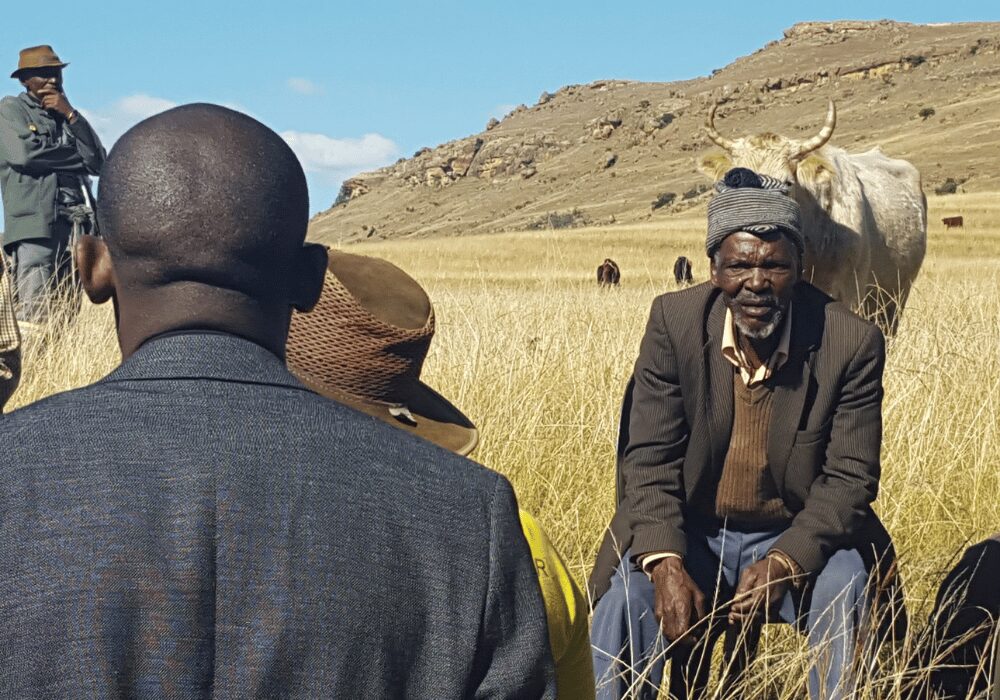 The CCB label under VM0042 is not a symbolic distinction. It requires documented evidence that carbon mitigation is matched by real gains for the communities living on and managing the land, and that biodiversity is being preserved or enhanced alongside carbon sequestration. For buyers increasingly scrutinised over the quality of their carbon claims, it provides a level of assurance that few credits can match.
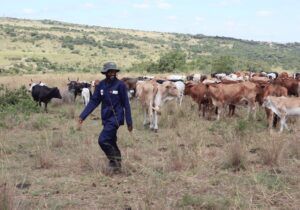
The first monitoring period has launched a story of scale and substance. While the initial credits generated R2,7 million for 15 communities, Meat Naturally and its partners are now working across 180 communities involving nearly 10 000 communal farmers managing their land and livestock in ways that resulted in the initial credits. Over 100 people are employed in ecological monitoring, grazing support and fire management roles – formal jobs in areas where formal employment is scarce. Across the project’s communal rangelands, approximately 600 herders are now being upskilled into long-term livestock management roles, with close to a third held by women.
The carbon project’s success carries weight that extends well beyond the Eastern Cape or KwaZulu-Natal where it was introduced.
Sarah Frazee, founder and CEO of Meat Naturally Africa, describes the shift in terms of who holds the reins: “What we have built is a proof of concept for conservation finance where the people managing Africa’s most threatened landscapes are in the driver’s seat, not an afterthought. The relationship between developer and community has to change – from paternalistic and external to genuinely partnership-based, with real local ownership and multi-generational investment flowing into communities rather than into the overheads of an outside organisation.”
De Wet agrees, and sees the model’s replicability as one of its most significant contributions:
The CCB label under VM0042 is not a symbolic distinction. It requires documented evidence that carbon mitigation is matched by real gains for the communities living on and managing the land, and that biodiversity is being preserved or enhanced alongside carbon sequestration. For buyers increasingly scrutinised over the quality of their carbon claims, it provides a level of assurance that few credits can match.
The first monitoring period has launched a story of scale and substance. While the initial credits generated R2,7 million for 15 communities, Meat Naturally and its partners are now working across 180 communities involving nearly 10 000 communal farmers managing their land and livestock in ways that resulted in the initial credits. Over 100 people are employed in ecological monitoring, grazing support and fire management roles – formal jobs in areas where formal employment is scarce. Across the project’s communal rangelands, approximately 600 herders are now being upskilled into long-term livestock management roles, with close to a third held by women.
The carbon project’s success carries weight that extends well beyond the Eastern Cape or KwaZulu-Natal where it was introduced.
Sarah Frazee, founder and CEO of Meat Naturally Africa, describes the shift in terms of who holds the reins: “What we have built is a proof of concept for conservation finance where the people managing Africa’s most threatened landscapes are in the driver’s seat, not an afterthought. The relationship between developer and community has to change – from paternalistic and external to genuinely partnership-based, with real local ownership and multi-generational investment flowing into communities rather than into the overheads of an outside organisation.”
De Wet agrees, and sees the model’s replicability as one of its most significant contributions:
“It demonstrates that community-managed land, with the right partnership structure, can meet the most rigorous global standards available.”“It shows that nature-based carbon finance does not have to choose between environmental integrity and social impact – and that when you design the financial model correctly, the community isn’t just a beneficiary, it’s the engine of the whole system.” TASC’s ambitions for the GRASS project are substantial: scaling to two million hectares by 2030, sequestering or avoiding close to two million tonnes of carbon dioxide equivalent annually and targeting 14 million tonnes of mitigation over the project’s first 30 years – with communities as long-term stewards of every hectare.