With global demand for new energy sources exceeding 1000 GW by 2030, mines, industrial operators and data centres face growing pressure to secure reliable, always-on power. To address this, USP&E and BAM Energy have launched Bridge Power Nuclear, a new joint venture designed to help large energy users bridge the gap between today’s urgent power needs and tomorrow’s lower-carbon baseload requirements.
The launch comes at a time when reliable, affordable electricity is becoming one of the defining constraints on African industrial growth. According to the World Bank Enterprise Surveys, 73% of firms in Sub-Saharan Africa experienced electrical outages in 2025. At the same time, global demand for data infrastructure has exploded in the past 12 months. The International Energy Agency projects that global electricity consumption from data centres will more than double to around 945 TWh by 2030, driven largely by AI and digital infrastructure growth. BridgePower Nuclear has been established to respond to this dual challenge: the immediate need for dispatchable, bankable power and the longer-term need for cleaner, lower-carbon baseload generation. According to BridgePower Nuclear, the company’s model combines a near-term fuel-flexible thermal power block with a future small modular reactor pathway on the same site, under one operator and one power purchase agreement. The thermal phase is designed to be deployed within 12 to 24 months, using gas, diesel, HFO or dual-fuel generation depending on site requirements. From 2029, BridgePower Nuclear plans to phase in Pearl SMR modules, subject to customer agreements, site selection, regulatory approvals and project financing. The company says this would allow customers to transition from thermal generation to modular nuclear power without replacing the entire site, renegotiating the commercial structure or leaving critical operations exposed to power interruptions. Will Gruver, Chairman and Founder of USP&E, says the venture is designed around the practical realities facing African industry.“African mines, industrials and data centre operators do not have the luxury of waiting for perfect grid conditions. They need firm power now, but they also need a credible pathway to lower-carbon baseload power before regulation, customers and capital markets force that transition for them. BridgePower Nuclear is designed to do both: deliver power today and create the bridge to modular nuclear power tomorrow.”Small modular reactors, or SMRs, are nuclear reactors generally designed to produce up to 300 MWe of electricity, using modular factory fabrication to support shorter construction timelines and more flexible deployment than conventional large-scale nuclear projects. The International Atomic Energy Agency has identified SMRs as an option for flexible power generation across a wider range of users and applications, while the World Nuclear Association’s SMR Design Database tracks multiple SMR designs at various stages of development globally. BridgePower Nuclear’s proposed technology platform is the Pearl reactor, developed by BAM Energy. According to BAM Energy, Pearl has been designed to address three of the major barriers that have delayed many SMR programmes: dependence on enriched or HALEU fuel, reliance on heavy forgings, and complex on-site construction. The company says the Pearl reactor is designed to be factory-built and transported by road, and uses a closed Brayton-cycle air turbine with zero water consumption for the power conversion cycle. Dr. Leon Malan, ThermoFluids and Numerics Engineer at BridgePower Nuclear, says this water profile is central to the African use case. “Many of Africa’s most power-constrained industrial and mining regions are also water-constrained. A reactor architecture that removes water consumption from the power conversion cycle changes the siting conversation. It means modular nuclear power can be considered in regions where conventional water-cooled generation would be far harder to justify.”

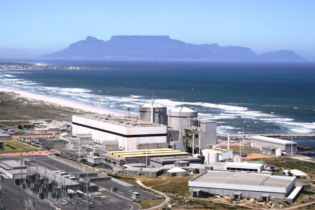
The technology also draws on South Africa’s historic leadership in pebble-bed modular reactor development. South Africa’s Pebble Bed Modular Reactor programme, developed through Eskom, positioned the country as an early participant in global modular nuclear design before the programme was discontinued following the 2008 financial crisis. BridgePower Nuclear says BAM Energy’s Pearl reactor builds on that pebble-bed lineage through two decades of development work linked to the High Temperature Test Unit programme.
“South Africa helped shape the original thinking around modular nuclear,” says Dr. Malan. “BridgePower Nuclear is about bringing that engineering lineage back to the African continent, but in a commercially practical model that starts with the power needs customers have today.”USP&E brings more than two decades of African frontier power delivery experience to the venture. Founded in 2002, the company has delivered more than 30 power stations across more than 45 countries, serving mining, oil and gas, industrial, utility and data centre clients in challenging operating environments. The company says its SmartPower predictive analytics platform has delivered a 26% reduction in downtime across monitored sites, while its operational track record includes ISO 9001:2015 and ISO 45001:2018 certification. According to BridgePower Nuclear, BAM Energy contributes the modular nuclear pathway, the Pearl reactor platform and two decades of pebble-bed SMR development, and are targeting first Pearl module deployment from 2029, subject to customer agreements, site selection, regulatory approvals and project financing. The venture has been structured around sectors where the need for reliable power is immediate and commercially material. Mining operations are increasingly constrained by power availability, while data centres require uninterrupted, high-quality electricity at industrial scale. According to the Africa Data Centres Association’s Data Centres in Africa 2026 report, power availability has overtaken connectivity as the principal constraint for Africa’s data centre sector, with operators increasingly adopting long-term PPAs and energy-led siting models. Gruver says this makes mines, data centres and industrial operators the natural first customers for the BridgePower Nuclear model. “These are not speculative power users. These are large, energy-intensive operators whose output, revenue and growth are directly tied to reliable and affordable electricity. They already understand the cost of downtime. What they need now is a bankable power pathway that does not strand capital as the energy transition accelerates.” BridgePower Nuclear says its model is designed to make the transition financeable by placing thermal and nuclear phases under one continuous commercial structure. This is intended to give lenders and customers a single long-term asset pathway: immediate dispatchable generation first, followed by phased modular nuclear deployment once regulatory, technical and commercial milestones are met. “This is not nuclear as a distant policy aspiration,” says Gruver. “It is a power infrastructure model built around what Africa’s industrial economy needs now: reliability, speed, financeability and a credible path to clean baseload power.” Senior leaders from USP&E and BAM Energy will present the BridgePower Nuclear venture publicly for the first time at the Africa Energy Forum (AEF) 2026, taking place in Cape Town from 16 – 19 June 2026. Widely regarded as the continent’s foremost gathering for energy investment and project development, AEF brings together ministers, utilities, miners, developers and financiers from across Africa and the global energy sector. The BridgePower Nuclear showcase is expected to be the only agenda item at this year’s Forum addressing nuclear power as a near-term commercial pathway for Africa’s industrial economy – a reflection of how nascent, and how significant, the BridgePower Nuclear proposition is at this moment in the continent’s energy transition. For more information on BridgePower Nuclear please visit www.powernuclear.com