Vis Reddy, chairman of SRK Consulting
Rooted locally, sprouting globally
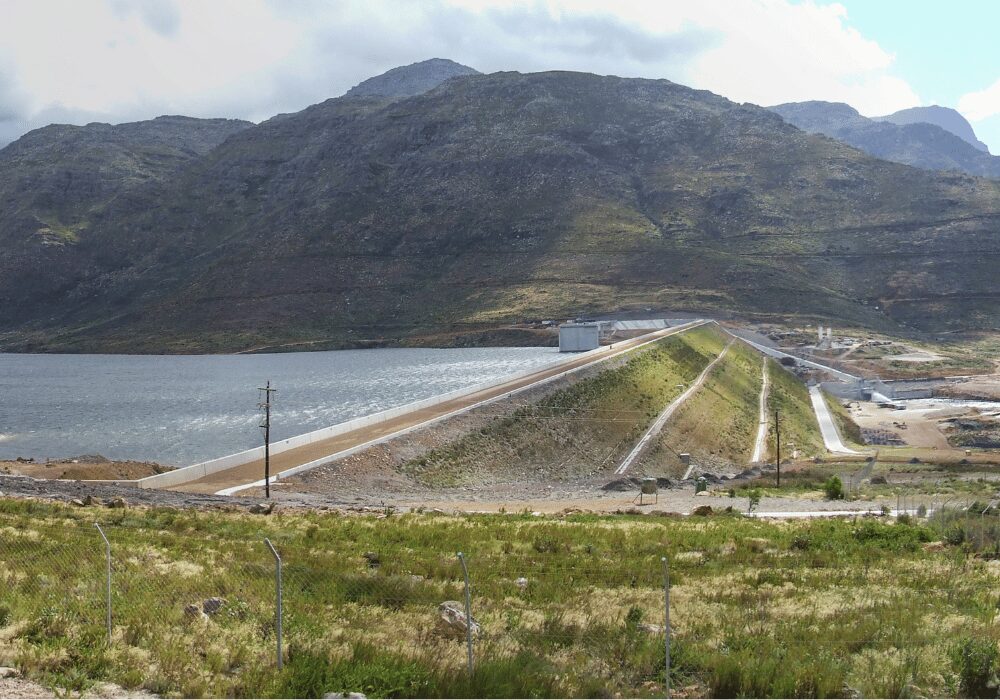
In the late 1970s SRK began to involve itself with tailings dams for mining companies. “Tailings might not seem like infrastructure, but there’s a lot of engineering that goes into them. They are repositories for waste materials, and they require extensive engineering for diversion, containment, recovery and protection of surrounding environments, all under long-term operational and closure scenarios,” explains Reddy. The company increasingly developed ancillary services linked to mine development and operations. This included water management, environmental, infrastructure engineering and groundwater studies. In the early days, SRK Consulting also worked alongside the South African government – building roads, upgrading industrial sites, conducting geotechnical studies, and water reticulation. “Some the landmark projects included work for the Lesotho Highlands Water Project Phase 1 and the Berg River Dam, Ceres Dam and Hex River Tunnel projects in the Western Cape and various Rand Water projects,” adds Reddy. SRK Consulting’s first office outside Africa was established in Vancouver, Canada in 1978, followed by an office in the United Kingdom in 1982. Over the following years, the company opened offices in Australia, with additional offices on the South American and the Asian continent. Much of this growth was driven by South African engineers relocating overseas, taking with them hard-won experience from deep-level mining, large dam engineering and complex infrastructure environments. This is particularly true of SRK’s North American operations, which grew through the boom and bust cycles of the 2000s, and is one of the largest SRK practices by revenue. Today, SRK Consulting’s expertise has been further extended into environmental, social and governance work, where processes such as stakeholder consultation and environmental management planning, now standard components of environmental impact assessments, were shaped by South African legislation.Employee owned
An interesting aspect of SRK Consulting is that it is employee owned.This model, Reddy notes, “was designed from an early stage as a way to both attract and retain talent by giving staff a genuine stake in the business.”While many companies offer profit-sharing through bonuses, these structures rarely translate into true ownership and are often weighted in favour of founders or long-serving executives. SRK instead has opted for a broad-based shareholding model, where ownership is distributed across the company, with different levels reflecting seniority and contribution. As employees progress, their shareholding grows, allowing them to benefit not only from annual dividends but also from increases in share value, effectively creating a long-term financial incentive akin to a retirement investment. Beyond the financial benefits, the model fosters a strong sense of accountability, commitment and self-development, with employees viewing the business as their own and therefore striving to contribute meaningfully to its success.

Reddy says that while the concept may take time for new employees to fully appreciate, it becomes a powerful retention tool once understood. The structure also addresses succession challenges that have affected many legacy firms, where ownership remained concentrated and ultimately led to external acquisitions. In contrast, SRK ensures continuity by requiring departing shareholders to sell their shares back into the company, making them available to the next generation of employees. This rolling system, combined with consistently high demand for shares, has proven both sustainable and attractive. Ultimately, the model supports an entrepreneurial culture, where individuals operate with a degree of autonomy within a structured framework, balancing independence with the support of a larger organisation.
“The key to our growth lies in our people, that expertise drives our success,” states Reddy. He links South Africa’s engineering prowess to the strong engineering education that has historically produced high-quality graduates. He adds, “Beyond that, South Africa’s challenges have forced innovation. We’ve had to design and build infrastructure in complex conditions, which has allowed engineers to develop unique solutions. South Africa has some of the deepest mines in the world. When you place South African engineers in other environments, they adapt quickly and perform well.”Operating across borders
 Operating across multiple jurisdictions has required SRK Consulting to balance global technical standards with local realities, adapting its approach to different regulatory, environmental and social contexts. SRK’s approach emphasises compliance with local laws, respect for regional context and ethical consistency – particularly in environments where regulatory frameworks may still be developing.
“Our ethos is to ‘do the right thing’, so we place a strong emphasis on complying with local laws and regulations. You can’t impose a South African way of doing things elsewhere. At the same time, our commitment to technical excellence remains consistent regardless of location. By combining global expertise with local knowledge, and by establishing offices in different regions, we are able to adapt to local conditions while maintaining the same high standards across the business. This is particularly important in water, environmental and social-impact projects, where infrastructure decisions intersect directly with communities, ecosystems and governance. Ultimately, we want clients to experience SRK as one integrated company, wherever they engage with us,” elaborates Reddy.
Working across so many differing locations is a challenge in itself; aside from legality and compliance, the biggest challenge is cultural differences while working in remote areas, as mines are rarely near large cities and often operate in difficult environments. This is also why SRK opens offices in many parts of the world, as local knowledge strengthens its capability. In these conditions, a consultant’s ability to handle what is thrown at them becomes a huge advantage. “It is a priority, but difficult to attract suitably qualified people in certain parts of the world,” maintains Reddy.
In many African jurisdictions, SRK teams work in environments with limited access to laboratories, contractors or specialist equipment, often requiring samples to be sent across borders and logistics carefully planned. Security, political instability and remote site access are additional realities that shape project execution.
Operating across multiple jurisdictions has required SRK Consulting to balance global technical standards with local realities, adapting its approach to different regulatory, environmental and social contexts. SRK’s approach emphasises compliance with local laws, respect for regional context and ethical consistency – particularly in environments where regulatory frameworks may still be developing.
“Our ethos is to ‘do the right thing’, so we place a strong emphasis on complying with local laws and regulations. You can’t impose a South African way of doing things elsewhere. At the same time, our commitment to technical excellence remains consistent regardless of location. By combining global expertise with local knowledge, and by establishing offices in different regions, we are able to adapt to local conditions while maintaining the same high standards across the business. This is particularly important in water, environmental and social-impact projects, where infrastructure decisions intersect directly with communities, ecosystems and governance. Ultimately, we want clients to experience SRK as one integrated company, wherever they engage with us,” elaborates Reddy.
Working across so many differing locations is a challenge in itself; aside from legality and compliance, the biggest challenge is cultural differences while working in remote areas, as mines are rarely near large cities and often operate in difficult environments. This is also why SRK opens offices in many parts of the world, as local knowledge strengthens its capability. In these conditions, a consultant’s ability to handle what is thrown at them becomes a huge advantage. “It is a priority, but difficult to attract suitably qualified people in certain parts of the world,” maintains Reddy.
In many African jurisdictions, SRK teams work in environments with limited access to laboratories, contractors or specialist equipment, often requiring samples to be sent across borders and logistics carefully planned. Security, political instability and remote site access are additional realities that shape project execution.
Looking ahead
Commenting on changes within the consulting engineering industry, Reddy notes that a few decades ago many parastatals, municipalities and private companies maintained large in-house engineering teams responsible for planning, design, operations and long-term infrastructure management. Over time, however, many of these organisations reduced their internal technical capacity due to financial pressures, restructuring and shifting business models, resulting in a greater reliance on outsourcing engineers for specialist expertise, project development and infrastructure delivery. According to Reddy, this has resulted in consulting engineers adopting an added role.“In the past, engineers were often engaging directly with other technical professionals who understood the engineering processes and long-term infrastructure requirements. Today, engineers frequently need to justify and communicate the value of maintenance, upgrades and infrastructure investment to decision-makers who may not have a technical background. This requires engineers to play a far more strategic and advisory role than before.”He adds, that when looking at the mining sector, many of the decision makers no longer reside in Johannesburg or even South Africa, but in other countries. “This is the advantage of having practises in other parts of the world.” While firmly rooted in South Africa, Reddy says, “Most of our growth will come from outside South Africa, particularly in Africa. Many countries are looking to increase the contribution of mining to their economies, and that creates opportunities across the full mining lifecycle. There’s also strong demand linked to new energy minerals like lithium, copper and cobalt, as well as ongoing opportunities in precious metals e.g. gold and platinum. We see ourselves playing a key role in supporting both emerging and established mining jurisdictions.”