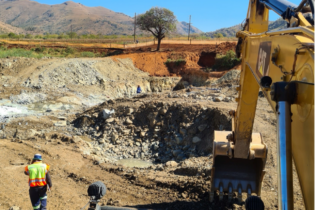

Recent floods in Mpumalanga have not created a crisis in the province’s road network, they have exposed systemic weaknesses that have developed over many years. Across the province’s secondary road network, the combined effects of ageing infrastructure, changing freight demands and increasingly intense rainfall are now visible as widespread failures. As consulting engineers who design and maintain both water and road assets across the province, we are seeing clear evidence that this network is no longer aligned with the realities it is expected to serve.
We see this challenge as an opportunity to build a more resilient, future-ready network that will serve our communities, farmers and tourism sector for generations to come.What We Are Seeing
During heavy summer downpours, runoff volumes and flow velocities have increased beyond the capacities older drainage systems were designed to carry. Floods routinely wash away pavement edges, scour subgrade materials and create sinkholes. These problems are further compounded on our local roads, as they were not engineered for repeated heavy vehicle traffic. This problem is two-fold, with the increasing number of activities in chrome, coal and magnetite mining in the province, as well as the continued failure of the rail networks that were meant to carry these loads. These recurring failures are not isolated incidents; they point to deeper structural and planning shortcomings.Technical Diagnosis
The root causes are multi-layered:- Many secondary roads were designed for light rural traffic and lack the structural capacity for sustained heavy haulage.
- Cross-drainage infrastructure is often undersized or degraded, reducing flow capacity and increasing scour risk.
- Inadequate drainage weakens subgrades, leading to loss of support and cracking.
- Preventive maintenance is underfunded, resulting in reactive patching rather than planned rehabilitation.
Technical Solutions That Work
We recommend a two-track response, which includes emergency stabilisation to restore access and a structured rehabilitation programme to rebuild resilience.
Consider, for example, how the deployment of rapid assessment teams to triage priority links using quick-condition surveys and geotechnical spot checks can change how the reoperation of roads are approached. Temporary reinstatements can be made using well-compacted granular overlays and geotextile separation, while the implementation of tactical traffic management to limit heavy axle loads on vulnerable routes can further support the proper rehabilitation of our province’s roads.
This would require pavement upgrades designed for realistic projections of loads, with increased base thickness and improved drainage layers; reconstructed cross-drainage sized to revised hydraulic models accounting for higher-intensity rainfall events and the adoption of asset management systems with condition-based prioritisation and lifecycle-costing.