
John Montgomery and Mirna Liesering explain how APE Pumps and Mather+Platt are developing South Africa’s next generation of engineers and artisans.
South Africa’s infrastructure ambitions depend on far more than new equipment. They require a new generation of artisans, technicians and engineers. Kirsten Kelly speaks to APE Pumps and Mather+Platt’s John Montgomery and Mirna Liesering about apprenticeships, knowledge transfer and why developing people has become one of the company’s biggest investments.
Over the years, APE Pumps and Mather+Platt (the group) have ensured their success through succession planning. What, in your opinion is the best possible hire?
John Montgomery, general manager, APE Pumps and Mather + Platt
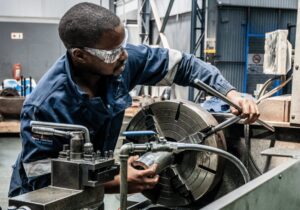
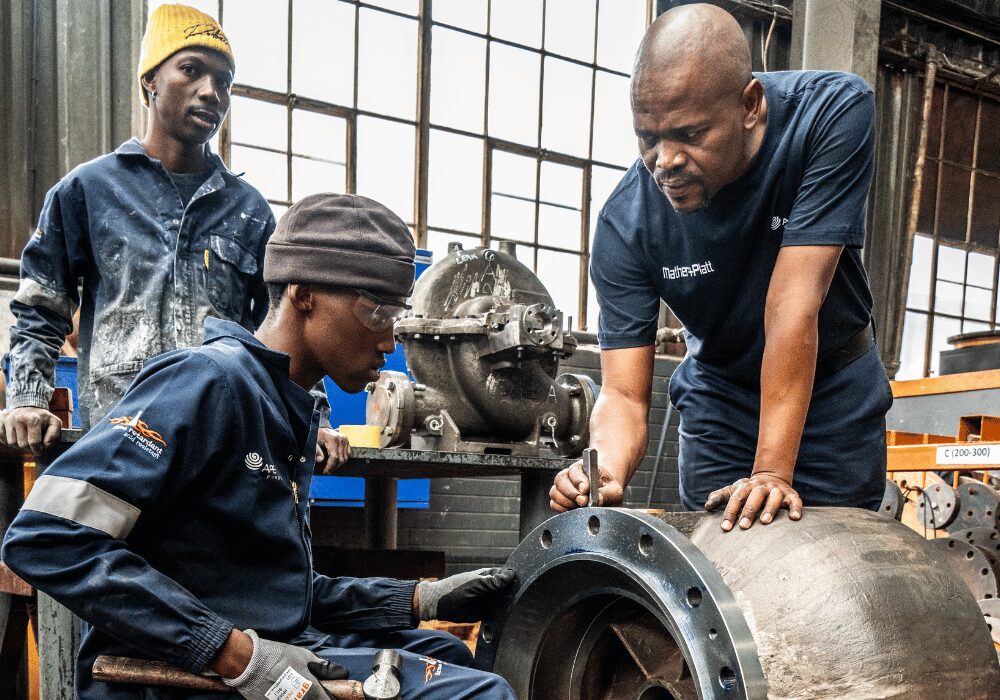 JM: When I started to work at APE 21 years ago, we employed three qualified fitter and turners. Today, we have over 30 qualified fitter and turners. Following qualification, a fitter and turner typically spends around three years gaining practical industry experience before attaining journeyman status. At APE, each journeymen mentor three apprentices on the workshop floor, passing on practical skills that cannot be learnt in a classroom. They teach precision machining, fitting, assembly, maintenance, fault-finding and the quality standards required to manufacture high-performance pumps. The result is a continuous skills pipeline that allows APE to develop its own artisans. As experienced journeymen retire, they pass their knowledge to the next generation, helping to safeguard critical engineering skills for both the company and South Africa’s manufacturing sector.
By investing in our own apprenticeship programme, we can train artisans to our standards and retain those who demonstrate the greatest potential. We currently have 19 active apprentices working through our programme.
Importantly, we don’t allow knowledge to walk out the door. Some of our most experienced employees have come back after retirement to mentor younger staff. Their role isn’t to work on the machines anymore — it’s to pass on decades of practical knowledge before it disappears.
We’re also establishing an in-house training facility where apprentices can learn on dedicated equipment while experienced artisans guide them through every stage of the process.
Your apprenticeship programme seems far more comprehensive than simply teaching someone a trade.JM: Firstly, we raise the entry level. It is not enough for our apprentices to have a matric, an N4 qualification is a minimum requirement. This gives us proof that the applicant is self-motivated, can commit to something and is prepared to invest in his or her future.
JM: When I started to work at APE 21 years ago, we employed three qualified fitter and turners. Today, we have over 30 qualified fitter and turners. Following qualification, a fitter and turner typically spends around three years gaining practical industry experience before attaining journeyman status. At APE, each journeymen mentor three apprentices on the workshop floor, passing on practical skills that cannot be learnt in a classroom. They teach precision machining, fitting, assembly, maintenance, fault-finding and the quality standards required to manufacture high-performance pumps. The result is a continuous skills pipeline that allows APE to develop its own artisans. As experienced journeymen retire, they pass their knowledge to the next generation, helping to safeguard critical engineering skills for both the company and South Africa’s manufacturing sector.
By investing in our own apprenticeship programme, we can train artisans to our standards and retain those who demonstrate the greatest potential. We currently have 19 active apprentices working through our programme.
Importantly, we don’t allow knowledge to walk out the door. Some of our most experienced employees have come back after retirement to mentor younger staff. Their role isn’t to work on the machines anymore — it’s to pass on decades of practical knowledge before it disappears.
We’re also establishing an in-house training facility where apprentices can learn on dedicated equipment while experienced artisans guide them through every stage of the process.
Your apprenticeship programme seems far more comprehensive than simply teaching someone a trade.JM: Firstly, we raise the entry level. It is not enough for our apprentices to have a matric, an N4 qualification is a minimum requirement. This gives us proof that the applicant is self-motivated, can commit to something and is prepared to invest in his or her future.We give preference to apprentices from communities close to APE Pumps. Investing in local talent is important to us because we want to create opportunities and contribute to the growth of the communities in which we operate. Apprentices require close mentorship and continuous guidance. If you walk around our factory floor, you won’t see anyone standing around waiting for work. We keep our apprentices actively engaged, challenging them with real-world tasks and exposing them to as many learning opportunities as possible. That hands-on experience is what accelerates their development into skilled artisans.

Mirna Liesering, skills and equity officer

If people are willing to invest in themselves, we’re prepared to invest alongside them. Training doesn’t stop once someone qualifies. We fund further studies, while we also assist some long-serving employees by covering their children’s school fees.
If there was something you could change if the way South Africa approaches water skills – what would it be?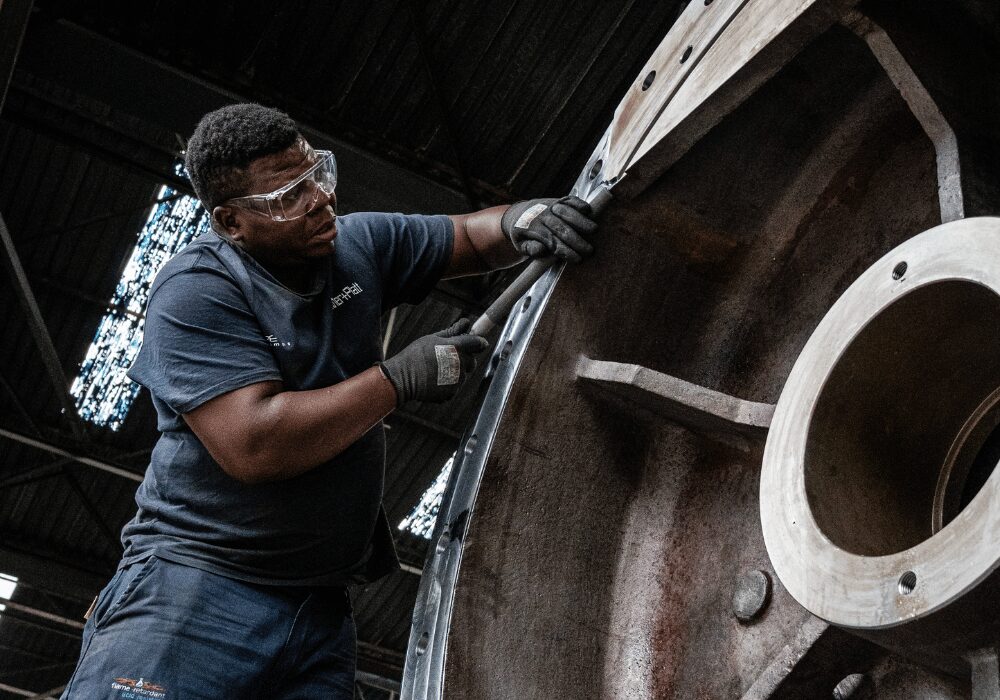 ML: It needs to be fair. Our apprenticeship programme is rigorous, we invest in the apprentices and try to retain talent. In fact, John has been known to create positions when there is a promising apprentice about to finish the programme.
There are companies that use an apprenticeship programme as a tick box exercise and honestly do the bare minimum to train and upskill the people in the programme, and never retain anyone. Many other learnerships only run for 12 months. It is very difficult to upskill an individual in such a short period of time.
Technology is changing engineering rapidly. How has this affected the skills you now recruit?
JM: Digital skills are becoming just as important as mechanical skills.
We have employed three new draughtsman that have completed the Autodesk Inventor course as well as a 3D scanning software course. They don’t simply sit behind computers either. They spend time in the workshop stripping pumps, the foundries to learn the casting process, pattern shop, stores and quality department so they understand the complete manufacturing process.
We are finding that the staff we onboard are already computer literate and that is important as they often need to compile reports.
As these digital technologies continue to evolve, artificial intelligence (AI) is becoming another valuable tool for engineers. When looking at artificial intelligence (AI), it won’t replace engineers. It will remove repetitive work so engineers can spend more time solving problems. For instance, our AI pump selection tool still requires engineering oversight because someone must interpret the results and ensure the recommendations are technically correct. AI can process information incredibly quickly, but engineering judgement still comes from experience.
Years ago engineers calculated everything manually before checking catalogues. Today software produces answers instantly. That’s why we still teach first principles. If you understand how pumps actually work, then digital tools become incredibly powerful. If you don’t understand the fundamentals, you simply become someone who knows how to operate software.
Looking back over your career, what skills have been most valuable that you didn’t necessarily learn through studying further?
JM: Communication.
Technical knowledge is essential, but engineering is ultimately about working with people. Whether you’re speaking to a cleaner, an apprentice or a CEO, you’re dealing with another human being.
I’ve also learned that good leaders don’t have all the answers. Some of my best ideas have come from people working on the factory floor. If you’re willing to listen, you’ll keep learning throughout your career.
And in closing?
JM: Clearly, no pump engineer, specialist technician or artisan is born overnight. The baseline skills are essential, but the experiential, applied learning is what defines master craftsmen, engineers and project managers in all our interrelated disciplines. That’s why our business is dedicated to attracting and mentoring the best talent available.
Bringing new talent onboard is part of our sustained investment in human capital – a forward-thinking approach that continues to position us as an OEM leader and specialist turnkey contractor in the fluid transfer field.
ML: It needs to be fair. Our apprenticeship programme is rigorous, we invest in the apprentices and try to retain talent. In fact, John has been known to create positions when there is a promising apprentice about to finish the programme.
There are companies that use an apprenticeship programme as a tick box exercise and honestly do the bare minimum to train and upskill the people in the programme, and never retain anyone. Many other learnerships only run for 12 months. It is very difficult to upskill an individual in such a short period of time.
Technology is changing engineering rapidly. How has this affected the skills you now recruit?
JM: Digital skills are becoming just as important as mechanical skills.
We have employed three new draughtsman that have completed the Autodesk Inventor course as well as a 3D scanning software course. They don’t simply sit behind computers either. They spend time in the workshop stripping pumps, the foundries to learn the casting process, pattern shop, stores and quality department so they understand the complete manufacturing process.
We are finding that the staff we onboard are already computer literate and that is important as they often need to compile reports.
As these digital technologies continue to evolve, artificial intelligence (AI) is becoming another valuable tool for engineers. When looking at artificial intelligence (AI), it won’t replace engineers. It will remove repetitive work so engineers can spend more time solving problems. For instance, our AI pump selection tool still requires engineering oversight because someone must interpret the results and ensure the recommendations are technically correct. AI can process information incredibly quickly, but engineering judgement still comes from experience.
Years ago engineers calculated everything manually before checking catalogues. Today software produces answers instantly. That’s why we still teach first principles. If you understand how pumps actually work, then digital tools become incredibly powerful. If you don’t understand the fundamentals, you simply become someone who knows how to operate software.
Looking back over your career, what skills have been most valuable that you didn’t necessarily learn through studying further?
JM: Communication.
Technical knowledge is essential, but engineering is ultimately about working with people. Whether you’re speaking to a cleaner, an apprentice or a CEO, you’re dealing with another human being.
I’ve also learned that good leaders don’t have all the answers. Some of my best ideas have come from people working on the factory floor. If you’re willing to listen, you’ll keep learning throughout your career.
And in closing?
JM: Clearly, no pump engineer, specialist technician or artisan is born overnight. The baseline skills are essential, but the experiential, applied learning is what defines master craftsmen, engineers and project managers in all our interrelated disciplines. That’s why our business is dedicated to attracting and mentoring the best talent available.
Bringing new talent onboard is part of our sustained investment in human capital – a forward-thinking approach that continues to position us as an OEM leader and specialist turnkey contractor in the fluid transfer field.