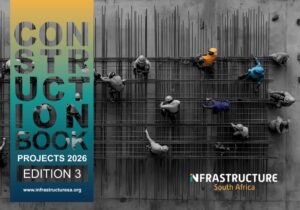
Infrastructure South Africa’s third Construction Book identifies 110 projects worth R395bn across water, transport, energy, municipal and digital infrastructure.
Infrastructure South Africa (ISA) has released the third edition of the Construction Book, identifying 110 infrastructure projects with a combined value of approximately R395 billion and providing industry with greater visibility of projects expected to progress towards procurement and construction.
The Construction Book is intended to give contractors, professional service providers, suppliers, financiers and other industry participants a clearer view of the public-sector infrastructure pipeline over the next 12 to 18 months. Rather than simply providing a catalogue of projects, ISA positions the publication as a market-signalling tool designed to give companies sufficient lead time to plan capacity, skills, equipment, supply chains and partnerships. The third edition has a national geographic spread and covers six infrastructure sectors. The largest component by value is municipal infrastructure, comprising 10 projects worth approximately R112 billion. The sector includes projects from municipalities including eThekwini, Cape Town, Polokwane, Tshwane, Johannesburg and Mogale City, reflecting the growing focus on infrastructure needed to support local economic development and essential services. The publication also provides a more detailed view of the water and sanitation pipeline, with 18 projects valued at approximately R35 billion. These include dams, water treatment and wastewater treatment facilities, irrigation systems, reservoirs and pipelines. Among the projects highlighted are the Beitbridge Musina Water Transfer Scheme, the Southern Aqueduct in KwaZulu-Natal and the City of Cape Town’s proposed permanent desalination plant. The Beitbridge Musina scheme, for example, involves approximately 20 km of pipeline crossing the Limpopo River between Beitbridge and Musina, with bidirectional capacity to transfer 41 Mℓ/day of treated water from the Beitbridge water treatment works to terminal reservoirs in Musina. The project is currently listed at feasibility stage, with procurement planned for the second quarter of 2027/28. Transport accounts for 41 projects worth approximately R81 billion. The pipeline includes road, rail, logistics, airport and port projects, with significant activity from SANRAL, Transnet and major municipalities. Among the projects highlighted are upgrades to national road corridors, the modernisation of rail container corridors and the procurement of a new concessionaire to operate the Gautrain system. The Construction Book notes a revival of rail and port investment through the Transnet group, with projects including the North-east, Cape, Central and Container corridors. These projects are aimed at restoring and expanding rail capacity and positioning the corridors for private-sector participation under the country’s rail reform programme. Energy represents a further 29 projects with a combined value of approximately R86 billion. These include substations, power plants and transmission infrastructure, with the Aries-Aggenys 400 kV line in the Northern Cape and refurbishment of the main plant at Steenbras in the Western Cape among the projects identified by ISA. Social infrastructure contributes 16 projects worth approximately R52 billion. The sector includes projects such as the Tygerberg and Belhar hospitals, Durban Film City, the Joburg Fresh Produce Market and Limpopo Central Hospital. ISA identifies social infrastructure as an area with significant potential for public-private partnerships, particularly because many projects have long-term operational requirements. The third edition also introduces digital infrastructure as a distinct sector, with three projects valued at approximately R28 billion. These include investments associated with the MeerKAT radio astronomy project and the SAeX East Subsea Fibre-Optic Cable. The Construction Book describes digital infrastructure as an increasingly important component of economic and social development, encompassing fibre-optic networks, data centres, broadband and other communications infrastructure.Greater role for PPPs
For the first time, the Construction Book specifically includes Public-Private Partnership projects. These span transport, social infrastructure, water and sanitation and reflect the government’s increasing use of alternative procurement and financing models to bring private-sector capital, expertise and operational capacity into infrastructure development. The publication notes that the PPP Framework was revised with effect from June 2026, including a fast-track approval route for PPPs below R2 billion, greater delegated authority for accounting officers and strengthened technical oversight and project preparation. The revised framework also allows unsolicited private-sector bids for conceptual projects aligned with public-sector priorities.
The inclusion of PPPs is accompanied by a broader expansion of municipal infrastructure in the Construction Book. The previous edition profiled one municipality, while the latest edition includes multiple metropolitan and other municipalities. ISA describes municipal infrastructure as the largest sector in the publication by value, with projects intended to address infrastructure deficits while supporting service delivery and local economic activity.
From pipeline visibility to pipeline monitoring

Mameetse Masemola, Head of Infrastructure South Africa
“The Construction Book will complement, rather than replace, formal procurement platforms such as National Treasury’s eTender Portal. Our intention is to create a clearer line of sight between the forward infrastructure pipeline and the tenders that subsequently enter the market, enabling contractors, professional service providers, suppliers and financiers to plan and position themselves earlier.”The Construction Book is therefore intended to provide information before projects reach formal tendering platforms, rather than serve as an alternative procurement mechanism. ISA says greater visibility should give companies time to prepare their capacity, secure equipment and skills, establish supply chains and position themselves for upcoming opportunities. The third edition comes against a challenging backdrop for the construction sector. The Construction Book records construction employment at 1.42 million people at the end of 2025, while construction gross value added averaged R99 billion during 2025, below the R103.6 billion recorded in 2024. ISA identifies procurement delays, project preparation gaps, rising input costs, weak local government implementation capacity and disruptions on construction sites among the constraints affecting delivery. Against this background, ISA’s approach places greater emphasis on the quality and maturity of the project pipeline, rather than simply the volume of projects announced. The third edition comprises projects submitted by national and provincial departments, municipalities, state-owned entities and other implementing institutions. ISA says the publication will progressively become a more regular source of information on projects approaching the market, with monitoring intended to show whether projects are progressing as anticipated and where intervention may be required. For an industry that needs to make investment and capacity decisions well ahead of construction activity, the value of the R395 billion pipeline will ultimately depend not only on the projects being listed, but on how effectively they move through preparation, procurement and into construction.