
Levels of carbon dioxide (CO2) and other major greenhouse gases in the atmosphere reached unprecedented highs in 2025, locking in more long-term temperature increase for the planet, according to a new report from the World Meteorological Organization (WMO).
The WMO Greenhouse Gas Bulletin reported that the globally averaged surface concentration of CO2 in 2025 was 426.8 parts per million, or 153% of the 1750 pre-industrial baseline. Concentrations of methane and nitrous oxide – the second and third most important long-lived greenhouse gases related to human activities – also rose to a new record.“Another year, another new record. Greenhouse gases are trapping an unprecedented amount of heat in the atmosphere, providing energy for more extreme weather and associated risks to our economies and societies. The past 11 years have been the warmest on record and this trend is set to continue. CO2 has a very long life-time and so will affect the global climate not just for years but for decades and even centuries,” said WMO Deputy Secretary-General Ko Barrett.WMO releases the Bulletin, one of its flagship annual publications, to provide authoritative scientific information for negotiators at the UN Climate conference. The COP 31 meeting in Antalya, Türkiye, from 9-20 November is seeking to turn climate commitments into concrete actions.
CO2 growth rates tripled
The Bulletin reports on greenhouse gas concentrations – namely the amount of gas that accumulates in the atmosphere – and not new annual emissions. About half of the total CO2 emitted each year remains in the atmosphere and the rest is absorbed by Earth’s land ecosystems and oceans.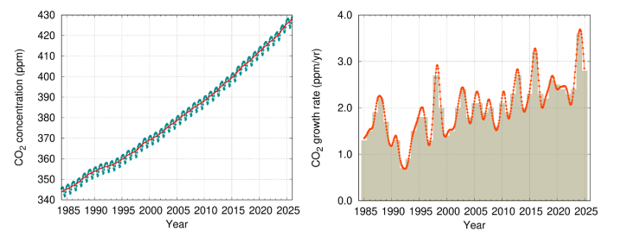
Globally averaged CO2 concentration (left) and its growth rate (right) from 1984 to 2025. Increases in successive annual means are shown as the shaded columns in (right). The red line (left) is the monthly mean with the seasonal variation removed; the blue dots and blue line (left) depict the monthly averages. Observations from 179 stations were used for this analysis.
“The more modest growth rate from 2024 to 2025 reflects recovery of the land carbon sinks and reduced fire carbon emissions in 2025 after the strong 2023/2024 El Nino, which reduced the efficiency of the biosphere through more drought, drier vegetation and more wildfires,” said WMO senior scientific officer Oksana Tarasova.“However, a 2.8 ppm annual increase is still a substantial addition of carbon to the atmosphere from fossil fuel burning. We can expect to see a further increase in concentrations in 2026 because of fossil fuel burning and the development of a powerful El Niño which will impact land carbon sinks as it did in 2023/2024. The risks of reduced CO2 uptake by the ocean are also increasing in our changing climate,” said Oksana Tarasova.
Methane and nitrous oxide
Methane accounts for about 16% of the warming effect on our climate by long-lived greenhouse gases but it has a much shorter lifetime than CO2. Approximately 35% of methane is emitted into the atmosphere by natural sources (for example, wetlands) which are sensitive to climate as well, and about 65% comes from anthropogenic sources such as cattle, rice farming, fossil fuel exploitation, landfills and biomass burning. The globally averaged methane concentration in 2025 was 1948 parts per billion (ppb) – or 267% of the 1750 level.
Nitrous oxide is the third most important long-lived greenhouse gas and comes from both natural sources and due to human activities such as biomass burning, fertilizer use and various industrial processes.
The globally averaged concentration of N2O reached 339.1 ppb in 2025, 126% above 1750.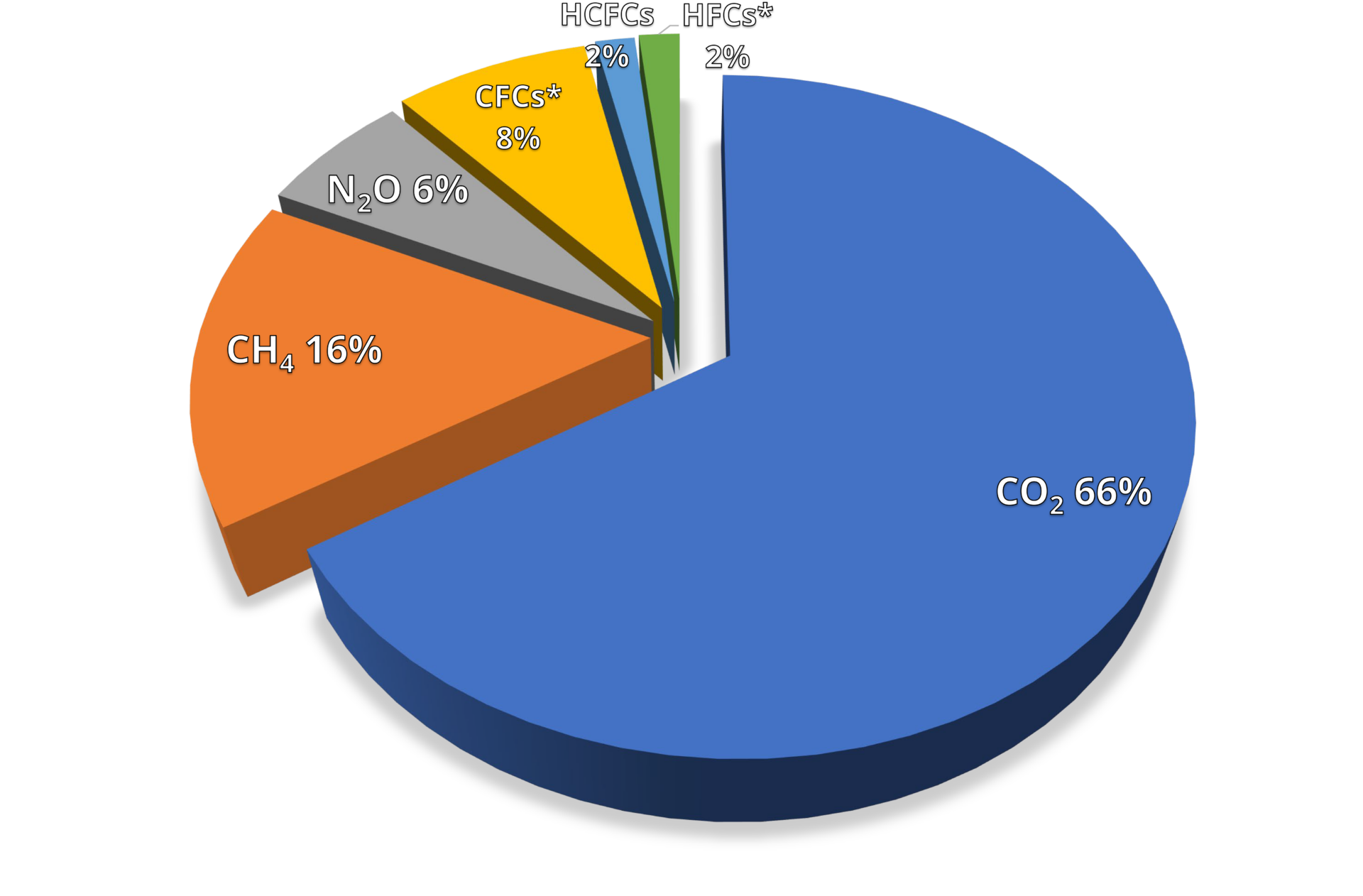
Contribution of the most important long-lived greenhouse gases to the increase in global radiative forcing from the pre-industrial era to 2025