What’s the connection between roads and conflict in west Africa? This may seem like an odd question. But a study we conducted shows a close relationship between the two.
We are researchers of transnational political violence. We analysed 58,000 violent events in west Africa between 2000 to 2024. Our focus was on identifying patterns of violence in relation to transport infrastructure. Anecdotal evidence suggests that roads, bridges, pipelines and other transport systems are increasingly attacked across west Africa, but little is known about the factors that explain when, where and by whom. Violence in west Africa involves a complex mix of political, economic and social factors. Weak governance, corruption, urban-rural inequalities and marginalised populations have been exploited by numerous armed groups, including transnational criminal networks and religious extremists. West Africa has been one of the world’s most violent regions since the mid 2010s. In 2024 alone, the Armed Conflict Location and Event Data initiative recorded over 10,600 events of political violence in the region. These ranged from battles between armed groups, explosions and other forms of remote violence, to attacks on unarmed civilians. An estimated 25,600 people were killed. This has been the status quo in the region for nearly a decade. The results of our study show that 65% of all the attacks, explosions, and violence against civilians recorded between 2000 and 2024 were located within one kilometre of a road. Only 4% of all events were located further than 10km from a road. This pattern was consistent across all road types but most pronounced near highways and primary roads. We think the reason for this pattern is that there is fierce competition between state and non-state actors for access to and use of roads. Governments need well-developed road networks for a host of reasons, including the ability to govern, enabling economic activity, and security. Roads enable military mobility and reduce potential safe havens for insurgents in remote regions. Insurgent groups also see transport networks as prime targets. They create opportunities to blockade cities, ambush convoys, kidnap travellers, employ landmines, and destroy key infrastructure. Our research is part of a long line of work that explored the role of infrastructure in relation to security in west Africa. Our latest research reinforces earlier findings linking the two. Transport networks have become battlegrounds for extremist groups seeking to destabilise states, isolate communities and expand their influence.The network
The west African road network is vast, estimated at over 709,000km of roads by the Global Roads Inventory Project. It compares unfavourably with other African regions. For example, paved roads remain relatively scarce in west Africa (17% of the regional network) when compared with north Africa (83%). Poorly maintained roads impose costs on west African countries. They increase transport time of perishable goods, shorten the operational life of trucks, cause more accidents, and reduce social interactions between communities. Still, significant variations in road quality are found across the region. The percentage of paved roads ranges from a high of 37% in Senegal to just over 7% in Mali. Nigeria has the largest road network in west Africa with an estimated 195,000km, but much of it has deteriorated because of poor maintenance.Road-related violence is on the rise
We found that road-related attacks have been on the rise since jihadist groups emerged in the mid-2010s. Only 31 ambushes against convoys were reported in Burkina Faso, Chad, Mali and Niger from 2000-2015, against 497 from 2016-2023. Attacks frequently occur along the same road segments, such as around Boni in the Gourma Mounts, where Jama’at Nusrat ul-Islam wa al-Muslimin (JNIM) conducted nine attacks against Malian forces and Wagner mercenaries between 2019 and 2024.
Violence was the most clustered near roads in 2011, with 87% of all violent events located within 1km of a road. Our analysis shows that, though still high, there’s been a decline post-2000: 59% in 2022 and 60% in 2024. This evolution reflects the ruralisation of conflict in west Africa. As jihadist insurgents target rural areas and small towns more and more, an increasing share of violent events also occurs far away from roads.
We’ve studied the root causes of west Africa’s violence for nearly a decade, documenting the ever-intensifying costs paid by its people. In the process, we’ve uncovered overlooked aspects of the turmoil, including the centrality of the road networks to an understanding of where the violence is happening.The most dangerous roads of west Africa
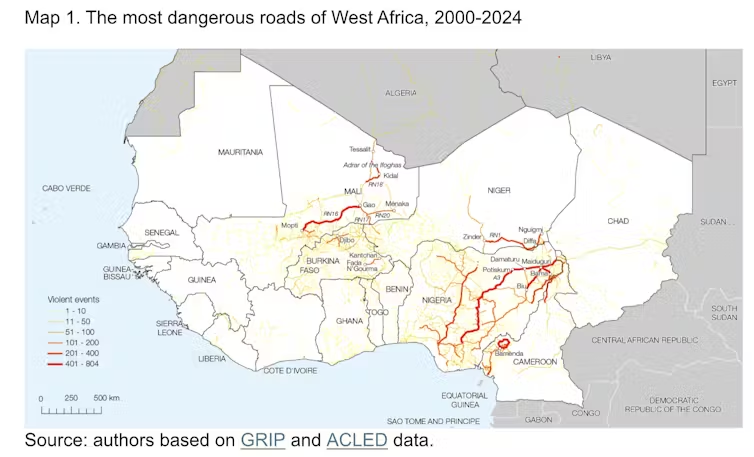
Our findings show that violence against transport infrastructure is very unevenly distributed in west Africa and that specific road segments have been repeatedly targeted. This was particularly the case in the Central Sahel, Lake Chad basin, and western Cameroon. For example, the 350km ring road linking Bamenda to Kumbo and Wum in Cameroon is the most violent road in west Africa, with 757 events since 2018, due to the conflict between the government and the Ambazonian separatists. The longest segments of dangerous roads are in Nigeria, particularly those connecting Maiduguri in Borno State to Damaturu, Potiskum, Biu and Bama. In the central Sahel, the road between Mopti/Sévaré and Gao is by far the most violent transport axis, with 433 events since the beginning of the civil war in Mali in 2012. South of Gao, National Road 17 leading to the Nigerien border, and National Road 20 heading east toward Ménaka have experienced 177 and 139 events respectively since the Islamic State – Sahel Province (ISSP) intensified its activities in the region in 2017. In Burkina Faso, all the roads leading to Djibo near the border with Mali have experienced high levels of violence since the early 2020s.