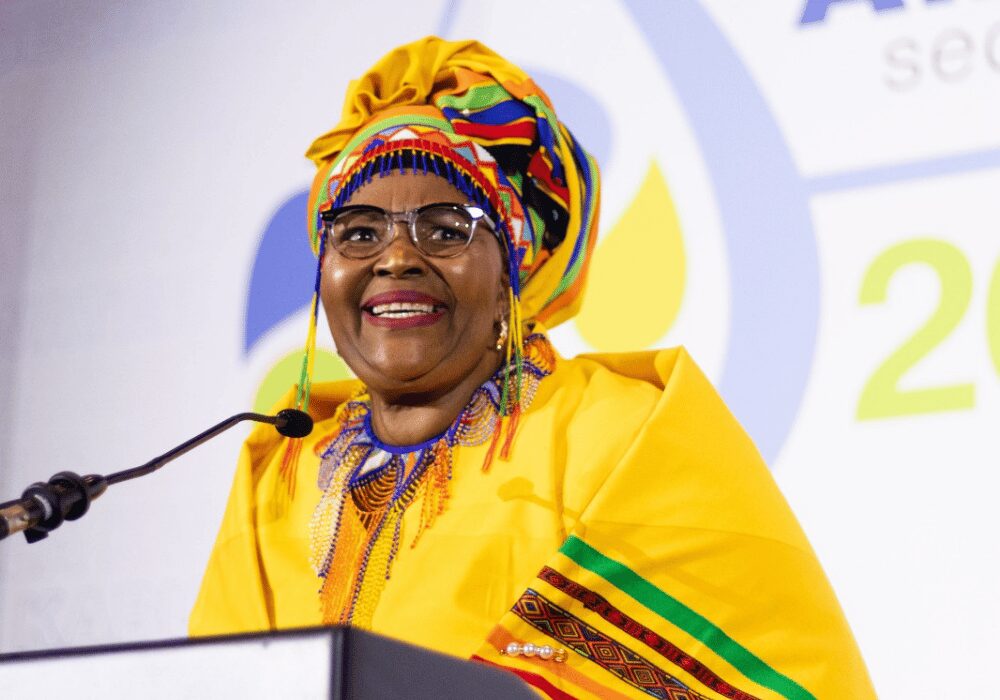
Read Minister Pemmy Majodina’s WISA 2026 opening address on rethinking water security, climate resilience, innovation and sustainable water management.
Theme: Rethinking Amanzi: Securing Our Future
Programme Director;President and Leadership of the Water Institute of Southern Africa;
Honourable Ministers and Deputy Ministers;
Director-General of the Department of Water and Sanitation;
Chairpersons and Chief Executive Officers of Water Boards and Water Sector Institutions; Members of Parliament;
Executive Mayors and Councillors;
Representatives of development finance institutions and our international partners; Scientists, engineers, technologists, process controllers, researchers, innovators and young professionals;
Distinguished delegates;
Ladies and Gentlemen, It is both an honour and a privilege to welcome you to the 2026 Water Institute of Southern Africa Biennial Conference and Exhibition. I wish to begin by congratulating WISA for once again convening what has become the premier gathering of water professionals, researchers, policymakers and practitioners in Southern Africa. Over many decades, this conference has established itself not merely as a technical event, but as one of the continent’s most influential platforms for shaping the future of water and sanitation. This year’s conference is particularly significant because it brings together more than two thousand delegates from across South Africa, the African continent and the international community at a time when water security has become one of the defining development challenges of our generation. Over the next three days, this conference will interrogate some of the most pressing issues confronting the sector: resilient infrastructure, innovative financing, water governance and accountability, climate adaptation, digital technologies, groundwater development, water reuse, circular economy approaches, citizen science, municipal performance, youth leadership and the future of water research. These conversations speak directly to the choices that will determine whether South Africa and our continent are able to build resilient, inclusive and water-secure societies. The Department of Water and Sanitation is proud of its long-standing partnership with WISA. As a Patron Member, we have worked together over many years to strengthen professional development, build technical capacity, support policy development and promote innovation across the sector. WISA has consistently demonstrated that sustainable water management requires a multidisciplinary approach that brings together engineers, scientists, economists, planners, environmental specialists, social scientists, municipalities, regulators, utilities and communities. That collaborative ethos has become one of WISA’s greatest strengths, and it reflects an important truth: the increasingly complex challenges confronting the water sector cannot be solved by any single institution acting alone. The theme of this conference, “Rethinking Amanzi: Securing Our Future,” could therefore not be more timely. It challenges us to question conventional assumptions, embrace new ideas and imagine a future in which water is managed differently – more intelligently, more sustainably and more collaboratively. It reminds us that securing our water future will require more than additional infrastructure. It will demand new forms of leadership, new governance models, new financing mechanisms, new technologies and, perhaps most importantly, a renewed commitment to collective action. History teaches us that water has always shaped the destiny of nations. The earliest civilisations flourished along rivers not simply because water sustained life, but because societies learned to organise themselves around its management. Wherever water was governed wisely, prosperity followed. Where it was neglected, instability, poverty and decline soon emerged. That historical lesson has lost none of its relevance. If anything, it has become more urgent. Today, the world is entering what many scholars describe as the century of water. Climate change is altering hydrological systems, disrupting rainfall patterns, increasing the frequency and severity of droughts and floods, degrading ecosystems and placing unprecedented pressure on already stressed water resources. At the same time, rapid urbanisation, industrial expansion, population growth and changing consumption patterns continue to increase demand for water. These global realities have profound implications for South Africa. We are one of the world’s thirty driest countries, with average annual rainfall well below the global average. Most of our economically important catchments are already heavily allocated. Many rivers continue to experience declining ecological health, while pollution, invasive alien plants, land degradation and ageing infrastructure place additional pressure on already constrained water resources. Climate change is expected to intensify these pressures further by increasing rainfall variability, extending periods of drought and increasing the frequency of extreme weather events. These realities require us to fundamentally rethink our relationship with water. For too long, water has often been viewed primarily as a service delivered through pipes, pumps and treatment works. While infrastructure remains indispensable, this perspective is no longer sufficient. Water must increasingly be understood as strategic national infrastructure in its own right. It is a resource that underpins economic growth, food production, industrial competitiveness, public health, environmental sustainability, social cohesion and national resilience. In other words, water security is no longer simply an environmental objective. It has become an economic imperative. Without secure water supplies, industries cannot expand. Without secure water supplies, agriculture cannot guarantee food production. Without secure water supplies, energy generation becomes increasingly vulnerable. Without secure water supplies, investment confidence weakens. Without secure water supplies, sustainable urbanisation becomes impossible. And without secure water supplies, the constitutional promise of dignity, equality and improved quality of life cannot be fully realised. This is why government regards water security as one of the foundational pillars of South Africa’s long-term development agenda. Our constitutional commitment demands responsible stewardship for both present and future generations – balancing competing demands fairly, protecting ecological systems, ensuring intergenerational equity and creating institutions capable of managing water resources sustainably. The challenge before us is institutional, economic, environmental, social and, above all, a governance challenge. The conference programme rightly emphasises governance, accountability and institutional effectiveness, including groundwater governance, municipal performance, regulatory accountability, institutional reform, data transparency and integrated water resource management. Engineering can build infrastructure. Science can deepen our understanding. Technology can improve efficiency. But only good governance can ensure these capabilities are translated into sustainable public value. This understanding lies at the heart of government’s reform agenda for the sector. The National Water and Sanitation Master Plan recognises that securing South Africa’s water future requires more than infrastructure investment alone. It calls for comprehensive transformation through improved governance, institutional reform, sustainable financing, professionalisation, enhanced regulation, strengthened partnerships and protection of our precious water resources. Its implementation remains one of government’s highest priorities. This conference forms part of a much broader national conversation about managing one of our most strategic national assets. Over the next three days, you will debate financing models, explore digital technologies, artificial intelligence and predictive analytics, examine water reuse, groundwater development, managed aquifer recharge and circular economy solutions, and discuss climate resilience, institutional reform and the role of young professionals. Every one of these discussions speaks directly to government’s strategic priorities and reinforces that the future of water security will be built through innovation, collaboration and evidence-based policymaking. The task before us is not merely to respond to today’s challenges. It is to anticipate tomorrow’s realities by rethinking Amanzi as a national imperative. If water security is the destination, infrastructure remains one of the principal vehicles. Yet infrastructure on its own cannot guarantee water security. Countries with impressive infrastructure sometimes struggle due to governance failures, while others with fewer advantages succeed through capable institutions and long-term planning. Infrastructure and institutions are mutually reinforcing pillars of a resilient water sector. Government is shifting the national conversation from managing recurring water crises to building lasting water security. This requires us to recognise water not simply as a municipal service, but as strategic national infrastructure that is essential for economic growth, social development and national resilience. Like energy, transport and digital connectivity, secure and reliable water services are fundamental to the country’s future prosperity It is for this reason that government has adopted the Presidential Water and Sanitation Five-Point Plan as the framework for sector reform. Government’s response is anchored in a comprehensive programme of institutional and infrastructure reform guided by the National Water and Sanitation Master Plan. This includes expanding water resources, rehabilitating ageing infrastructure, strengthening regulation, improving municipal performance, mobilising investment and protecting water integrity. One of the most significant institutional reforms is the establishment of the National Water Resource Infrastructure Agency. It creates a modern platform for planning, financing, developing, operating and maintaining major water resource assets with improved efficiency, financial sustainability and long-term resilience. Government is also advancing legislative reforms through amendments to the Water Services Act and the National Water Act to modernise the regulatory framework, clarify responsibilities and strengthen accountability.

Delegates, a recurring theme is resilient infrastructure. Sessions will explore maintenance, asset management, smart monitoring, climate-resilient design and financing. South Africa’s greatest infrastructure challenge is sustaining what we already have. Insufficient maintenance has eroded performance, causing service interruptions, water losses and declining efficiency. Infrastructure must be viewed as a strategic national asset requiring continuous professional management and sustained support throughout its lifecycle.
Closely linked is the challenge of municipal water services. Many municipalities face operational, financial and technical constraints affecting reliable supply and dignified sanitation. Poor services impact public health, local economies, investment and public confidence. Government is committed to supporting municipalities while strengthening accountability through technical programmes, regulatory oversight, professionalisation and consequence management. Another prominent issue is non-revenue water. Every litre lost represents wasted resources. In a water-scarce country, reducing losses through better management is often more cost-effective than developing new sources and must be a core principle of water security. The future requires a diversified water portfolio. While surface water infrastructure remains vital, we must strategically expand groundwater as a buffer against drought, advance water reuse and circular economy approaches, and incorporate desalination, rainwater harvesting and conservation. Climate change reinforces the urgency, with longer droughts, intense floods and variability demanding adaptive planning and nature-based solutions. Digital innovation features strongly, with emphasis on artificial intelligence, machine learning, predictive maintenance and smart systems. These technologies are transforming water management, but they complement, rather than replace, skilled water professionals who will lead the Fourth Industrial Revolution in the sector. If infrastructure is the backbone, people are the heart of the water sector. WISA has been the custodian of professional excellence through training, research and knowledge exchange. The conference emphasis on empowering people, skills development, mentoring young professionals and fostering innovation recognises that investing in human capability is the foundation of all reforms. We need more engineers, scientists and practitioners who reflect South Africa’s diversity. A transformed profession is a stronger one. The conference’s commitment to research and innovation is equally defining. Hundreds of technical papers will address emerging contaminants, reuse, AI, climate adaptation and advanced treatment. The future depends on generating, applying and sharing knowledge so that research informs policy and improves service delivery at scale. Financing is another key conversation. The scale of investment needed cannot come from public resources alone. Government promotes blended finance models combining public, development and private capital while safeguarding water as a public good. Investment follows confidence in strong governance, transparent regulation and competent institutions. Accountability is central. I am pleased to announce the publication of the Department of Water and Sanitation’s National Polluters Register. This platform provides transparent access to information on pollution incidents, enforcement actions, Green Drop findings and convictions through an interactive spatial map and searchable database. It strengthens stewardship, encourages compliance, empowers communities and reinforces that our rivers, wetlands and aquifers are national heritage belonging to all South Africans, including future generations. Protecting water is a shared responsibility. The challenges confronting the water sector are increasingly interconnected with energy, food, environment, economy and social justice. This demands multidisciplinary leadership and partnerships across all stakeholders. Partnership extends beyond our borders through regional and continental cooperation. The future of water management will be knowledge-driven, requiring data, science and institutions that turn evidence into action. Ultimately, sustainable water security depends on values of integrity, professionalism, ethical leadership, accountability and stewardship.Programme Director, I encourage all delegates to engage actively in the programme: attend sessions with curiosity, challenge ideas, share research, build relationships, mentor young professionals and commit to turning discussions into implementation. The true success of this conference will be measured by partnerships formed, innovations adopted, institutions strengthened and tangible improvements for millions of South Africans. Just last week, South Africa co-chaired the 44th SADC Joint Meeting of Ministers Responsible for Water and Energy, where Member States reaffirmed their commitment to strengthening regional water security through cooperation on shared watercourses, infrastructure development and climate resilience. Ministers noted progress on key transboundary initiatives led by the Orange-Senqu River Commission, the Limpopo Watercourse Commission and the Incomati and Maputo Watercourse Commission, all of which are critical for regional water security and economic development. The meeting also approved the review of the SADC Protocol on Shared Watercourses, the implementation of the Water Sector Resource Mobilisation Plan, the extension of the Regional Strategic Action Plan V to 2030, and the next phase of the regional groundwater programme. South Africa further proposed the establishment of a SADC Water Week to strengthen regional collaboration, knowledge-sharing and innovation across the sector. These outcomes will be submitted for consideration by the SADC Summit in August and reflect our collective commitment to securing water for the people of Southern Africa. “Rethinking Amanzi: Securing Our Future” is a national call to action. It requires courage to reform institutions, wisdom to invest in long-term resilience, humility to learn from one another, and determination to prioritise future generations. Let this conference be part of the legacy in which South Africa reimagined its water future, recognising water as the foundation of sustainable development. Working together as government, academia, business, civil society, development partners and communities, we have the responsibility and capability to secure that future. As we prepare to host the SADC Summit next month and co-chair the Investment for Water Dialogue at the United Nations 2026 Water Conference in November, South Africa remains committed to providing leadership that advances both national and regional water security, while ensuring that no community is left behind in the journey towards universal access to safe water and dignified sanitation. Together, let us rethink Amanzi. Together, let us secure our future. I thank you.