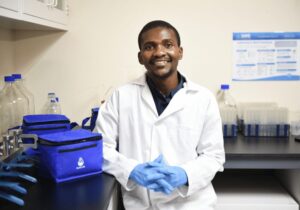

In isiXhosa, the name Sithethelele translates closely to “intercede for us” or “speak up for us”. For 31-year-old Sithethelele Bekwa, raised in the deep rural town of Tsolo outside Mthatha in the Eastern Cape, living up to that name began with personal loss, and has grown into Blue Lab, a rapid water quality monitoring toolkit poised to protect vulnerable communities ahead of an incoming El Niño cycle.
The eldest of three children, Bekwa lost his mother to cancer in 2011. Throughout her illness, he watched her endure stomach pains and intestinal infections. The experience, together with his awareness of the challenges surrounding access to safe drinking water in rural communities, influenced his decision to pursue environmental sciences and develop practical water-quality monitoring solutions. After his mother’s passing, Bekwa was raised by his grandmother, who is blind. When he eventually engineered Blue Lab, he designed it so simply that “even a grandmother from a rural area who never went to school can test the water by herself.” His grandmother, however, offered a playful critique that sparked his next innovation: “How can I use your product when I cannot see the water changing colour?” Bekwa laughs as he shares the memory, noting that her joke has now inspired him to adapt the kit for the visually impaired.The Importance of Water Testing
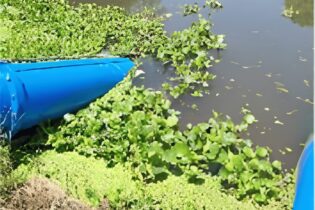
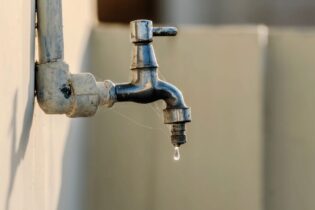
With El Niño expected to bring warmer and drier conditions to parts of South Africa, access to practical water-quality monitoring tools may become increasingly important for communities and small-scale farmers who rely on natural water sources. Back home in Tsolo, Bekwa has seen firsthand how difficult it can be for households to assess the quality of the water they use. One mother of three who used the kit told him that she had previously been unable to assess the safety of the river water she collected for her family.“Many rural areas and communities in the Eastern Cape province rely on rivers for their water,” Bekwa explains. “The animals drink this water. We use it to wash our clothes. Some areas are still drinking directly from the rivers without knowing whether it is safe.”
How Blue Lab Works
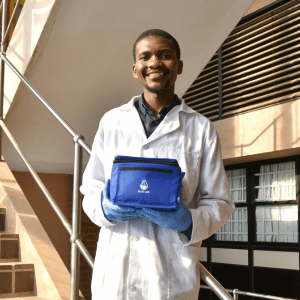 Bekwa, who holds a Bachelor of Science in Environmental Sciences and is completing his Master’s in Geography (specialising in water quality) while working at the Walter Sisulu University Centre for Entrepreneurship Innovation Incubator, developed Blue Lab to provide an affordable, rapid initial screening tool for communities located far from formal testing laboratories.

Designed as an early-warning screening kit, Blue Lab comes with a step-by-step instruction guide requiring no prior scientific training.
The toolkit uses three screening methods to identify potential water-quality concerns. These include a hydrogen sulphide test that screens for indicators of bacterial contamination, a specialised film that helps detect bacterial presence, and a phosphate strip that measures phosphate levels associated with possible pollution. Together, these tests provide an initial indication of water quality and can help users identify when further testing may be necessary. The kit is intended as an initial screening tool rather than a substitute for comprehensive laboratory testing.National Recognition and Future plans
In October 2026, Bekwa was named among 20 social innovators recognised at the SAB Foundation’s Social Innovation and Disability Empowerment Awards in Johannesburg.Blue Lab was among the innovators selected to receive grant funding and business development support as part of the R18.4 million awarded across the 2026 winners.
“These are entrepreneurs looking at challenges in healthcare, education, housing, mobility, water, access to finance and economic participation and asking how they can solve them differently,” says Sarah Mthintso, Executive Director of the SAB Foundation. “The opportunity is to help those solutions become stronger businesses capable of reaching more people.”Beyond the physical kit, Bekwa is building a Blue Lab dashboard and training local “water champions” to log test results from offline communities, alerting municipalities to contamination hotspots in real time. Having already assisted the OR Tambo District Municipality with rapid testing during severe floods, Bekwa is now working toward formal SABS certification as he explores opportunities to make the toolkit more widely available to rural communities and small-scale farmers. For more information about the SAB Foundation and its programmes, visit www.sabfoundation.co.za.