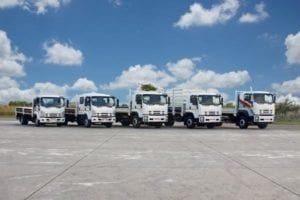
Isuzu trucks.
The company said it has the potential to save operators thousands of rand a year with its Automated Manual Transmission (AMT) range of medium commercial vehicles.
What is AMT?
“Basically, AMT is a manual gearbox that operates without a clutch and is controlled by an on-board computer,” Young said in a statement. “The fact that, from a driver’s perspective, it behaves like an automatic gearbox, means that an AMT truck is far easier to operate, requiring less training and driving skill.”
Young added that this meant it was cheaper to buy than an automatic truck and that this was where an operator would first benefit when buying the product.
Isuzu said its AMT ‘Smoother’ transmission system was an industry first in South Africa that promised to make a substantial difference to what operators could expect from their vehicles, drivers and budgets.
Operators biggest challenges
Isuzu said AMT was a solution to the challenges presented by a severe lack of skilled drivers and the threat of down time – a situation often caused by poor driving.
“The AMT range is a solution to both,” Young said. “It’s the answer to many of our clients’ biggest threats to their bottom line,” he added.
The clutch
The company said that on average, clutches could last between 70 000 and 100 00 km’s.
“This means that over the course of a vehicles life, the clutch will need to be replaced five times. Over a fleet of vehicles this becomes a substantial cost,” it said, and added that downtime could be detrimental to an operator who had delivery deadlines to meet.
AMT as a solution to operator challenges
The problem many local operators face is a shortage of skilled drivers and often not enough time to invest in driver training as deliveries need to be met first, Young said.
He added that AMT was an answer to this problem as these trucks were much simpler to drive, which meant that drivers could concentrate on the road and delivering loads on time, rather than focus on how they were driving the vehicle.