The Covid-19 pandemic is driving important shifts in designing spaces within buildings. This encompasses the provision of fresh air and ventilation, increased monitoring of the internal environment, maintenance and cleaning activities and different procedures for entering a building and using its facilities.
For example, designing office fit-outs now involves increased distance between desks, installing protective screens, improved wayfinding to limit occupant and visitor interaction in circulation areas and automation of internal doors to limit surface contact.
Proper outdoor air distribution with increased ventilation rates is also required to reduce pathogen build-up in the air.
In terms of infrastructure, many leading global cities are changing the way public transport operates by making a concerted effort to increase alternative mobility – that is, non-motorised transport, including cycling lanes and bicycles, e-scooters and pedestrianising the inner city.
“All of these measures are being taken to ensure the health and well-being of occupants and visitors of buildings and communities at large,” says Yovka Raytcheva-Schaap, Associate, Environmentally Sustainable Design (ESD) Consulting & Project Management at Zutari.
Essentially, when designing new buildings, project teams should have a deeper appreciation of the contextual characteristics of sites, the location and climatic conditions, the availability or lack of finite resources and the ecological and social make-up of neighbourhoods.
Thus the design development can be fully integrated with the organic offering of the sites.
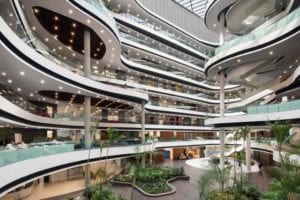
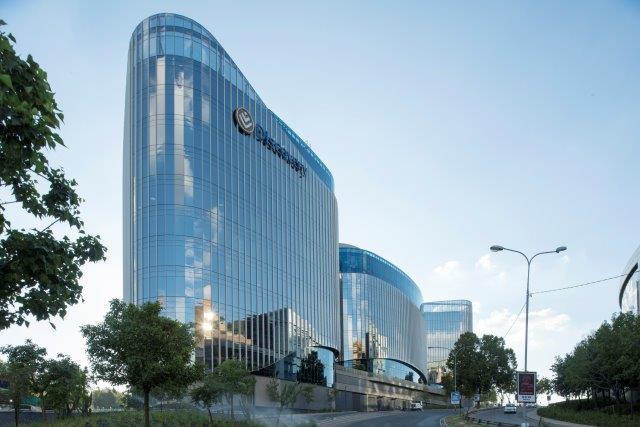
Zutari provided ESD (Environmentally Sustainable Design) services for the new Discovery head office in Sandton
In addition, passive design must be fully explored and implemented as a first step to reduce dependency on utilities, to make real estate more self-sufficient and resilient and to approach net zero performance.
The lockdown imposed due to the Covid-19 pandemic has not only reduced air and car travel, but has resulted in many people working from home thanks to the latest technologies for digitising business and operational processes. Pollution and greenhouse gas emissions have subsequently declined as people now fly and drive less.
“In returning to a ‘new normal’ post Covid-19 world, we must be more appreciative of such alternative ways of interaction, and be more caring towards each other and the environment we live in. Our efforts towards a more sustainable future must be renewed and intensified. As we rebuild those parts of the economy that have been negatively affected, or introduce new industries, it is our responsibility to shape a more sustainable future,” highlights Raytcheva-Schaap.
It is the government’s responsibility, however, to lead the shift towards a decarbonised economy and more inclusive communities. In this regard, the first step would be to remove the impediments confronting the private sector in producing energy from sources other than fossil fuels.
South Africa’s geographic location is such that a much higher proportion of the national energy mix could be attributed to renewable sources. However, the legal and regulatory framework, as well as the government’s procurement policies, need to change to enable such a shift.
In addition, the government should incentivise local capacity and production in the sustainable environment that lead to decarbonising the economy, while creating jobs and uplifting communities.
“The government could also set an example by taking a leadership role to implement energy, water and waste -reducing strategies for its buildings and infrastructure,” concludes Raytcheva-Schaap.
South Africa’s constitution promises all citizens access to adequate housing and basic services – water, security, sanitation and electricity. In practice, people from rich to poor experience persistent water cuts, sewage overflows, electricity...
Something remarkable is happening across South Africa. In workshops, research facilities, farms and urban centres, pioneering minds are reimagining one of society’s oldest problems: what to do with our waste. The answer, increasingly, is...
The eThekwini Municipality has reported steady progress in restoring and strengthening the city’s sanitation infrastructure through extensive repair, rehabilitation and preventative maintenance programmes underway across Durban. The progress was...