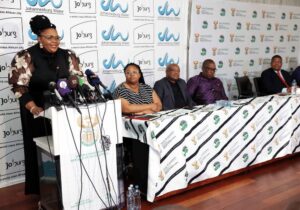
The 2026 Budget Vote Speech delivered by Minister of Water and Sanitation, Pemmy Majodina, on 15 May 2026, represents one of the clearest and most significant policy interventions yet undertaken to confront South Africa’s deepening water and sanitation crisis.
At a time when many communities continue to endure unreliable water supply, sewage spillages, collapsing municipal infrastructure and growing public frustration, the Minister’s address demonstrated a willingness by government to confront uncomfortable truths while outlining a practical pathway towards recovery and renewal. For AWSISA, the speech is significant not only because of the scale of infrastructure commitments announced, but because it signals an emerging governance shift within the water sector – one that recognises that sustainable water security depends not merely on engineering solutions, but on capable institutions, accountability, professional management and collaborative leadership across all spheres of society. The Minister correctly reminded us about the progress made since 1994. Millions who were historically excluded now have formal access to basic services. At the same time, Minister acknowledges that access alone is no longer sufficient. The challenge confronting us today is one of reliability, sustainability and institutional functionality. Of particular importance was the Minister’s emphasis on the establishment of the National Water Crisis Committee under the leadership of President Cyril Ramaphosa and the development of the National Water Action Plan. The decision to elevate the water crisis to a national strategic priority reflects an important recognition that water security is inseparable from economic growth, public health, social stability and national development. AWSISA welcomes this co-ordinated whole-of-government approach. Water governance in South Africa has too often suffered from fragmentation, weak intergovernmental coordination and delayed implementation. The consolidation of efforts between the Department of Water and Sanitation, the Presidency, National Treasury and COGTA creates an opportunity for a far more integrated and decisive response. AWSISA stands ready to lend a hand in these noble efforts. Equally important is the emphasis placed on professionalisation, financial sustainability and ring-fencing of water revenues within municipalities. The failure by many municipalities to protect water revenues for operations, maintenance and infrastructure renewal has become one of the central drivers of service collapse. Water systems cannot function sustainably where revenue intended for water services is diverted elsewhere while maintenance is neglected and technical capacity erodes. AWSISA strongly supports the growing emphasis on ring-fencing, financial accountability and competency-based management within municipal water services. These are practical necessities for sustainability. Water infrastructure is highly capital-intensive and operationally complex. It requires predictable revenue streams, proper maintenance cycles, long-term planning and technically competent leadership. The Minister’s clear warning that government “will not hesitate” to intervene in failing municipalities is also a necessary and welcome position. South Africa can no longer afford a culture of paralysis where institutional collapse is tolerated while communities suffer prolonged deprivation. The use of constitutional and legislative intervention mechanisms, including Section 139 interventions and Section 63 provisions under the Water Services Act, must be guided by the principle that access to water is a constitutional right, not a negotiable administrative privilege. One of the most important dimensions of the Budget Vote was the renewed focus on Water Boards. Over the past decade, some Water Boards have faced severe financial and governance pressures, largely driven by escalating municipal debt and broader weaknesses within the local government system. The Minister’s speech, however, reflects encouraging signs of stabilisation within these strategic institutions. AWSISA welcomes the Minister’s observation that governance across the seven Water Boards has generally improved, with most entities achieving strong audit outcomes and demonstrating leadership stability. This is important because Water Boards remain among the most technically capable public institutions within the sector and are indispensable to the long-term sustainability of bulk water services. The increasing role being played by Water Boards in supporting struggling municipalities is particularly noteworthy. Institutions such as Rand Water, Magalies Water, Amatola Water, Lepelle Northern Water and uMngeni-uThukela Water are increasingly serving not merely as bulk suppliers, but as strategic implementing agents, operational partners and centres of technical expertise.
This evolving role must be carefully strengthened and institutionalised. South Africa requires strong regional water institutions capable of supporting municipalities that lack sufficient technical and financial capacity. However, this support must occur within clear governance frameworks that preserve accountability, operational efficiency and financial sustainability.
The issue of municipal debt owed to Water Boards remains one of the most serious systemic risks confronting the sector. The revelation that municipal debt to Water Boards now exceeds R27 billion is deeply alarming. No infrastructure institution can remain financially sustainable under such conditions indefinitely. AWSISA therefore welcomes the stronger measures being implemented jointly by the Department and National Treasury, including equitable share withholding mechanisms and debt restructuring frameworks linked to current payment compliance.The continued viability of institutions such as Vaal Central Water and Magalies Water is critical not only for water supply, but for national economic stability itself. The deterioration of Water Boards would have cascading consequences across municipalities, industries and communities. The Minister’s remarks also carry important implications for Catchment Management Agencies (CMAs). AWSISA has consistently maintained that strong, capacitated and functional CMAs are indispensable for sustainable water governance in a water-scarce country such as South Africa. As climate variability intensifies and competing demands on water resources increase, effective catchment management will become even more important. The future of South Africa’s water security depends not only on infrastructure expansion, but also on integrated resource management, pollution control, groundwater protection, ecological sustainability and improved water-use efficiency. CMAs occupy a strategic position in achieving these objectives. They must therefore be properly resourced, professionally managed and integrated into broader national planning frameworks. AWSISA also welcomes the Minister’s commitment to fighting corruption and strengthening consequence management within the sector. Corruption in water infrastructure procurement and project implementation does not merely waste public resources. It directly undermines human dignity, public health and economic development. The establishment of the Water Sector Anti-Corruption Forum is therefore a significant step that deserves broad support from all stakeholders. For AWSISA, this Budget Vote represents more than an annual fiscal statement. It signals the emergence of a more assertive and reform-oriented phase within South Africa’s water sector. It reflects a growing recognition that the country’s water challenges require difficult decisions, institutional reform, stronger governance and collaborative partnerships across government, civil society, organised labour, the private sector and professional bodies. South Africa’s water future cannot be secured through government action alone. It requires a national partnership built on shared responsibility, disciplined implementation and long-term vision. The Minister’s Budget Vote has provided an important foundation for such a partnership. As AWSISA, we will work with the Department of Water and Sanitation, municipalities, development finance institutions, professional associations and all relevant stakeholders to advance the shared objective of water security for all South Africans.
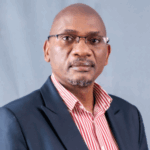
Ramateu Monyokolo is Chairperson of the Rand Water Board and the Association of Water and Sanitation Institutions in South Africa