The WRC’s Bronkhorstspruit investigation reveals 10 concerning findings, from failed chlorine monitoring and contaminated water to equipment breakdowns and municipal governance failures.
An independent investigation commissioned by the Water Research Commission (WRC) has exposed a series of operational failures, inadequate maintenance, unreliable water quality monitoring and serious shortcomings in municipal oversight at the Bronkhorstspruit Water Treatment Works.
The findings suggest that the contamination concerns were not simply the result of a chlorine shortage. Multiple safeguards designed to protect drinking water failed or were compromised, while weaknesses in procurement, staffing and management left communities exposed to potentially unsafe water. Between 7 and 22 October 2026, 455 cases of acute gastrointestinal illness were reported across Bronkhorstspruit and surrounding communities, with children under four particularly affected. Here are 10 of the most concerning findings from the WRC’s independent investigation, published on 23 October 2026.1. Chlorine monitoring stopped for nearly three weeks
The last recorded routine chlorine measurements were taken on 26 September 2026. Chlorine cylinders were only reconnected and the plant restarted on 15 October. Even before monitoring stopped, recorded chlorine residuals repeatedly fell below the report’s 0.5 mg/L reference value, sometimes approaching or reaching zero. Chlorination is one of the most important safeguards against waterborne pathogens. The absence of reliable monitoring meant the plant could not demonstrate that effective disinfection was maintained.2. The equipment used to test chlorine gave wildly different results
 During an inspection, a general worker obtained a free chlorine reading of 1.03 mg/ℓ, while independent testing produced a reading of just 0.2 mg/ℓ.
The chlorine measurement cell was visibly dirty, and investigators found no evidence of routine calibration or verification.
The report also concluded that the methodology used by operational staff was likely to overestimate chlorine concentrations. In other words, even the recorded chlorine readings could not be trusted.
3. No process controller or supervisor was present during a three-hour inspection
When investigators visited the treatment works on 18 October, only a general worker and security personnel were present. Neither the process controller nor the supervisor was observed during the approximately three-hour inspection.Although qualified personnel were listed in staffing records, investigators could not establish that appropriately qualified staff were consistently available to manage the treatment process.
4. Treated water was repeatedly far too turbid
Operational records showed that final-water turbidity was generally between 3 and 6 NTU during September, compared with the report’s reference value of 1 NTU.Some readings reached approximately 20 NTU.High turbidity indicates that particles are not being adequately removed from water. These particles can interfere with disinfection and potentially shield microorganisms from chlorine.
Importantly, these readings were taken from water that had already passed through the treatment process.
5. Essential water treatment equipment was not functioning properly
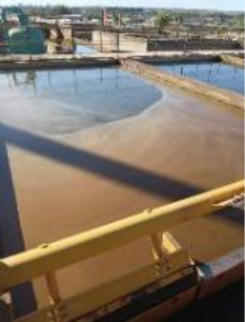
Investigators identified multiple failures throughout the treatment process. Flocculation stirrers were not functioning, lime dosing had been out of operation for an extended period, dissolved air flotation was inadequate, desludging valves were blocked and the backwashing of one sand filter was unreliable. Routine jar testing, used to determine appropriate chemical dosing, was also not being performed. These deficiencies meant that several treatment barriers were compromised simultaneously, rather than a single piece of equipment failing.6. E. coli was detected in treated drinking water
Laboratory analysis of final treated water collected on 20 October detected E. coli, an indicator of faecal contamination.
The sample also contained 29 total coliforms, exceeding the report’s stated criterion of 10, while turbidity measured 4.6 NTU.
The presence of E. coli in treated drinking water is particularly concerning because it indicates that the treatment process may not have adequately removed or inactivated faecal contamination.