Sanitech’s Robert Erasmus explains why portable sanitation requires safe waste handling, regulatory compliance and treatment from collection to final disposal.

Robert Erasmus, managing director of Sanitech
Delivering a toilet is only the visible part of a sanitation service. Robert Erasmus, managing director of
Sanitech, says the real test is whether waste is safely contained, collected, transported and treated, while workers and the environment are protected at every step.
“If you generated the waste, you are ultimately responsible for its safe disposal,” states Erasmus. Yet many clients still underestimate this obligation.
“A lot of people think, ‘I’m going to get someone to take the stuff away, and then it’s not my problem.’ Unfortunately, that is not how it works.”
The National Environmental Management: Waste Act places a duty on waste generators to take reasonable measures to prevent harm and ensure environmentally sound disposal. The National Water Act also requires those who own, occupy or control land to prevent activities on that land from polluting water resources.
This does not absolve the contractor of responsibility. The contractor remains accountable for collecting, transporting and disposing of the waste lawfully, but waste generators are ultimately responsible. If the contractor fails to perform or disposes of the waste illegally, the client could face regulatory action or clean-up costs.
The principle applies to waste from portable toilets and septic tanks alike. Choosing a contractor therefore cannot be reduced to price alone. Clients also need evidence that a contractor’s transport permissions are valid, disposal takes place at an authorised facility and the people handling the waste are properly trained and protected.
Compliance that can be proved
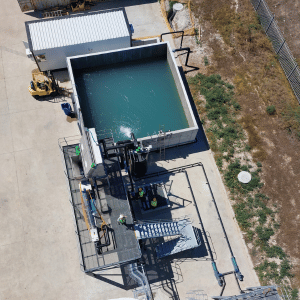
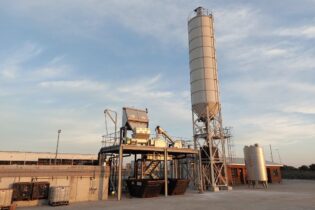
Sanitech established treatment plants at Steelpoort, Secunda and Witbank after long transport distances and rising municipal discharge tariffs made disposal increasingly costly
Portable sanitation sits across several parts of the regulatory landscape. Environmental law, different occupational health and safety requirements, building rules and municipal bylaws can all apply, depending on the service and site. Erasmus says this fragmented framework makes disciplined management systems particularly important.
For Sanitech, ISO 14001 environmental management and ISO 45001 occupational health and safety are the most directly relevant certifications for portable sanitation. The environmental system requires the company to maintain waste-management plans, check transport and discharge permissions, keep training records and prepare for spills. The occupational health and safety system covers safe working procedures, standard operating procedure, personal protective equipment, exposure controls and employee health records and vaccinations issued.
The value lies in the continuing audit trail. “It is not a once-off tick-box exercise where you say, ‘I did an environmental plan and it is in a cupboard,’” Erasmus says.
“You constantly have to keep it updated and show the evidence. It has taken Sanitech close to a decade to reach this high level of compliance.”
Sanitation as a service
Equipment and servicing methods are part of that risk control. Sanitech moved away from removable drum-type systems as its standard operating model in favour of concealed waste tanks emptied by vacuum pumps. This limits direct contact with waste and reduces the risk of spills during servicing. The company also stopped using formaldehyde-based chemicals around a decade ago, opting for bioenzyme additives to control odour with less risk to operators and the receiving environment.
Greener chemistry brings its own operational demands. Bleach and other household chemicals can neutralise biological additives, particularly where a communal toilet is also used as a convenient disposal point for wash water. That makes user education part of the service. The chemical, the toilet, the collection method and the behaviour of users all have to work as a system.
The treatment challenge
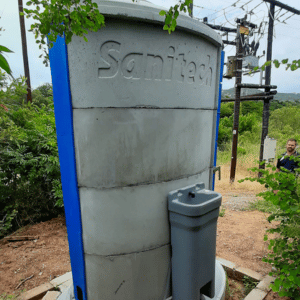
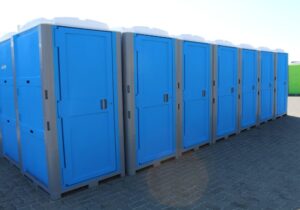
The Khusela unit is a patented sanitation solution to replace dangerous and unhygienic traditional open pit latrines
Portable toilets can save substantial volumes of potable water because they do not flush after every use. The trade-off is a highly concentrated waste stream that must be collected and treated. Erasmus says this concentration is one reason municipal wastewater works can be reluctant to accept portable toilet waste. Many plants were designed for sewage diluted by water from toilets, basins and showers, while their access and discharge points may not be designed for frequent tanker movements.
Capacity constraints add another obstacle. Often a municipal works is overloaded, out of service or far from the point of collection.
“Every additional kilometre that waste has to trave raises fuel use, cost and risk. Fortunately Sanitech has a wide branch network that shortens collection routes, but the most solution is (where possible) to treat waste closer to where it is generated,” explains Erasmus.
This operational pressure helped shape Sanitech’s water and waste treatment division. The company established treatment plants at Steelpoort, Secunda and Witbank after long transport distances and rising municipal discharge tariffs made disposal increasingly costly. It also began offering package plants at customer sites, particularly for remote industrial and mining operations.
Sanitech’s acquisition of Green-Tech Water and Waste Technology followed close to a decade of collaboration with the specialist as a design and technical partner. The deal added in-house design, specification, procurement and project execution capability. It also strengthened Sanitech’s ability to offer mobile and modular treatment systems through outright purchase, rental or rent-to-own arrangements.
“What began as a practical solution to support our core sanitation business has since evolved into a fully fledged water and waste treatment offering,” adds Erasmus. Decentralised plants can reduce waste-haulage distances and create opportunities for reuse, turning a disposal problem into a water-management intervention.
Erasmus argues that wastewater treatment works should not regard portable sanitation waste as an additional burden. “We are providing a sanitation service. This is waste generated by your customers; we are simply bringing it to the treatment works by road instead of it arriving through the sewer network. Portable sanitation companies serve the public by collecting and transporting this waste safely.”
One service does not fit every site
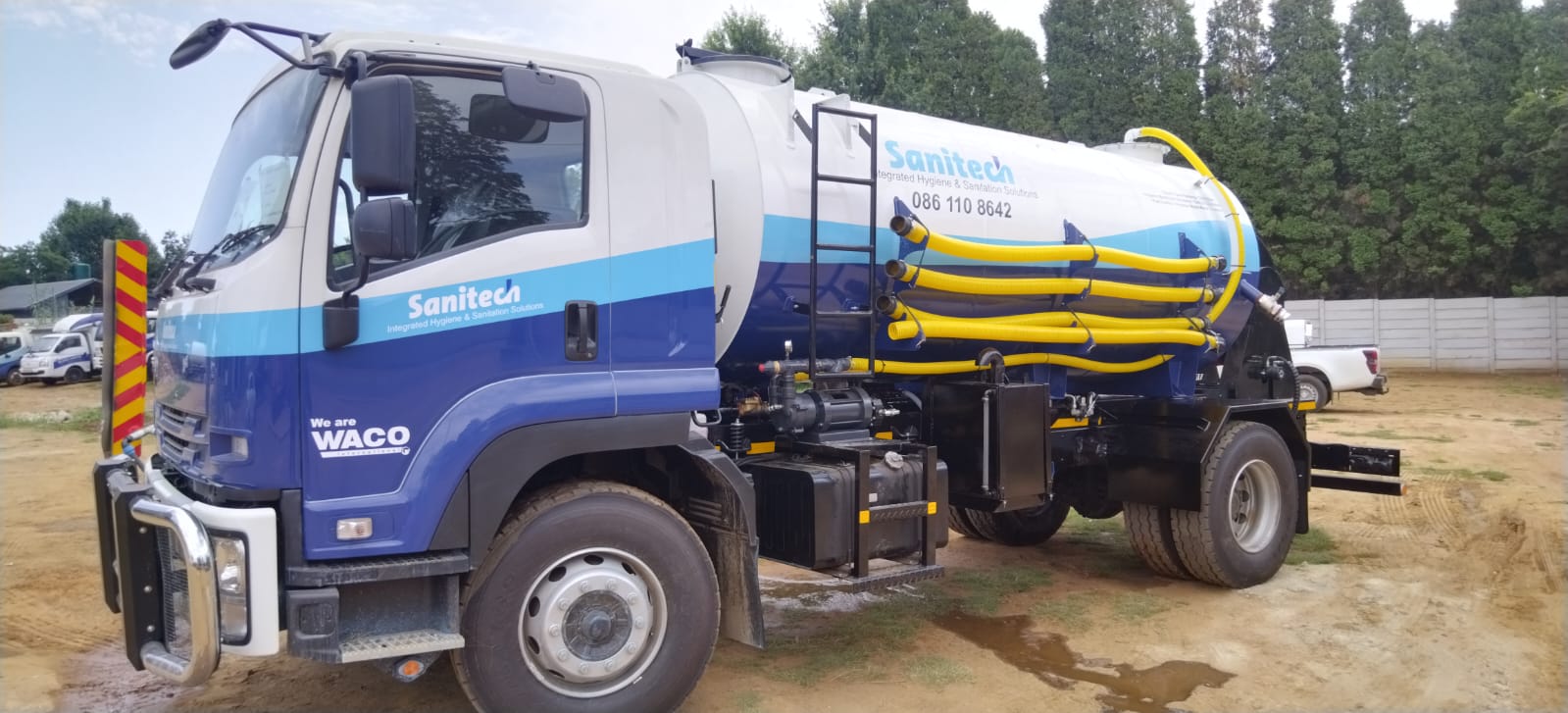
Waste must be safely contained, collected, transported and treated
The required portable sanitation service changes sharply from one market to another. At events, the condition of the toilets can shape the public’s view of the entire experience. On a construction site, procurement can become a numbers exercise focused on providing the minimum required units. Industrial operations tend to place greater emphasis on handwashing, separation from waste and frequent servicing. Underground mines introduce tight space, transport and handling constraints.
Unit design is only one variable. Service frequency can be just as important. A lightly used construction toilet may be serviced weekly, while units supporting a shutdown at an industrial plant may need attention before the day shift, at lunchtime and again before the night shift. In informal settlements, where one toilet may serve several households, more frequent servicing can be the most immediate way to improve hygiene and user experience.
The same site-specific thinking is needed as extreme weather becomes more disruptive. Flooded roads can prevent service vehicles from reaching units, while strong winds can overturn toilets and sandy ground can make anchoring difficult. An overturned unit filled with an inappropriate chemical creates a far greater environmental hazard than one using a carefully selected biological additive.
Ultimately, the measure of a sanitation service is therefore not the number of toilets delivered. It is whether people can use them with dignity, whether workers can service them safely and whether every load of waste reaches an authorised treatment or disposal point.
“That is what cradle-to-grave responsibility looks like in practice, and we give our customers peace of mind by embracing this concept,” concludes Erasmus.