South Africa’s recent droughts are teaching businesses a life-changing lesson: we can no longer simply assume that clean water will always be available to keep operations running smoothly.
According to Gert Nel, partner and principal hydrogeologist at SRK Consulting, responsible water management is becoming a cornerstone of any sustainable business model – with investors starting to look more critically at how water risks are mitigated.
“When putting together a business model for a multi-million rand business development, a key factor will now be the reliability of water supply,” said Nel. “Can you trust the local and regional water services provider to always offer a sustainable water source, and what are the broader environmental, social and governance (ESG) issues you will face with securing your own supply?”
He highlighted that the signing of a contract with a public service provider does not necessarily guarantee water supply if all available the traditional sources simply run out.
“Indeed, the experiences of severe drought in cities like Cape Town and Port Elizabeth show that the communities’ basic right to water will take precedence, and businesses will be left to develop their own solutions in a crisis,” he said.
In this context, groundwater remains the most readily accessible resource to businesses – as long as it is used and managed in strict accordance with ESG best practice. This means early-stage scientific investigations into the viability of boreholes, as well as careful adherence to the regulatory framework.
“While desalination has been considered in coastal locations, it is a relatively costly option and takes years to implement,” he said. “Drilling boreholes is generally the only practical option, but businesses might be located on a very poor aquifer which could be low-yielding or have an unacceptable water quality.”
To ensure the integrity of the business model, developers generally require the involvement of a professional groundwater specialist to investigate and highlight the groundwater development potential of the town, city or area in which the operation will be established. These studies will also include a consideration of the number of existing groundwater users in the immediate area, and their respective water uses.
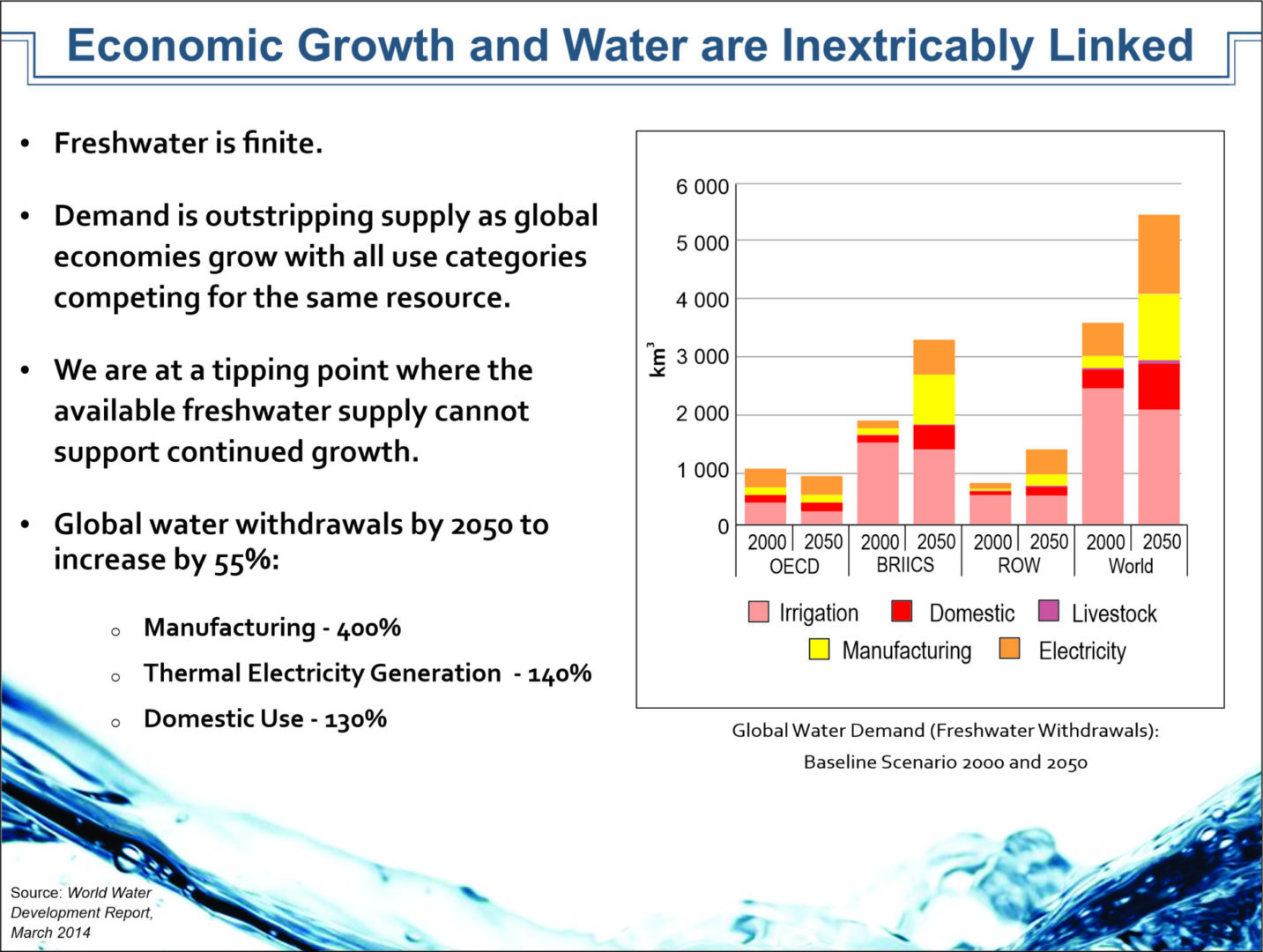
As global water demand grows rapidly across all use categories, competition for the world’s finite water resources is placing added risk on business sustainability
“The question that needs to be answered is whether there is enough groundwater for your business, in addition to the other private and public users in the area,” said Nel. “A hydrogeologist can compile a numerical groundwater model that delivers scientific predictions on the future availability of groundwater in the area you’re investing in – taking into account both existing use and the likely increased demand in the future. This is standard practice in the mining sector, for example, and all sectors can learn from this.”
Legal compliance is of course a key aspect of ESG, and this requires early planning to accommodate the potentially lengthy permitting period. Boreholes require a water use license (WUL), which can take up to two years to approve. Having the necessary license in place gives a business the ability to start drilling and preparing the necessary infrastructure for self-supply of water in case of a drought.
“This creates the vital back-up water supply to mitigate the operation’s risk in situations when the usual water supplier is unable to deliver,” he said. “It does need the investment in studies and permitting well in advance, though, as it will be too late to respond once ‘Day Zero’ is in sight.”
He reiterated the importance of considering ESG impacts related to the drilling of boreholes, and the crucial need to follow due process.
“If you drill boreholes to provide a supplementary or sole supply to your business, and you don’t follow scientific, environmental and social due processes, you could face public resistance,” he warned. “Surrounding borehole users could well accuse you of depleting their groundwater, or even causing the failure of their businesses due to their only water supply source drying up.”
While it might be possible to address these claims through detailed hydrogeological investigations, it cannot always be assumed that the scientific answer will be accepted by all stakeholders. Careful processes of communication and consultation – and perhaps even collaboration over the use of available groundwater – will help to manage the risk of reputational damage or worse.
“Irrespective of the specific environmental and social context of the business, it is wise to engage experienced scientists and engineers in preparing a water solution for a sustainable business plan,” he said. “The regulatory, social and physical landscape is complex, and there are a number of pitfalls that a responsible business would do well to avoid.”
The City of Johannesburg, together with Johannesburg Water and City Power, is running a Level 3 Disconnection Drive targeting chronic non-paying, high-consumption customers with long-standing, unpaid, and undisputed municipal debt. The drive is...
Building on Siemens’ legacy of 150 years of engineering excellence and innovation, Innomotics offers a portfolio of leading motors, drives, converters, programmable logic controllers, software and other engineered solutions. Local presence...
Between 27 January 2026 and 1 February 2026, several electro-mechanical failures occurred at Rand Water’s Palmiet and Zuikerbosch pumpstations, as well as a huge pipe burst at the Rand Water Klipfontein reservoir. These disruptions caused a severe...